Introduction
Vietnam fulfillment service has become more relevant for startups, brands, and international businesses. Many companies now seek a balance between cost, delivery speed, and supply chain flexibility.
From our operational experience, warehousing and fulfillment in Vietnam goes beyond storage and shipping. Instead, it requires choosing the right warehouse model. Moreover, it depends on matching fulfillment capacity with order volume and business stage.
Therefore, this article explains key concepts and shares practical insights from real operations.
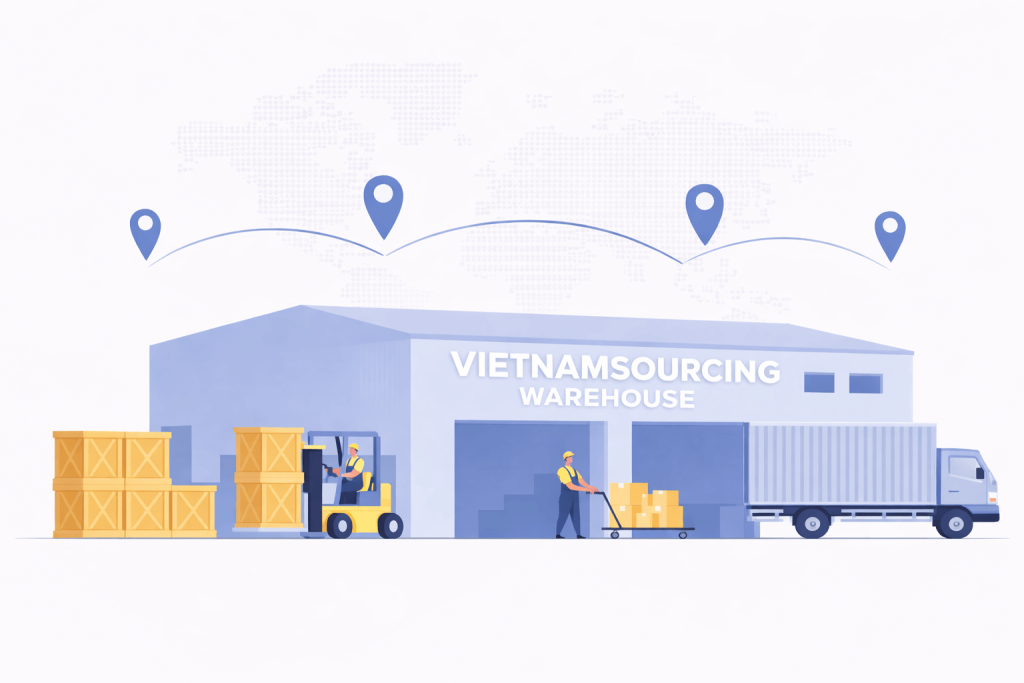
Warehousing Models in Practice
In-production warehouse
An in-production warehouse stores raw materials, work-in-progress, or finished goods during manufacturing.
- Usually located inside or next to the factory
- Supports daily production flow
- Not suitable for B2C order fulfillment
As a result, this model focuses on production, not customer orders.
Off-site warehouse / 3PL warehouse
An off-site warehouse is operated by a third-party logistics provider. It sits outside the factory location.
- Suitable for long-term inventory storage
- Uses warehouse management systems
- Often supports pick, pack, and ship services
Therefore, this is the most common model used for Vietnam fulfillment service.
On-site warehouse (warehouse onsite)
An on-site warehouse is located within the factory area. However, it mainly stores finished goods.
- Reduces local transport cost
- Works well for pallet or carton shipments
- Has limited flexibility for small B2C orders
Thus, this model fits B2B shipments better than B2C fulfillment.
What Is Vietnam Fulfillment Service?
A Vietnam fulfillment service covers the full order handling process. This process includes:
- Picking products from inventory
- Packing based on agreed rules or branding
- Shipping directly to end customers
With this setup, inventory stays in Vietnam. Meanwhile, individual orders ship as soon as they arrive. As a result, many businesses use this model for cross-border e-commerce to the US, EU, UK, and Canada.
Fulfillment Service vs. Dropshipping
| Criteria | Fulfillment Service | Dropshipping |
|---|---|---|
| Inventory ownership | Yes | No |
| Quality control | High | Low |
| Order speed | Stable | Supplier dependent |
| Branding options | Flexible | Limited |
| Best use case | Long-term growth | Market testing |
In practice, many businesses start with dropshipping. However, they move to fulfillment once volume and branding needs increase.
How We Support Startups with Vietnam Fulfillment Service
From our experience, no single fulfillment model fits every business. Therefore, our role is to help startup founders find logistics partners that truly match their needs.
What we check with logistics partners
- Do they support pick, pack, and ship directly to customers?
- Can they store inventory and fulfill individual orders?
- Which markets do they ship to, such as US, EU, UK, or Canada?
- Do they support B2C e-commerce or mainly B2B shipments?
- What is the minimum order volume or MOQ?
- Can they support low volume, such as under 500 orders per month?
- How is pricing structured across storage, handling, and shipping?
Practical insight
- Many 3PLs claim fulfillment services, but few handle true B2C orders well
- Some warehouses only process bulk or carton shipments
- Large providers often lack flexibility for early-stage startups
Therefore, our focus is on screening, negotiating, and aligning partners with real business needs.
Conclusion
Vietnam fulfillment service can offer a strong operational advantage when used correctly. It helps businesses improve delivery speed, control quality, and scale across borders.
However, success depends on:
- Choosing the right warehouse model
- Working with the right logistics partner
- Matching fulfillment capacity to business stage
From real operations, we see one clear rule. Fulfillment success is not about size. Instead, it is about fit.
Another concept you may want to explore in global logistics and supply chain is FOB and US landed cost — find out more.