For decades, companies built supply chains for cost. They chose the cheapest country. They scaled production fast.
However, that model is changing.
In 2026, supply chains are no longer just about cost. Instead, they are shaped by geopolitics, risk, and control.
This shift marks a new phase: Globalization 2.0.
More importantly, this is not a short-term business trend. It is a long-term geopolitical shift that may last for decades.
What Are Geopolitical Supply Chains?
Geopolitical supply chains refer to supply chains shaped by political strategy. They are not driven only by business decisions.
In the past, companies chose suppliers based on price. Now, governments also influence these choices.
As a result, companies must consider:
- Political risk
- Trade policies
- Tariffs
- National security
- Strategic alignment
Therefore, sourcing is no longer just operational. It is also strategic.
Why Supply Chains Are Becoming Political
Several factors drive this shift.
First, the US–China tension changed global trade. It created tariffs and restrictions. As a result, companies faced higher risk.
Second, COVID exposed supply chain weaknesses. Many companies could not ship goods on time. Therefore, resilience became critical.
Third, technology became strategic. Chips, AI, and data are now linked to national power.
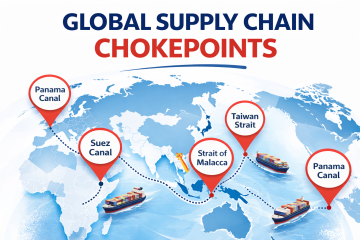
In addition, recent conflicts in the Middle East have increased uncertainty. Key routes such as the Strait of Hormuz are critical for global oil flows. When tensions rise, oil supply may be disrupted.
You maybe interested in How Oil and Gas Prices Impact Key Manufacturing Materials.
As a result, energy prices can increase quickly. Higher energy costs then impact manufacturing, logistics, and transportation.
For example:
- Shipping costs increase
- Fuel costs rise
- Production costs become less stable
Therefore, supply chains are now linked to energy security.
Because of this, companies must consider not only suppliers, but also global stability.
Finally, governments now act more directly. They guide where companies produce and source.
From Cost Efficiency to Risk Control
In the past, companies focused on cost. Lower cost meant higher margin.
However, this logic is no longer enough.
Today, companies ask different questions:
- What if this supplier shuts down?
- What if tariffs increase?
- What if shipments are delayed?
Therefore, companies now balance cost and risk.
In many cases, they accept higher cost. In return, they gain stability.
Geopolitical Supply Chains and the New Global Model
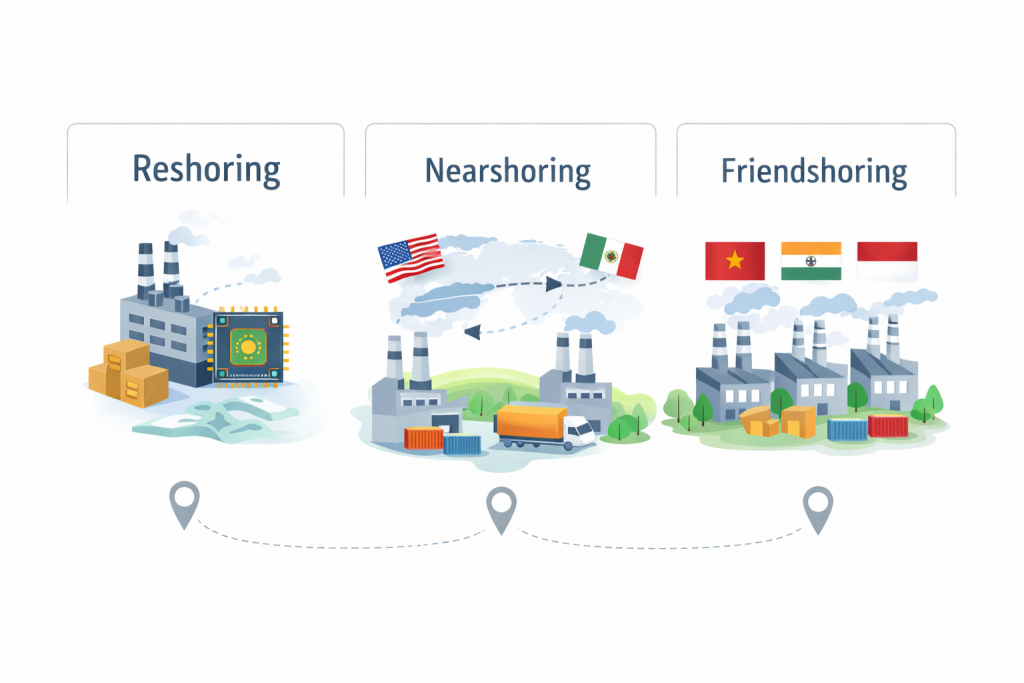
Geopolitical supply chains create a new structure. This structure has three main layers.
1. Reshoring (Critical industries)
Companies bring key production back home.
For example:
- Semiconductors
- Defense products
- Advanced technology
These sectors are strategic. Therefore, countries want full control.
2. Nearshoring (Control and speed)
Companies move production closer to their main market.
For example:
- US companies move to Mexico
- EU companies move to Eastern Europe
As a result:
- Lead time is shorter
- Logistics are easier
- Risk is lower
3. Friendshoring (Aligned countries)
Companies source from trusted countries.
For example:
- Vietnam
- India
- Indonesia
These countries offer cost advantages. At the same time, they align better politically.
What This Means for Global Sourcing
This shift changes how companies source products.
Before, companies relied on one country. Now, they diversify.
As a result, sourcing strategies now include:
- Multi-country suppliers
- Backup factories
- Flexible production plans
In addition, buyers now ask more questions:
- Where do materials come from?
- Can production shift quickly?
- Is the supply chain compliant?
Therefore, sourcing becomes more complex. However, it also becomes more strategic.
Why the World Is Moving Beyond China — But Not Leaving It
Many companies move some production outside China.
However, China still plays a key role.
China remains strong because:
- It has deep supply chains
- It has strong infrastructure
- It can scale fast
At the same time, other countries are growing.
For example:
- Vietnam focuses on assembly
- India builds long-term capacity
- Mexico supports nearshoring
Therefore, the global model is not “China vs others”.
Instead, it is:
China + the rest of the world
This Is a Long-Term Geopolitical Shift, Not a Business Trend
This change is not temporary. Instead, it is driven by geopolitics.
First, trust between major powers has declined. As a result, companies must reduce dependency.
Second, governments have committed large investments. These include factories, infrastructure, and incentives. Therefore, supply chains will not shift back quickly.
Third, political alignment now matters. Countries prefer to trade with trusted partners.
Because of these factors, this trend may last for decades.
At the same time, manufacturing outside China will grow faster than ever.
However, this growth will not fully replace China. Instead, it will expand around it.
As a result, the global system will become more distributed.
How Companies Should Respond
Companies must adapt to this new reality.
First, they should build a China+N strategy. This reduces dependence on one country.
Second, they should map supply chain risk. This helps them react faster.
Third, they should invest in supplier networks.
Key actions include:
- Develop suppliers in multiple countries
- Create backup production options
- Review tariffs and trade rules
As a result, companies gain flexibility and control.
Conclusion
Globalization is not ending. However, it is changing.
In 2026, geopolitical supply chains define how companies build and manage production.
This shift is not temporary. Instead, it will shape global manufacturing for many years.
Cost still matters. However, control, resilience, and alignment now matter more.
Therefore, companies that adapt will stay competitive. Those that do not may face higher risk.