Introduction
Vietnam is becoming a key hub for golf production. In recent years, many global brands have shifted sourcing to Vietnam. As a result, the local supply chain has grown fast. Today, Vietnam can support a nearly complete, 100% made-in-Vietnam ecosystem for golf products and accessories.
Moreover, large brands and retailers are already producing here. Therefore, the golf industry in Vietnam is becoming more complete and competitive. This guide explains what Vietnam can do, where it is strong, and how to source effectively.
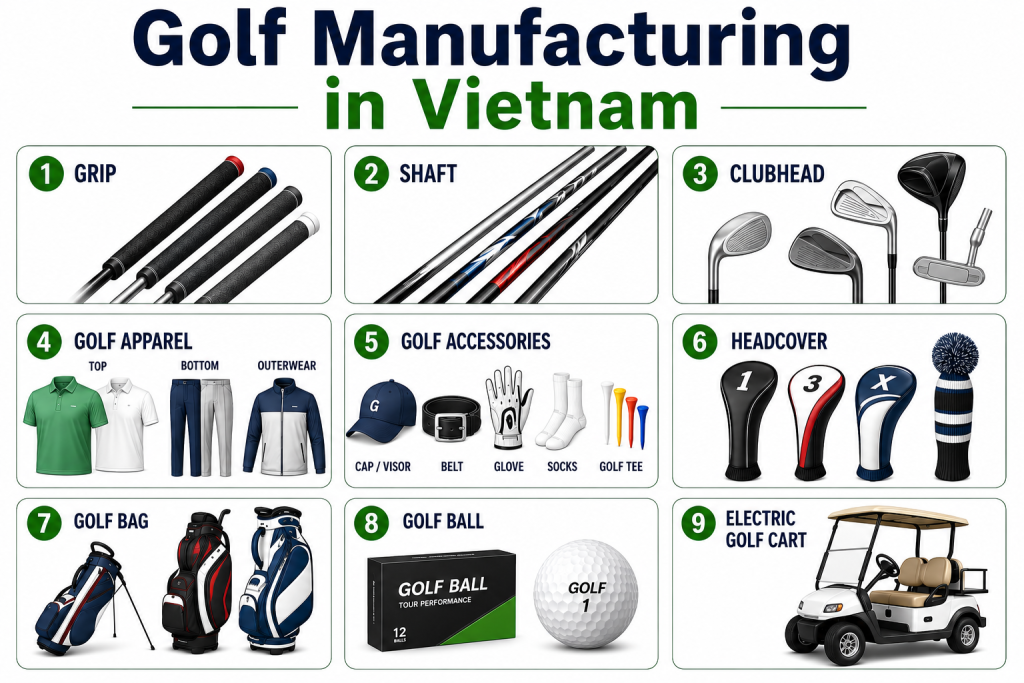
Golf Manufacturing in Vietnam: Full Product Coverage and Core Categories
Vietnam can produce most golf product categories locally. In addition, many factories support OEM and private label projects. As a result, buyers can consolidate sourcing in one country. Moreover, Vietnam supports a wide range of golf product categories. Therefore, buyers can build a full product line within one supply chain.
1. Grip (Handle)
Grip is the outer layer of the golf club. It is where the player holds the club.
- Rubber or synthetic materials
- Different sizes (standard, midsize, oversize)
- Easy to source and replace
Therefore, this is a simple but essential component.
2. Shaft (Club Shaft)
The shaft connects the grip and the clubhead. It controls swing speed and feel.
- Steel or graphite materials
- Different flex levels
- Often sourced regionally
In Vietnam, local capability is very limited. Currently, only one supplier is producing shafts domestically. Therefore, most shafts are still imported from other countries.
3. Clubhead
The clubhead is the main impact part. It directly hits the ball.
- Iron, driver, wedge, putter
- Metal processing required
- Partial production capability
However, high precision and finishing require high-quality suppliers. Currently, only a few suppliers can meet this level. In practice, only about two suppliers in Vietnam can produce high-end clubheads. Therefore, supplier selection is critical for premium products.
4. Golf Garment / Golf Apparel
Vietnam is very strong in this category. In addition, many global brands already produce here.
Top, Bottom:
- Polo shirt (most common)
- T-shirt (less common on standard courses)
- Light jacket / windbreaker
Outerwear:
- Rain jacket
- Lightweight thermal wear
Moreover, Vietnam has a strong textile ecosystem. Therefore, this is a key advantage.
5. Golf Accessories
This category is flexible and easy to scale. In addition, it supports private label well.
- Cap / visor
- Belt
- Golf glove
- Socks
- Golf tee
Golf tees are commonly made from:
- Wood
- Bamboo
- Plastic
As a result, this category is suitable for new brands and bundle products. Moreover, golf tees are relatively easy to manufacture in Vietnam because the country has strong capabilities in wood processing, bamboo processing, and plastic injection molding.
6. Headcover
Headcovers protect the clubhead. They also support branding.
- PU, leather, or fabric
- Custom design and logo
- Often produced with golf bags
Therefore, this is a strong export category.
7. Golf Bag
Vietnam has strong capability in bag production. Moreover, many factories already export globally.
- Stand bag, cart bag, tour bag
- Multi-compartment design
- Cut-and-sew strength
As a result, this is one of the most competitive categories in Vietnam.
8. Golf Ball
Golf ball production requires high R&D and specialized technology. Therefore, this category is more complex than others.
- Complex core technology
- High investment requirement
- Limited supplier base
Vietnam can produce golf balls. However, the number of suppliers is still very limited. As a result, most brands continue to source golf balls from other countries..
9. Electric Golf Cart
This category is emerging in Vietnam. In addition, demand is increasing in resorts and golf courses.
- Local assembly available
- Battery and motor often imported
- Used for transport on golf courses
As a result, Vietnam is more suitable for assembly rather than full production.
Why Global Brands Choose Vietnam
Many global brands are already producing in Vietnam. As a result, the ecosystem continues to improve.
Key reasons:
- Competitive cost
- Labor cost is lower than China
- Stable production cost
- Strong export capability
- Experience with US and EU markets
- Good compliance standards
- Trade agreements
- EVFTA and CPTPP reduce tariffs
- Therefore, pricing becomes more attractive
- Skilled workforce
- Especially in textile and sewing
- Consistent quality output
In addition, global trade policies are changing. For example, the US is increasing tariffs on products with low local content. At the same time, Vietnam is tightening Certificate of Origin (CO) requirements. Therefore, having a true 100% made-in-Vietnam supply chain becomes very important.
Moreover, brands now need higher local value content. As a result, Vietnam’s ability to support a full supply chain gives a strong advantage. Buyers can reduce risk and improve compliance. Therefore, Vietnam is not only a cost option, but also a strategic sourcing base.
Conclusion
Vietnam is now a strong player in golf manufacturing. It can support a wide range of products and accessories. In addition, many global brands are already producing here. Therefore, the local supply chain continues to improve.
While some high-tech areas are still developing, Vietnam remains a top choice for apparel, bags, and accessories. For buyers, it offers a balance of cost, quality, and flexibility.
You maybe interested in How to Verify Factories from Vietnam