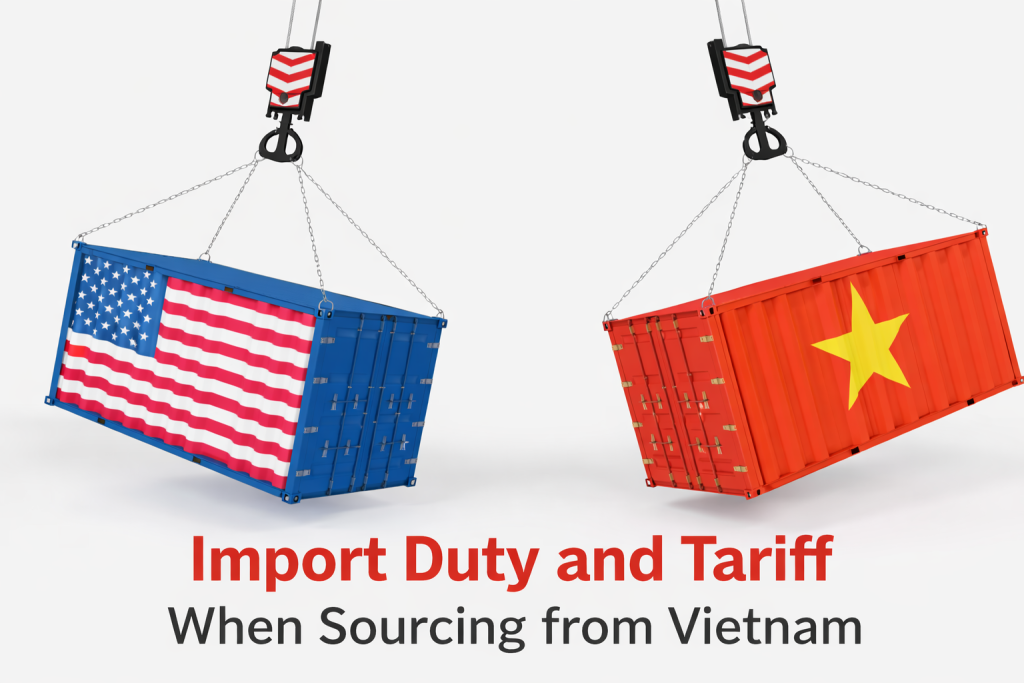
When sourcing products from Vietnam to the United States, import taxes are unavoidable. However, many buyers still confuse import duty and tariff. Because of this, buyers often miscalculate costs at the early stage.
This article explains the difference in simple terms. It also shows who pays these taxes and how they apply to Vietnam-made goods.
What’s the Difference Between Duty and Tariff?
Import duty and tariff are related, but they are not the same.
Import duty is the base tax applied to goods entering the US. Tariff is a broader term and often reflects trade policy or political measures.
In other words, duty is the standard rule. Meanwhile, the government adds tariffs when trade risks or imbalances exist.
What Is a Tariff? Who Pays Tariffs?
A tariff is an extra tax set by the US government. Usually, the government uses it to protect local industries or reduce trade deficits.
In practice, the US importer pays the tariff, not the factory. However, the cost is often pushed into product pricing.
For Vietnam sourcing, tariffs can change by policy and timing. Therefore, tariffs must always be checked before shipment.
What Is an Import Duty? Who Pays Import Duties?
Import duty is the basic tax charged on all imported goods. It applies to products from every country, not only Vietnam.
The duty rate depends on the HS code of the product. Because of this, the same product category can have different rates.
Typically:
- 0% duty may apply for 100% Vietnam-made products with proper origin
- 2–5%, 10%, or higher may apply for other product types
Again, the US importer pays the import duty at customs clearance.
Overview of Import Duty and Tariff When Sourcing from Vietnam
Base Import Duty for Vietnam Exports to the US
For products sourced from Vietnam, the base import duty is unavoidable. However, the rate is often low compared to other countries.
In many cases:
- Duty is 0% with clear Vietnam origin
- Or it falls within 2–10%, depending on the HS code
This duty is not political. Instead, it is part of the US tariff schedule for all imports.
Reciprocal Tariff 20% on Vietnam Goods
In 2025, the US announced a 20% reciprocal tariff on certain Vietnam goods. This policy is linked to the US–Vietnam trade deficit.
As a result, some Vietnam exports now face higher landed costs. However, negotiations between Vietnam and the US are ongoing.
Because of this, the 20% rate may change in the future. So, timing plays a key role in cost planning.
40% Tariff on Transshipment Risks
A 40% tariff applies to suspected transshipment cases. This is one of the highest risk areas when sourcing from Vietnam.
It targets goods that:
- Originate from China
- Are routed through Vietnam
- Do not undergo substantial transformation
If US customs flags the shipment, penalties can be severe. Therefore, supply chain transparency is critical.
Anti-Dumping and Countervailing Duties (AD/CVD)
Beyond base duty and tariffs, some products face AD/CVD taxes. These are special penalties for unfair pricing or subsidies.
Common examples include:
- Steel nails
- Rolled steel
- Tires
- Certain wood products
AD/CVD rates can reach dozens or even hundreds of percent. However, they usually apply to specific companies, not all exporters.
Because of this, factory selection matters as much as product selection.
Key Notes for US Importers
Before sourcing from Vietnam, keep these points in mind:
- All tax numbers are estimates
- Final rates depend on HS code, product design, and timing
- Trade policies can change quickly
- Origin documents must be accurate and consistent
Therefore, duty and tariff checks should be done early. This avoids surprises after production is finished.
Final Thoughts
Import duty and tariff when sourcing from Vietnam are manageable. However, they must be understood clearly.
With the right HS code, origin proof, and supplier setup, costs stay controlled. Without them, risks rise fast.
In short, smart sourcing starts with tax clarity.
You maybe interested in FOB and US landed cost