Introduction
As global manufacturers shift supply chains away from China, Vietnam has quickly become a key destination for advanced composite materials. Among these, Vietnam carbon fiber prepreg is gaining strong attention due to its use in marine, aerospace, automotive, and consumer industries.
Between tariff disputes and the complex ties among global powers such as China, India and the U.S., Vietnam is emerging as a perfect alternative. Choosing a reliable partner in Vietnam is not only about lower costs. It is also a necessary step for building sustainable and resilient businesses.
Vietnam combines cost efficiency, a strategic location, and a growing base of expertise, making it an attractive sourcing hub for prepreg. Yet, the current supply chain still depends on foreign vendors. That is where Vietnamsourcing comes in. We are developing 100% Vietnamese suppliers to change the game.
Why Choose Vietnam for Carbon Fiber Prepreg?
- Supply Chain Diversification: Companies worldwide are looking for options beyond China to reduce risks.
- Competitive Costs: Vietnam offers lower labor and operations costs compared to Japan, Korea, and Europe.
- Rising Demand: Marine, defense, and consumer industries in Vietnam are adopting prepreg solutions at a fast pace.
- Supportive Policies: Vietnam’s government is promoting high-tech investment and manufacturing growth.
Key Players in Vietnam’s Prepreg Supply Chain
Today, the Vietnam carbon fiber prepreg market is mainly led by:
- A Korean supplier with strong capacity and certifications.
- A Taiwanese supplier covering diverse applications.
- A Chinese supplier offering competitive pricing.
These vendors play a big role. However, they often do not meet the full Made in Vietnam requirement that many U.S. buyers need for Certificate of Origin (CO).
Vietnamsourcing’s Role: A 100% Vietnamese Supplier
At Vietnamsourcing, we are building a Vietnamese-owned and operated prepreg supplier.
Our work focuses on:
- Made in Vietnam Certification: Products are made fully in Vietnam by Vietnamese companies and workers, meeting U.S. and EU import rules.
- Technology Transfer: Bringing advanced prepreg production know-how to local manufacturers.
- Domestic Growth: Moving Vietnam beyond assembly into a true materials innovation hub.
- Free Consulting: We advise global buyers at no cost if they are open to working directly with Vietnamese suppliers.
This approach creates a homegrown prepreg ecosystem. It gives global buyers an option that is compliant, competitive, and future-ready.
Supply Chain Structure in Vietnam
The Vietnam carbon fiber prepreg supply chain has four main stages:
- Raw Materials: Carbon fiber (PAN-based) and epoxy systems are still imported. In prepreg form, this means resin-impregnated carbon fiber, or fabric made from carbon fiber impregnated with epoxy resin (about 90% carbon and 10% epoxy plastic).
- Prepreg Conversion: Mostly done by foreign vendors today, but Vietnamsourcing is working to build local conversion capacity.
- Cold Chain Logistics: Prepreg must be stored at -18 °C. Vietnam’s logistics system is quickly improving to support this.
- Downstream Manufacturing: Vietnam already has advanced users, such as marine builders and part makers, with autoclaves ready to process local prepregs.
Applications of Vietnam Carbon Fiber Prepreg
Prepregs made in Vietnam — with 90% carbon fiber and 10% epoxy resin — provide the right mix of strength, stiffness, and light weight. As a result, they are used in many industries:
- Drone & Flycam Shells: Extend flight time and improve stability.
- Sports Equipment: Baseball bats, golf shafts, and fishing rods gain stiffness and reduced vibration.
- Automotive Components: Front bumpers, panels, and structures are lighter, improving EV range and fuel savings.
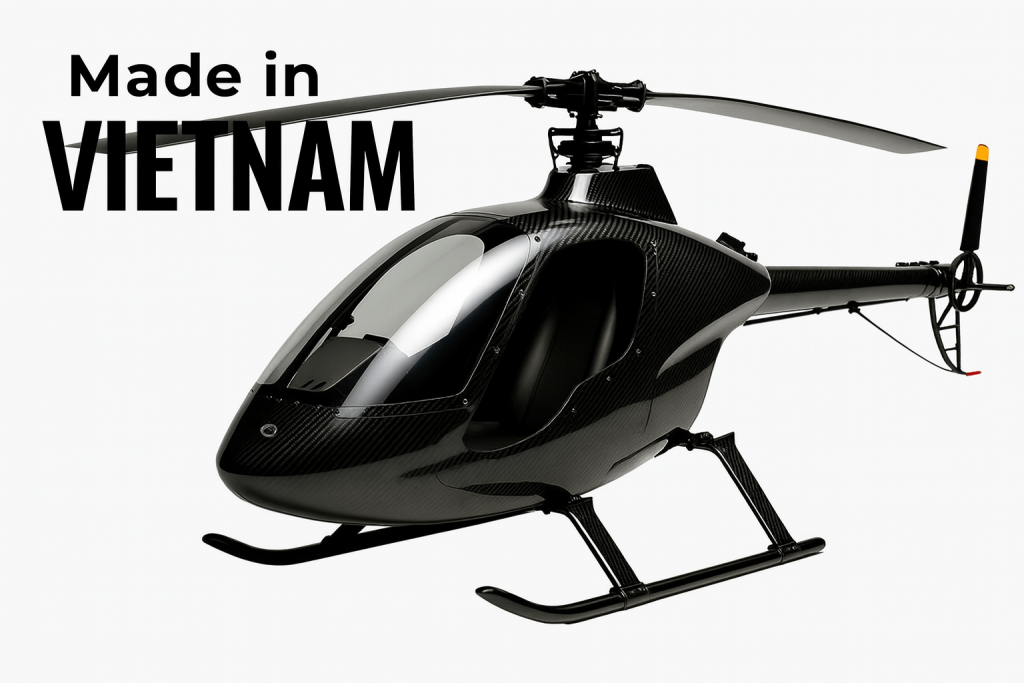
- Personal Aircraft & UAVs: Carbon fuselage parts are strong yet lightweight.
- Travel Goods: Premium luggage shells combine durability with sleek design.
These examples show that Vietnam carbon fiber prepreg is not only for industrial use. It is also used in consumer and lifestyle products, giving global buyers multiple entry points.
Challenges and Opportunities
Challenges
- MOQ Limits: Aerospace-grade prepregs often require large orders.
- Certification Gaps: Local producers need AS9100 and similar approvals.
- Tech Dependence: High-spec resin systems still come from outside Vietnam.
Opportunities
- Market Gap: A fully Vietnamese prepreg plant will give buyers a true CO-compliant source.
- Cost Advantage: Vietnam labor and energy remain cheaper than in China or Korea.
- First-Mover Edge: Early partners of Vietnamsourcing gain a unique supply chain position before competitors catch up.
Conclusion
The Vietnam carbon fiber prepreg industry is at a turning point. While Korean, Taiwanese, and Chinese vendors lead today, the future belongs to Vietnamese-owned, certified, and globally competitive suppliers.
With tariff wars and shifting relations between India, the U.S., and other industrial powers, Vietnam stands out as a stable and smart choice. Partnering with Vietnamsourcing means working with a team that connects global buyers to reliable, compliant, and cost-effective Vietnamese prepreg solutions.
By doing so, you not only diversify your supply chain but also support the growth of Vietnam’s advanced manufacturing sector.
To know more or further support, please find us HERE