Introduction
Vietnam rubber molded parts sourcing has become increasingly attractive for global buyers seeking competitive pricing and stable manufacturing capacity. However, choosing the wrong rubber factory often leads to higher costs, longer development cycles, and inconsistent quality. Therefore, buyers must clearly understand rubber production processes, material specialization, and factory capabilities before starting sourcing activities.
In this guide, we explain how rubber molded parts factories in Vietnam operate and how buyers can select the right supplier to reduce cost and time-to-market.
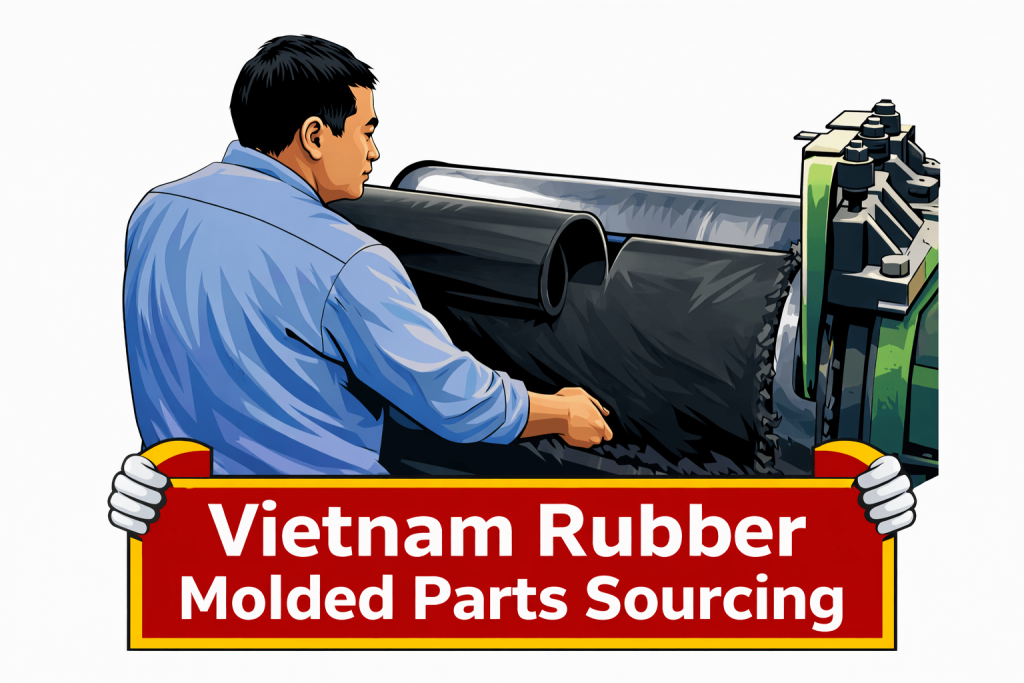
Understanding Rubber Molded Parts Manufacturing Processes in Vietnam
Most rubber molded parts factories in Vietnam follow a similar production flow. However, the level of expertise and investment varies significantly between factories.
The typical rubber manufacturing process includes:
- Compounding – mixing raw rubber with additives and fillers
- Vulcanization – curing rubber to achieve final mechanical properties
- Deflashing – removing excess rubber after molding
- Post-curing – improving heat resistance and stability
- Secondary processes (optional) – bonding, coating, or printing
- Packaging – preparing products for shipment
Because each step affects cost and quality, buyers must understand which processes are critical for their product.
Rubber Classification by Application
Rubber products are commonly divided by application. This classification directly impacts factory selection.
Industrial Rubber Products (Non-Food Grade)
Industrial rubber products are widely used in machinery, construction, and general industrial applications. These products usually do not require food-contact compliance. As a result, production costs remain relatively low.
Food-Grade Rubber and Silicone Products
Food-grade rubber products, such as silicone components, must comply with FDA material requirements. Therefore, factories producing food-grade rubber typically operate clean facilities and apply stricter quality controls. Consequently, pricing and lead times are usually higher.
Rubber Classification by Production Process
Vietnam rubber molded parts sourcing requires a clear understanding of production processes, as many factories specialize in only one or two technologies.
Common rubber production processes include:
- Compression molding
- Extrusion molding
- Injection molding
- Liquid Silicone Rubber (LSR) molding
- Rubber-to-metal bonding
- Transfer molding
If a factory does not specialize in your required process, tooling costs increase and product quality becomes unstable. Therefore, process matching is critical.
Rubber Classification by Material Type
Vietnam is particularly strong in natural rubber (NR) production. In addition, some factories specialize in selected synthetic rubbers, such as SBR and EPDM.
However, Vietnam remains less competitive in high-end synthetic rubber compounds compared to China or Japan. For this reason, many factories focus on a limited range of materials to optimize pricing.
Examples of material specialization include:
- NR-focused factories
- EPDM-only production lines
- Rubber latex factories (e.g., rubber gloves)
When buyers source from material-specialized factories, unit pricing often becomes highly competitive.
Rubber Classification by Product Specialization
Many rubber factories in Vietnam optimize their operations for specific product categories. As a result, they achieve better efficiency and cost control.
Common product specializations include:
- Rubber seals and gaskets
- Rubber pads
- Rubber mats
- Rubber mounts
- Rubber toys
If a factory focuses on only one or two product types, mold design, machinery, and labor skills are usually well optimized. Therefore, buyers benefit from lower defect rates and stable pricing.
Rubber Classification by Product Size
Product size plays a critical role in factory selection.
Small rubber molded parts, such as seals and gaskets, require small compression or injection presses. In contrast, large rubber mats and heavy rubber parts require high-tonnage presses.
Factories operating only small machines cannot efficiently produce large rubber parts. Similarly, factories designed for large products may struggle with small precision components. Therefore, buyers must match product size with factory equipment.
Rubber Classification by Color Capability
Not all rubber factories can produce colored rubber parts.
Some factories only manufacture black rubber products, while others invest in facilities for colored rubber production. This difference exists because even minimal black carbon contamination can destroy a colored rubber batch.
As a result, factories specializing in black rubber must set up separate production areas to handle colored rubber. Consequently, many factories avoid colored rubber production altogether.
Secondary Processes Capability (Optional)
Secondary processes are not always available at rubber factories in Vietnam. Many factories focus only on molding operations.
Common secondary processes include:
- Bonding
- Coating
- Overmolding
- Printing (screen printing, pad printing, heat transfer printing)
If your product requires these processes, factory selection becomes more complex. Therefore, buyers should confirm secondary capabilities early in the sourcing process.
Rubber Classification by Application Complexity
Rubber products can also be divided by application complexity.
Engineered Rubber Parts
Engineered rubber parts require tight dimensional tolerances and strict quality control. These factories often support:
- High-level PPAP requirements
- IATF 16949 certification for automotive-grade components
- Advanced measurement and inspection systems
Because of these requirements, engineered rubber factories invest heavily in tooling, machines, and quality systems.
General Industrial Rubber Parts
In contrast, general industrial rubber products usually allow looser tolerances. Therefore, factories producing these products operate with lower cost structures.
Why Factory Selection Matters in Vietnam Rubber Molded Parts Sourcing
In Vietnam rubber molded parts sourcing, factory selection often matters more than price negotiation. When buyers understand product requirements and factory specialization, they can:
- Reduce tooling and unit costs
- Shorten product development timelines
- Improve quality consistency
- Minimize sourcing risks
As a result, proper factory matching leads to long-term cost savings and stable supply chains.
Conclusion
Vietnam rubber molded parts sourcing offers strong cost advantages when buyers select the right factory. By understanding rubber materials, production processes, product specialization, and application requirements, buyers can significantly reduce cost and development time.
Ultimately, successful sourcing depends not on finding the cheapest supplier, but on choosing the most suitable manufacturing partner.
Learn more about: How to Find Suitable Partners for Your Business in Vietnam?