Introduction
Global trade depends on a few narrow sea routes. These routes are often called global supply chain chokepoints. Many ships must pass through them every day.
When one chokepoint faces disruption, shipping costs rise quickly. As a result, supply chains feel pressure across many industries. Manufacturing, energy, and raw materials all depend on these routes.
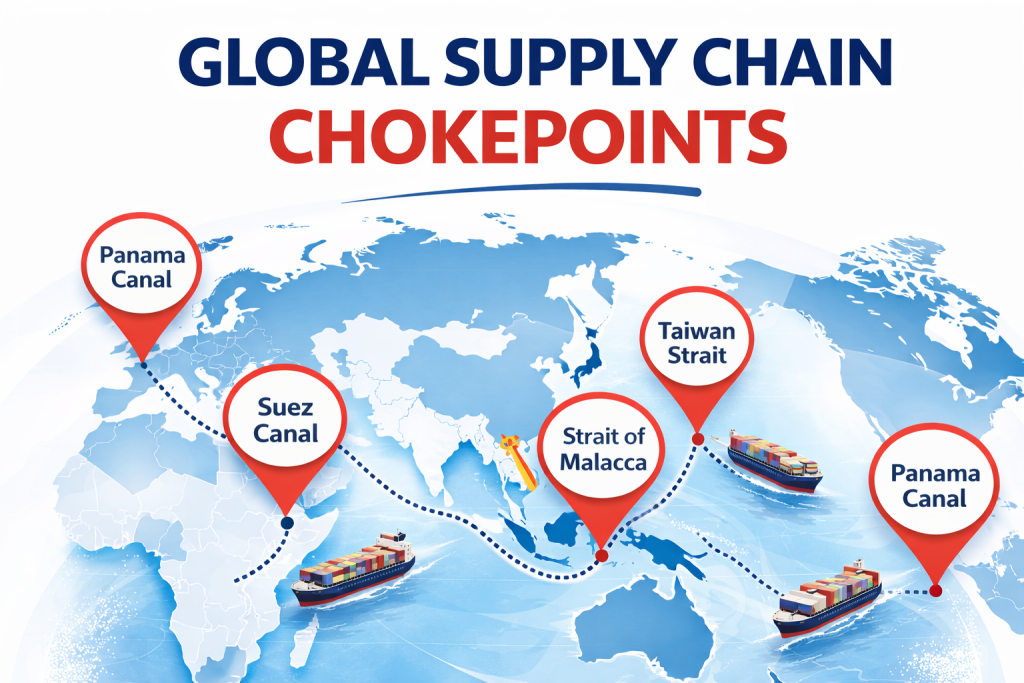
Five locations play a major role in global trade:
- Strait of Hormuz
- Strait of Malacca
- Suez Canal
- Taiwan Strait
- Panama Canal
Each chokepoint connects major manufacturing regions with large consumer markets. In particular, these routes link Asia with the United States and Europe.
For Southeast Asia and Vietnam, these routes also shape export logistics.
Why Global Supply Chain Chokepoints Matter
Global trade moves mainly by sea. In fact, about 80–90% of goods travel on ships.
However, ships cannot move freely everywhere. Instead, many routes pass through narrow waterways.
These chokepoints matter because they control the flow of:
- energy
- raw materials
- container cargo
- industrial inputs
If one route stops working, companies must change shipping plans. Consequently, transport time increases and logistics costs rise.
Therefore, understanding global supply chain chokepoints helps businesses manage risk in international trade.
Strait of Hormuz: The World’s Energy Gateway
The Strait of Hormuz connects the Persian Gulf to global shipping routes.
Most importantly, it handles a large share of the world’s oil trade.
Key facts:
- About 20% of global oil supply passes through this route
- Major exporters include Saudi Arabia, Iraq, Kuwait, and UAE
- LNG shipments from Qatar also move through this strait
If the strait closes, global energy markets react quickly.
For example:
- oil prices rise
- shipping insurance increases
- energy supply becomes uncertain
As a result, industries worldwide face higher production costs.
Strait of Malacca: The Main Trade Route of Asia
The Strait of Malacca sits between Malaysia, Singapore, and Indonesia. It connects the Indian Ocean with the Pacific Ocean.
Therefore, it plays a major role in Asian trade.
Important points:
- Around one quarter of global trade moves through this route
- Many ships carry goods from China and Southeast Asia
- Energy shipments also pass through this strait
For Southeast Asia, this route is extremely important.
Exports from the region often follow this path:
- Vietnam
- Thailand
- Malaysia
- Indonesia
These goods then travel toward Europe, the Middle East, or North America.
However, the strait is narrow and busy. Because of this, congestion and accidents remain constant risks.
Suez Canal: The Shortcut Between Asia and Europe
The Suez Canal links the Mediterranean Sea with the Red Sea.
Because of this connection, ships can move between Europe and Asia without sailing around Africa.
Key trade impacts include:
- about 12–15% of global trade passes through the canal
- roughly one third of container traffic uses this route
- many energy shipments travel from the Middle East to Europe
However, disruption can occur quickly.
For instance, a single blocked ship once stopped the canal for several days. During that time, hundreds of vessels waited outside the waterway.
As a result:
- shipping delays increased
- container shortages appeared
- freight rates climbed globally
Even though the route mainly serves Europe, global logistics still feel the impact.
Taiwan Strait: A Critical Route for Technology Supply Chains
The Taiwan Strait lies between China and Taiwan. Many ships pass through this area when moving across East Asia.
This route matters because the region produces advanced technology products.
In particular, Taiwan plays a central role in semiconductor manufacturing.
Important supply chain links include:
- electronics exports
- semiconductor shipments
- technology components
These goods supply industries in the United States, Europe, and Asia.
If conflict disrupts this route, the consequences could be severe.
Possible impacts include:
- shortages of chips
- higher electronics prices
- delays in manufacturing
Therefore, the Taiwan Strait represents a major risk for global technology supply chains.
Panama Canal: A Key Route for US Trade
The Panama Canal connects the Atlantic Ocean with the Pacific Ocean.
Because of this shortcut, ships move easily between Asia and the eastern United States.
Typical trade flows include:
- Asian exports to the US East Coast
- US agricultural exports to Asia
- LNG shipments from the United States
Many container ships use this route when transporting goods from Asia.
For example:
- China
- Vietnam
- Thailand
These goods often arrive at ports such as New York, Savannah, or Houston.
However, the canal depends on freshwater from nearby lakes.
During drought periods, ship traffic may decrease. Consequently, shipping delays increase and freight costs rise.
Why These Chokepoints Matter for Southeast Asia and Vietnam
Southeast Asia relies heavily on maritime trade.
Therefore, global supply chain chokepoints strongly influence export logistics in the region.
Vietnam especially depends on stable shipping routes.
Many Vietnamese exports travel along these paths:
- Vietnam → Malacca Strait → Europe
- Vietnam → Pacific Ocean → United States
- Vietnam → Panama Canal → US East Coast
Because of this, disruptions can affect Vietnamese manufacturers in several ways:
- higher shipping costs
- longer delivery times
- uncertainty in supply planning
At the same time, geopolitical changes can create opportunities.
For example, if supply chains shift away from China, more production may move to Vietnam.
Conclusion
Global trade depends on a few strategic sea routes. These routes are known as global supply chain chokepoints.
Five locations play an especially important role:
- Strait of Hormuz
- Strait of Malacca
- Suez Canal
- Taiwan Strait
- Panama Canal
Together, they connect manufacturing hubs, energy exporters, and consumer markets.
For Southeast Asia and Vietnam, these chokepoints influence export logistics every day. Meanwhile, the United States relies on several of these routes to support trade and supply chains.
Therefore, companies that understand these routes can better manage global supply chain risks.