Buyers sourcing custom aluminum frames in Vietnam often start with extrusion factories. However, these suppliers may require high MOQs and may not handle cutting, machining, or assembly.
A fabrication company can offer another route. Instead of owning an extrusion line, it may source profiles from several extruders and manage downstream production.
This article explains why fabrication partners can offer more flexible sourcing options and how buyers can find the right manufacturing partner in Vietnam.
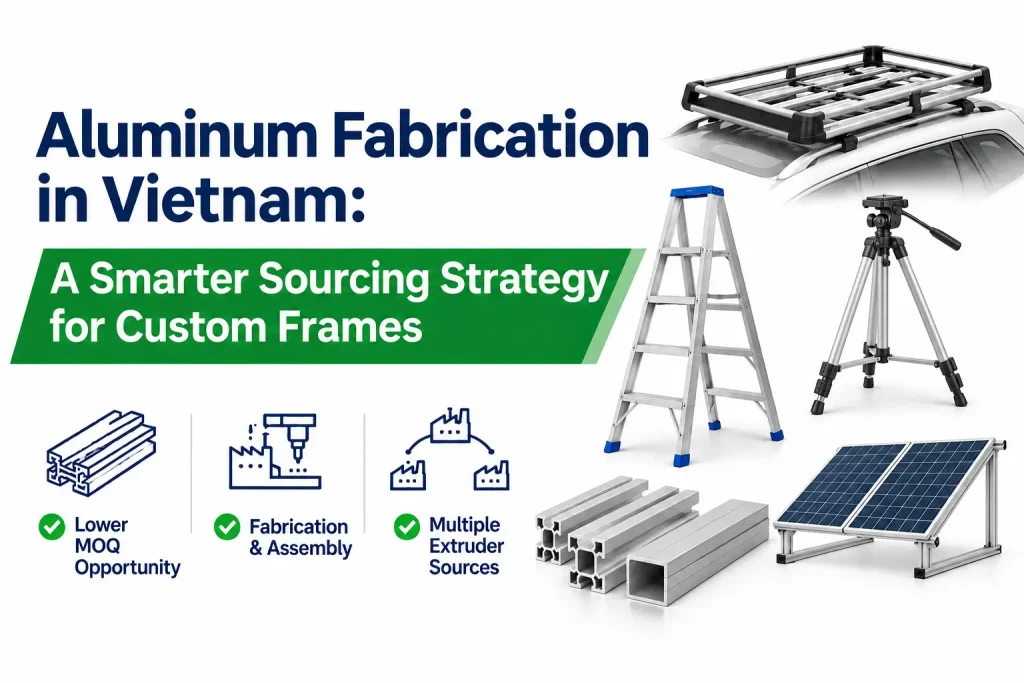
1. Why Sourcing Directly from Aluminum Extruders Can Create MOQ Challenges
Aluminum extrusion manufacturers focus on producing aluminum profiles. Their main operations include billet heating, extrusion, cooling, stretching, cutting, and surface treatment.
However, their business model often favors larger production volumes. Custom profiles also require dedicated extrusion dies, which add tooling costs.
For buyers developing custom aluminum frames, this can create several challenges:
- High MOQ: Extruders often prefer large orders to keep their production lines efficient.
- Tooling investment: Custom aluminum profiles require extrusion dies, which increase initial costs.
- Limited fabrication services: Some extruders focus on profile production rather than finished products.
- Multiple suppliers: Buyers may need separate factories for machining, assembly, and finishing.
As a result, buyers may face higher costs and more complex supplier management.
For example, a buyer may need a relatively small quantity of custom aluminum frames. However, the extrusion factory may only accept a much larger profile order.
This creates a gap between the buyer’s project requirements and the extruder’s production model.
2. Why Aluminum Fabrication Companies Can Offer More Flexible MOQ
Instead of approaching an extrusion manufacturer directly, buyers can work with a metal or aluminum fabrication company.
These companies may not own extrusion lines. Instead, they build relationships with multiple aluminum extruders and source profiles based on project requirements.
This business model gives them more flexibility when managing custom manufacturing projects.
A fabrication company can provide several advantages:
- Multiple sourcing options: They can work with different extruders based on profile specifications, pricing, and MOQ.
- Flexible production: They may handle smaller projects without operating their own extrusion lines.
- Manufacturing coordination: They can manage material sourcing, cutting, machining, and assembly.
- One-stop service: Buyers can work with one manufacturing partner instead of coordinating several factories.
In addition, some fabricators serve multiple customers and projects. Their combined purchasing volume may help them negotiate better terms with extrusion suppliers.
However, lower MOQ is not guaranteed. The actual minimum order still depends on profile specifications, supplier requirements, and production costs.
The key advantage is flexibility in supplier selection and project management.
3. Understanding the Difference Between Aluminum Extruders and Fabrication Partners
Both types of manufacturers play important roles in the aluminum supply chain. However, they focus on different production stages.
| Criteria | Aluminum Extruder | Aluminum Fabrication Company |
|---|---|---|
| Main business | Aluminum profile production | Metal fabrication |
| Extrusion equipment | Usually owned or operated | Usually outsourced |
| Supplier network | May focus on its own production | Often works with multiple extruders |
| MOQ flexibility | Often limited by extrusion volume | Potentially more flexible |
| CNC machining | Depends on factory capability | Often available |
| Cutting and drilling | May be available | Common services |
| Assembly | Not always available | Often available |
| Project management | Focus on extrusion production | Can manage multiple processes |
For buyers, the right choice depends on the product and order volume.
An extrusion manufacturer may be the better option when the project requires large volumes of aluminum profiles. It also offers more direct control over extrusion specifications.
Instead, a fabrication company may be more suitable when the buyer needs a finished aluminum frame with multiple manufacturing processes.
For a broader understanding of factory capabilities, see our guide to aluminum extrusion manufacturers in Vietnam with in-house melting, extrusion, and fabrication.
4. When Should Buyers Choose an Aluminum Fabrication Company in Vietnam?
An aluminum fabrication company is not always the best choice. The right manufacturing model depends on order volume, product complexity, and cost targets.
Choose an aluminum extruder when:
- You need large production volumes.
- Your product uses standardized or customized aluminum profiles.
- You want direct control over the extrusion process.
- You can support the required MOQ and tooling investment.
Choose an aluminum fabrication company when:
- Your project has relatively low or medium order quantities.
- You need multiple aluminum profiles from different sources.
- The product requires CNC machining, cutting, drilling, or assembly.
- You prefer one partner to coordinate multiple manufacturing processes.
- You need more flexibility during product development.
For example, a custom aluminum frame may require several profiles, brackets, drilled holes, and final assembly.
Instead of managing an extruder, a machining supplier, and an assembly factory separately, buyers can work with one fabrication partner to coordinate the project.
This approach can reduce supplier management effort and improve communication throughout production.
Conclusion
Aluminum extrusion factories are important, but they are not always the best sourcing partners for custom frame projects. A fabrication company with strong extrusion supplier relationships can offer more flexible MOQ options and manage more production stages.
For buyers sourcing in Vietnam, the smarter approach is to evaluate the entire manufacturing network. Choose a partner based on project requirements, not simply factory size or equipment ownership.