For many years, global companies relied heavily on China manufacturing. China offered low costs, strong supplier networks, and fast production. As a result, many brands built most of their supply chains in one country.
However, the market has changed quickly in recent years. COVID disruptions, trade wars, rising tariffs, and geopolitical tensions exposed major supply chain risks. Therefore, many buyers now understand the danger of depending too much on one sourcing market.
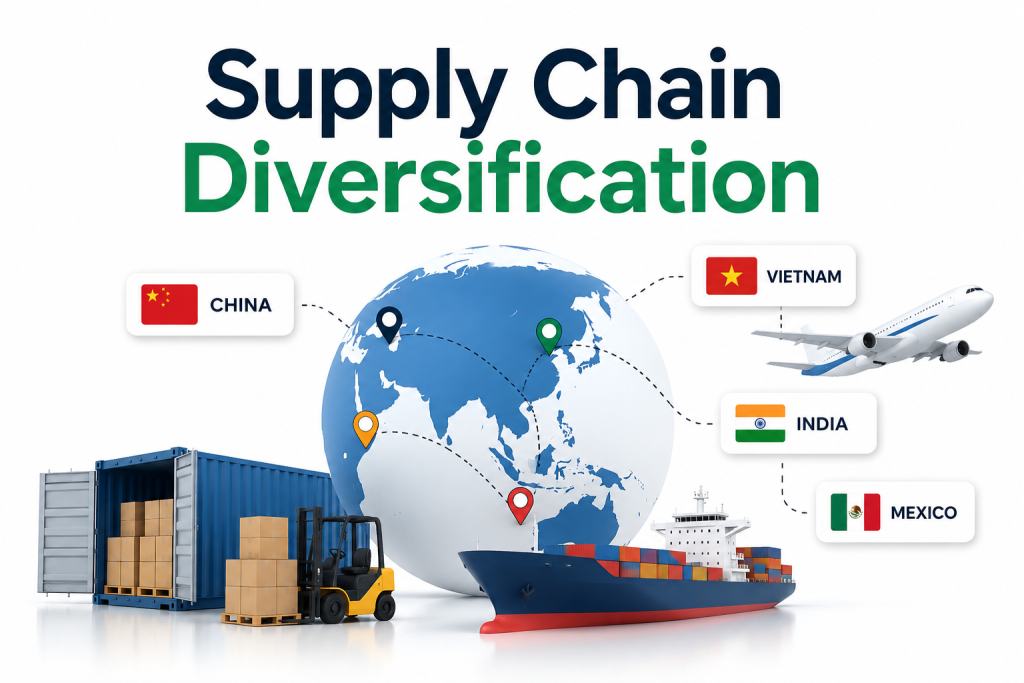
Today, supply chain diversification has become a key strategy for global buyers. Companies are expanding manufacturing to Vietnam, India, Mexico, and other regions. Instead of replacing China completely, most businesses now follow a China+1 strategy to reduce risk and improve flexibility.
How China Became the Center of Global Manufacturing
China became the world’s largest manufacturing hub over the past three decades. The country built a strong industrial ecosystem that very few markets can match.
For example, buyers can find:
- Raw material suppliers
- Packaging factories
- Mold makers
- Electronics suppliers
- Logistics providers
- Testing labs
Additionally, China offers large production capacity and fast scaling. This system helped companies reduce costs and launch products quickly.
As a result, many industries became highly dependent on China manufacturing.
How COVID Accelerated Supply Chain Diversification
COVID changed how companies think about sourcing and manufacturing. During the pandemic, many factories and ports stopped operating. Consequently, buyers faced serious delays and shortages.
Many companies experienced:
- Long shipping delays
- Rising freight costs
- Product shortages
- Factory shutdowns
- Inventory problems
Furthermore, some businesses could not meet customer demand for months.
Because of these disruptions, many global buyers started reviewing their supply chain strategies. They realized that relying on one country creates major business risks.
Therefore, supply chain diversification became a top priority after COVID.
Why Trade Wars Increased Supply Chain Risks
Trade tensions between the United States and China also pushed companies to diversify sourcing.
Higher tariffs increased import costs for many products. In addition, political uncertainty created concerns for long-term manufacturing planning.
Many buyers worried about:
- Tariff increases
- Customs delays
- Regulatory changes
- Geopolitical tensions
- Supply chain instability
As a result, companies started searching for alternative manufacturing locations outside China.
Supply Chain Diversification Helps Reduce Risk
Supply chain diversification allows companies to spread manufacturing across multiple countries. Instead of depending on one market, buyers can create a more balanced sourcing strategy.
This approach offers several advantages.
Lower Supply Chain Risk
If one country faces disruptions, production can continue in another location. Therefore, businesses can avoid major interruptions.
Better Flexibility
Companies can move production based on market conditions, tariffs, or customer demand. As a result, buyers gain more control over operations.
Improved Business Continuity
Diversified sourcing helps companies prepare for future disruptions. For example, businesses can respond faster during political or logistics problems.
More Competitive Pricing
Buyers can compare suppliers across multiple countries. Consequently, companies often improve pricing and negotiation power.
Why Vietnam Benefits from Supply Chain Diversification
Vietnam has become one of the biggest winners of global supply chain diversification.
Many companies now see Vietnam as a strong alternative manufacturing base because the country offers:
- Competitive labor costs
- Growing industrial zones
- Skilled workforce
- Strong export growth
- Multiple free trade agreements
In addition, Vietnam is located near China. Therefore, companies can still access Chinese materials and components when needed.
Today, many global brands are expanding operations in Vietnam, especially in industries such as:
- Furniture
- Textiles
- Consumer goods
- Packaging
- Electronics assembly
- Toys and plush products
As a result, Vietnam continues attracting international sourcing projects.
Supply Chain Diversification Does Not Mean Leaving China Completely
Most companies are not abandoning China entirely. Instead, they are reducing overdependence on one market.
China still offers major advantages, including:
- Large supplier networks
- Advanced manufacturing capabilities
- Strong infrastructure
- Fast production speed
- Deep industrial ecosystems
Therefore, many businesses now follow a China+1 sourcing strategy.
In this model:
- China remains an important production base
- Additional manufacturing moves to other countries
- Buyers reduce concentration risk
- Supply chains become more flexible
This strategy helps companies balance cost, speed, and risk management.
Challenges of Supply Chain Diversification
Although diversification offers many benefits, the process also creates challenges.
For example, buyers may face:
- Different quality standards
- Smaller supplier ecosystems
- Limited production capacity
- Higher training requirements
- Longer supplier development time
Additionally, some alternative markets still depend heavily on Chinese raw materials and machinery.
Therefore, companies should build diversification strategies carefully and gradually.
How Buyers Can Build a Strong Diversified Supply Chain
Companies should take a structured approach when expanding sourcing beyond China.
Important steps include:
- Evaluating supply chain risks
- Identifying backup suppliers
- Testing new manufacturing markets
- Auditing factories carefully
- Building long-term supplier relationships
- Diversifying critical components first
Furthermore, buyers should avoid moving production too quickly. A gradual transition usually creates better long-term results.
The Future of Supply Chain Diversification
Global supply chains will continue changing over the next decade. Companies now focus not only on cost but also on stability and resilience.
As geopolitical risks increase, more buyers will expand manufacturing across multiple countries. Therefore, supply chain diversification will remain a major strategy for global sourcing teams.
At the same time, China will likely continue playing a major role in global manufacturing. However, companies no longer want all production concentrated in one market.
Instead, businesses are building more flexible and balanced supply chains for the future.
Conclusion
Supply chain diversification is no longer just a trend. Today, it has become an important strategy for global buyers and manufacturers.
COVID, trade wars, and geopolitical tensions exposed the risks of relying too heavily on one sourcing country. Therefore, many companies are expanding manufacturing beyond China while still maintaining part of their existing supply chain there.
Countries like Vietnam are benefiting from this global shift. At the same time, buyers are creating stronger and more flexible sourcing strategies to reduce future disruptions.
In the coming years, supply chain diversification will continue shaping global manufacturing and international sourcing decisions.
You maybe interested in Geopolitical Supply Chains: How Globalization 2.0 Is Reshaping Manufacturing in 2026