Introduction
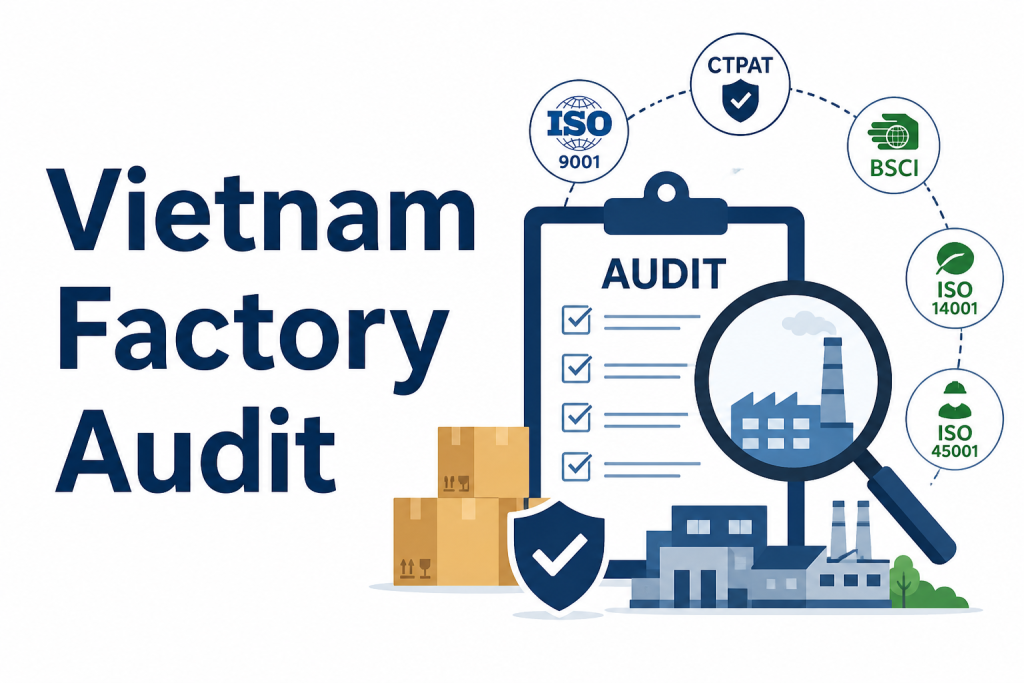
When buyers source from Vietnam, they often focus on ISO and product certifications. However, a full Vietnam factory audit should go beyond that. Many risks sit outside quality systems. Therefore, buyers need a broader view before placing orders.
Vietnam Factory Audit: What Most Buyers Check First
Most buyers start with standard checks. These are important. Yet, they are not enough.
- ISO 9001: Quality management system
- Product certifications:
- OEKO-TEX (textile)
- FDA (food, food contact)
- IATF 16949 (automotive)
These certifications show capability. However, they do not cover all risks.
However, What Buyers Often Miss in a Vietnam Factory Audit
Even though buyers use audit forms, they often overlook key areas. As a result, hidden risks remain.
1. CTPAT (Customs-Trade Partnership Against Terrorism)
- Focus: Supply chain security
- Benefit: Faster customs clearance into the US
- Therefore, it reduces shipping delays
Many buyers ignore this. However, it directly impacts delivery time and reliability.
2. BSCI (Business Social Compliance Initiative)
- Focus: Social responsibility
- Covers:
- Working conditions
- Labor rights
- Ethical sourcing
Today, brands face pressure from consumers. Therefore, BSCI becomes more important.
3. ISO 14001 (Environmental Management)
- Focus: Environmental impact
- Covers:
- Waste control
- Emissions
- Resource usage
If ignored, environmental issues can damage brand reputation. Moreover, regulations are getting stricter.
4. ISO 45001 (Occupational Health and Safety)
- Focus: Worker safety
- Covers:
- Workplace risks
- Injury prevention
- Safety systems
A safe factory is more stable. Therefore, production disruptions are less likely.
Why These Certifications Still Appear in Audit Forms
Interestingly, many buyer audit forms include questions about these areas. However, buyers do not always verify certificates.
- They ask about security → linked to CTPAT
- They ask about labor → linked to BSCI
- They ask about environment → linked to ISO 14001
- They ask about safety → linked to ISO 45001
So, even if buyers skip certificates, the risks still exist.
How to Strengthen Your Vietnam Factory Audit Process
To reduce risk, buyers should expand their audit scope.
- First, check ISO 9001 and product certifications
- Then, review:
- CTPAT (if shipping to US)
- BSCI or equivalent social audits
- ISO 14001 and ISO 45001
- Finally, verify documents, not just answers
In addition, use a local team if possible. They can validate real conditions faster.
Conclusion
A strong Vietnam factory audit goes beyond basic certifications. While ISO and product standards are essential, they are not enough. Therefore, buyers should also review security, social responsibility, environment, and safety. In the long run, this approach reduces risk and improves supply chain stability.