Introduction
Choosing the right manufacturing process is important. It affects cost, quality, and supply chain speed.
In many cases, buyers compare powder metallurgy and casting. Both methods are common. However, they serve different needs.
In Vietnam, casting is widely available. Meanwhile, powder metallurgy Vietnam is still limited. Therefore, understanding both helps you make better sourcing decisions.
What Is Powder Metallurgy Vietnam?
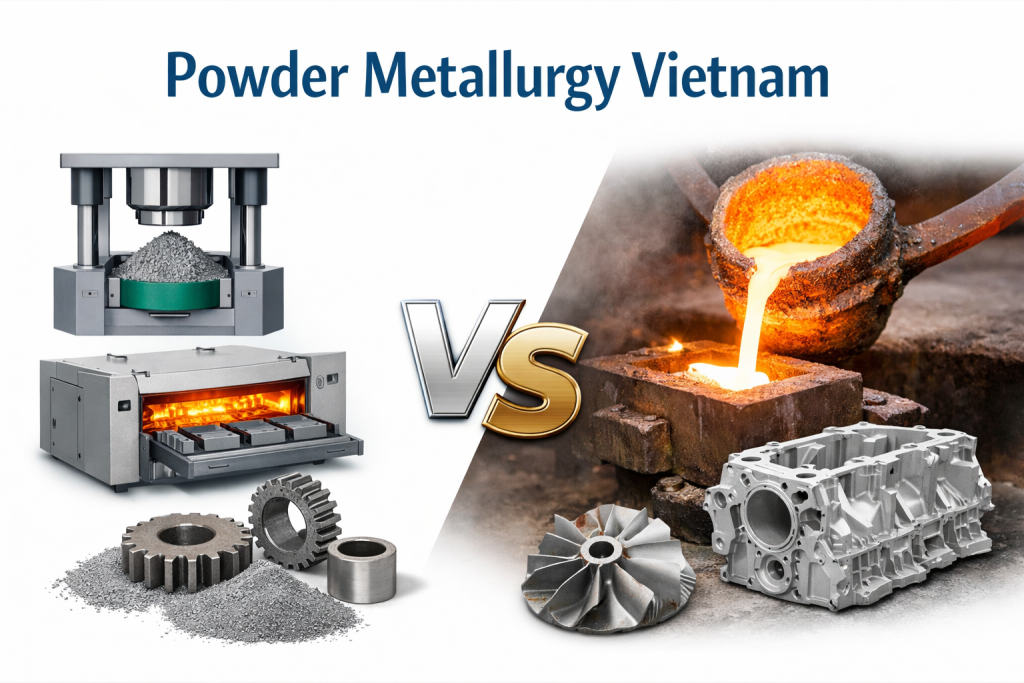
Powder metallurgy is a process using metal powder. First, factories press powder into shape. Then, they heat it below melting point.
As a result, the part forms without full melting. This method is also called sintering.
In powder metallurgy Vietnam, suppliers usually focus on:
- Small precision parts
- Automotive components
- Self-lubricating bushings
However, supplier capability is still developing. Therefore, MOQ is often high.
What Is Metal Casting?
Casting uses fully melted metal. Factories pour liquid metal into a mold. Then, the metal cools and solidifies.
Because of this, casting supports many shapes. It is also widely used in Vietnam.
Common casting types include:
- Sand casting
- Die casting
- Investment casting
As a result, buyers have many supplier options.
Key Differences Between Powder Metallurgy Vietnam and Casting
1. Process Method
Powder metallurgy does not fully melt metal. Instead, it bonds particles with heat.
In contrast, casting melts metal completely. Then, it reshapes the liquid metal.
2. Precision and Machining
Powder metallurgy offers high precision. Therefore, parts need less machining.
On the other hand, casting often requires CNC work. This increases total cost.
3. Material Properties
Powder metallurgy parts may have small pores. As a result, strength is lower.
However, casting creates dense parts. Therefore, it provides higher strength.
4. Cost Comparison
Powder metallurgy has high tooling cost. However, unit cost becomes low at scale.
Meanwhile, casting has flexible setup cost. Therefore, it works well for lower volume.
5. Design Flexibility
Casting supports complex shapes. For example, undercuts and thin walls are easier.
In contrast, powder metallurgy has design limits. Especially, vertical pressing restricts geometry.
When to Choose Powder Metallurgy Vietnam
You should consider powder metallurgy when:
- You need high volume production
- You want consistent part size
- You want to reduce machining cost
- Your part design is simple
In addition, powder metallurgy works well for small components.
However, you should check supplier capability early. Because in Vietnam, not many factories can handle complex sintering.
When to Choose Casting
Casting is a better choice when:
- You need complex shapes
- Your product requires high strength
- You want flexible MOQ
- You are still testing the market
Also, casting suppliers in Vietnam are easy to find. Therefore, sourcing is faster.
Powder Metallurgy Vietnam vs Casting in Real Sourcing
In real projects, the decision is not only technical. Instead, supply chain factors matter more.
For example:
- Powder metallurgy Vietnam has fewer suppliers
- Lead time may be longer
- MOQ is usually higher
Meanwhile:
- Casting factories are everywhere in Vietnam
- Pricing is competitive
- Tooling is more flexible
Therefore, many buyers start with casting. Later, they switch to powder metallurgy for scale.
Conclusion
Both powder metallurgy and casting have clear advantages. However, the best choice depends on your product and volume.
If you need scale and precision, powder metallurgy is a strong option. Meanwhile, if you need flexibility and strength, casting is more practical.
In Vietnam, casting is still the dominant method. However, powder metallurgy Vietnam is growing. Therefore, it can be a good option for long-term cost optimization.
You maybe interested in Hot Pressing, Hot Forging, and Cold Pressing