Introduction
Choosing the right metal forming process is important. It affects cost, lead time, and product design.
Many buyers compare deep drawing and hydroforming. However, they are very different in practice.
In this guide, you will learn the key differences. More importantly, you will know when to use each process.
What Is Deep Drawing?
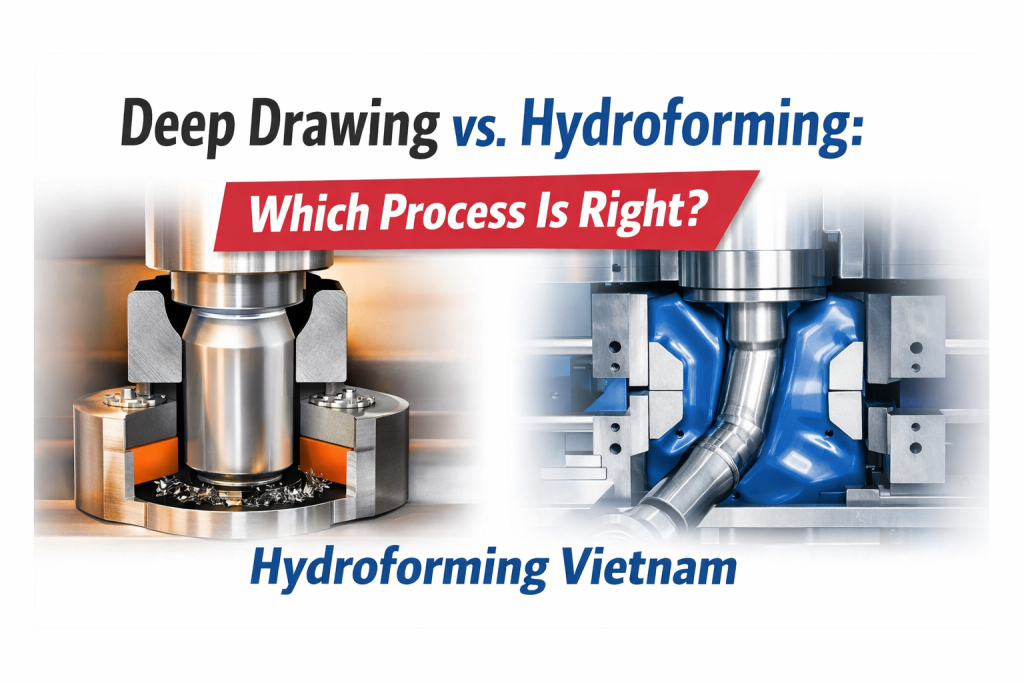
Deep drawing is a common metal forming method. A metal sheet is pressed into a die to create a shape.
It is widely used in mass production. For example, beverage cans and food containers use this process.
Key points:
- High speed production
- Low cost per unit at scale
- Stable and repeatable quality
However, design flexibility is limited. Complex shapes are harder to achieve.
What Is Hydroforming?
Hydroforming uses high-pressure fluid. The fluid pushes the metal into the mold.
As a result, the metal can form more complex shapes. The surface is also smoother.
Key points:
- Better for complex designs
- Fewer steps in some cases
- Good surface quality
However, the equipment cost is higher. In addition, production speed is slower.
Deep Drawing vs. Hydroforming: Key Differences
Although both processes shape metal, they work in different ways. Therefore, the output and cost are also different.
- Tooling
- Deep drawing uses rigid dies
- Hydroforming uses fluid pressure
- Design flexibility
- Deep drawing is limited
- Hydroforming supports complex shapes
- Production volume
- Deep drawing fits high volume
- Hydroforming fits medium or low volume
- Cost structure
- Deep drawing has lower unit cost at scale
- Hydroforming has higher setup cost
When to Use Deep Drawing
In most cases, deep drawing is the better choice for standard products.
You should use deep drawing when:
- You need large volume production
- The shape is simple (round or uniform)
- Cost per unit is critical
For example:
- Beverage cans
- Food cans
- Simple metal containers
As a result, most factories prefer this method for mass production.
When to Use Hydroforming Supplier Services
If your design is complex, you should consider a hydroforming supplier.
In particular, this process is useful when design matters more than cost.
You should use hydroforming when:
- The shape is complex or non-uniform
- You want fewer welds or joints
- Surface quality is important
For example:
- Premium metal bottles
- Custom containers
- Automotive parts
Therefore, a hydroforming supplier is often chosen for custom projects.
Cost and Tooling Comparison
Cost is always a key factor. However, you need to look at both tooling and unit cost.
- Deep drawing
- Lower cost at high volume
- High tooling investment, but stable output
- Hydroforming
- Higher machine cost
- More flexible for small batches
As a result, the best option depends on your volume.
How to Choose the Right Hydroforming Supplier or Process
Before choosing a process, you should review your product needs.
Consider these factors:
- Annual volume
- Shape complexity
- Budget
- Lead time
If your product is simple, deep drawing is usually enough.
However, if your design is complex, a hydroforming supplier can add value.
In addition, always check:
- Supplier experience
- Sample capability
- Tooling support
Conclusion
Both deep drawing and hydroforming are useful. However, they serve different needs.
Deep drawing is best for high volume and simple shapes. In contrast, hydroforming is better for complex designs.
Therefore, your choice should depend on your product and business goals.
You maybe interested in Powder Metallurgy vs Casting: Key Differences, Cost & When to Choose Each