Global sourcing gives buyers many opportunities. However, it also creates hidden risks. One of the biggest risks is biased supplier recommendation.
Many buyers believe their sourcing partner works only for them. In reality, some sourcing agents also receive commissions from factories. As a result, supplier recommendations may not stay fully objective.
This issue affects product cost, quality, and long-term supply chain stability. Therefore, buyers should understand how biased supplier recommendation works before choosing a sourcing partner.
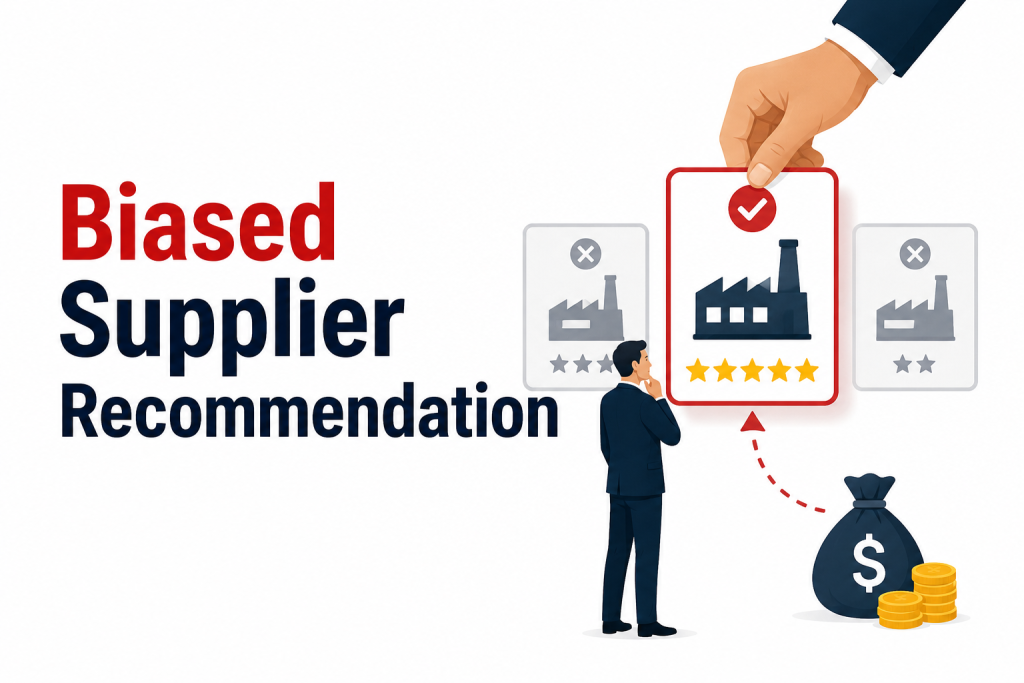
What Is Biased Supplier Recommendation?
Biased supplier recommendation happens when a sourcing company promotes certain factories for its own benefit.
In many cases, the sourcing agent receives:
- hidden factory commissions
- referral fees
- pricing markups
- special incentives from suppliers
Because of this, the recommended factory may not be the best option for the buyer.
Instead, the sourcing company may prioritize:
- higher commission
- easier communication
- existing personal relationships
- higher markups
As a result, buyers may lose access to better factories and more competitive pricing.
Why Biased Supplier Recommendation Is a Serious Problem
At first, the issue may seem small. However, the long-term impact can become very expensive.
Higher Product Costs
Some factories include hidden commissions inside the product price. Therefore, buyers often pay more without knowing it.
In addition:
- factory pricing becomes less transparent
- negotiations become harder
- cost reduction opportunities disappear
Over time, this increases total sourcing cost.
Wrong Supplier Selection
A supplier may look good during the sales stage. However, the factory may not truly match the buyer’s needs.
For example:
- the MOQ may be too high
- production quality may become unstable
- lead times may increase later
- communication may slow down
Nevertheless, some sourcing agents still push those suppliers because of financial incentives.
Reduced Supply Chain Flexibility
Some sourcing companies try to keep buyers dependent on specific factories.
As a result:
- buyers have fewer sourcing options
- supplier diversification becomes difficult
- factory switching becomes slower
This creates long-term supply chain risk.
Common Signs of Biased Supplier Recommendation
Buyers should watch for several warning signs.
Limited Supplier Options
Some sourcing agents show only one or two factories. In contrast, a transparent sourcing process should compare multiple suppliers.
A buyer should receive:
- supplier comparisons
- pricing analysis
- production strengths and weaknesses
- MOQ comparison
Without this information, buyers cannot make informed decisions.
Unclear Pricing Structure
Transparent sourcing companies explain how they charge clients.
However, some companies avoid discussing:
- sourcing fees
- commissions
- factory rebates
- pricing structure
Therefore, buyers should ask direct questions early.
Aggressive Pressure Toward One Factory
Sometimes, the sourcing company strongly pushes one supplier without clear reasons.
For example:
- they avoid factory comparisons
- they discourage supplier audits
- they resist price benchmarking
This may indicate a biased supplier recommendation process.
Why Ethics Matter in Supply Chain Consulting
Supply chain consulting should align with the buyer’s interests.
However, conflicts of interest can damage trust. Therefore, ethics play an important role in sourcing and procurement consulting.
A transparent sourcing model creates:
- fair supplier selection
- clearer pricing
- better negotiation leverage
- stronger long-term partnerships
In addition, ethical sourcing improves supply chain stability.
Our Approach to Transparent Sourcing
We believe sourcing partners should work for buyers only.
Therefore:
- we do not accept factory commissions from suppliers outside our own operations
- we do not take hidden referral fees
- we do not inflate factory pricing
Instead, we receive payment from one side only: the buyer.
This structure helps ensure:
- unbiased supplier recommendation
- transparent sourcing decisions
- fair pricing
- aligned business interests
As a result, buyers can evaluate suppliers more objectively.
How Buyers Can Reduce Sourcing Risk
Buyers should build a sourcing process with transparency and verification.
Ask Direct Questions
Before starting a project, buyers should ask:
- How does the sourcing company make money?
- Do factories pay commissions?
- Are supplier recommendations independent?
Clear answers help reduce future problems.
Compare Multiple Suppliers
Buyers should avoid making decisions too quickly.
Instead:
- compare several factories
- review quotations carefully
- analyze production capabilities
- evaluate communication quality
This process creates better supplier visibility.
Conduct Factory Audits
Factory audits help buyers verify:
- production capability
- quality systems
- compliance standards
- actual factory operations
Therefore, audits reduce sourcing uncertainty.
Conclusion
Biased supplier recommendation is a real issue in global sourcing. Unfortunately, many buyers discover the problem too late.
A sourcing partner should protect the buyer’s interests. However, hidden commissions and supplier incentives can create conflicts of interest.
Therefore, buyers should work with sourcing companies that prioritize transparency and ethical consulting.
In the long run, transparent sourcing creates:
- better supplier relationships
- fair pricing
- lower sourcing risk
- stronger supply chains
Most importantly, it helps buyers make decisions based on facts instead of hidden incentives.
You maybe interested in Vietnam Factory commission Issue