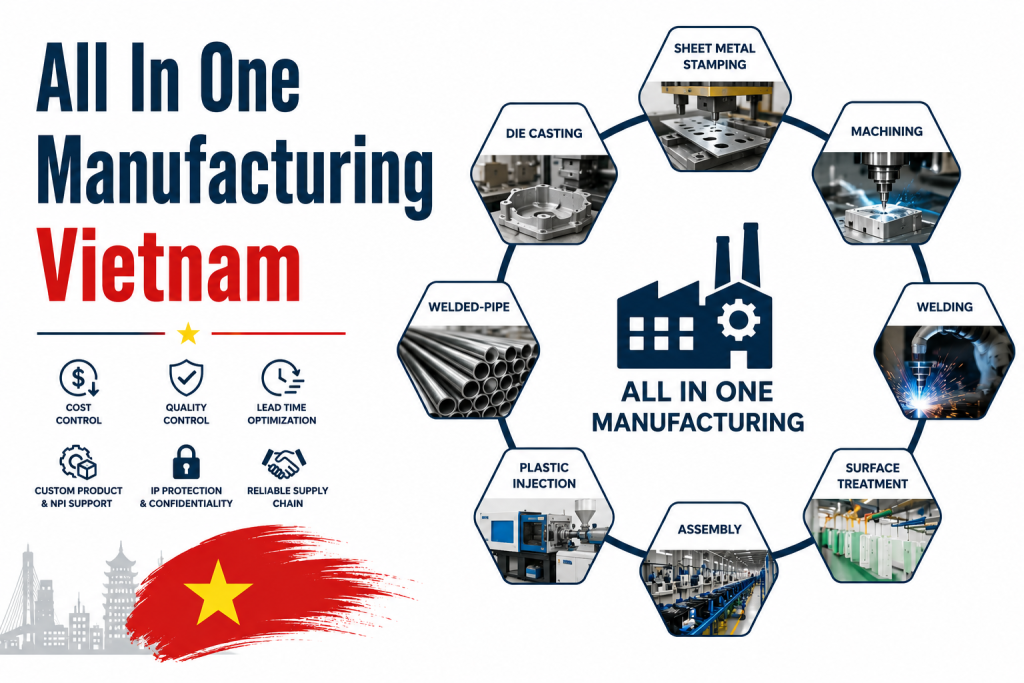
Many global buyers want factories with as many in-house processes as possible. They prefer suppliers that can handle most production steps inside one factory. This model is often called “all in one manufacturing”.
In China, this model is more common. Some industrial regions in China have complete supply chains inside one city or province. Moreover, many Chinese factories also invest heavily in vertical integration. They build forging, plastic injection, coating, welding, assembly, and tooling inside one facility.
However, Vietnam is different.
Most Vietnamese factories still rely on outside suppliers for many components and production processes. Therefore, buyers who search for “all in one manufacturing Vietnam” may find fewer options compared to China.
This article explains why.
Why Buyers Want All In One Manufacturing Vietnam
Some buyers strongly prefer factories with many in-house processes. They believe this model gives better control over manufacturing.
Additionally, this model can reduce sourcing risks.
Main reasons include:
- Better cost control
- Better quality control
- Faster lead time
- Faster product development
- Better IP protection
- Easier communication
- Lower supply chain risk
Furthermore, buyers can manage engineering changes faster when processes stay inside one factory.
All In One Manufacturing Vietnam Helps Control Cost
Cost control is one of the biggest reasons buyers prefer vertically integrated factories.
When a factory depends on many outside suppliers:
- supplier margins increase
- transportation costs increase
- communication becomes slower
- quality issues become harder to solve
As a result, total product cost may rise.
However, factories with more in-house processes can optimize the entire BOM structure. They can also redesign components based on the final application instead of using expensive standard industrial parts.
Why In-House Processes Can Be Smarter
One major advantage of all in one manufacturing Vietnam is application-based optimization.
For example, a garden tool factory may need steel tubes for tool handles.
If the factory buys tubes outside:
- the supplier may only produce water pipe products
- the supplier may use expensive industrial standards
- the supplier may not support custom tube geometry
- the supplier may require high MOQ
However, garden tools do not need water pipe standards.
The factory may only need:
- light weight
- basic strength
- good welding performance
- easy powder coating
- ergonomic tube design
Therefore, building tube processing inside the garden tool factory can reduce cost significantly.
At the same time, the factory can optimize:
- tube thickness
- tube diameter
- tube shape
- coating compatibility
- assembly efficiency
This is a very smart manufacturing strategy.
Other Examples Of Vertical Integration
Many industries use similar strategies.
For example:
- Furniture factories make simple hardware internally instead of buying expensive furniture hardware
- Appliance factories inject plastic parts internally instead of buying industrial-grade plastic components
- Tool factories forge heads internally based on product use cases
- Bicycle factories hydroform tubing internally to optimize weight and cost
As a result, factories can remove unnecessary industrial specifications and reduce overall product cost.
Why China Has More All In One Manufacturing Factories
China developed strong industrial clusters over many decades.
In many Chinese provinces:
- raw material suppliers are nearby
- machine makers are nearby
- tooling suppliers are nearby
- component factories are nearby
Additionally, China has:
- larger industrial ecosystems
- stronger supporting industries
- deeper engineering talent pools
- better manufacturing scale
Therefore, Chinese factories often invest aggressively in vertical integration.
Some factories even operate:
- forging
- CNC machining
- plastic injection
- powder coating
- stamping
- welding
- assembly
- packaging
inside one manufacturing campus.
Why All In One Manufacturing Vietnam Is More Limited
Vietnam has many strong factories. However, the industrial ecosystem is still developing.
Most factories focus on:
- assembly
- labor-intensive production
- selected core processes
Instead of building every process internally.
There are several reasons for this.
High Investment Cost
Every manufacturing process requires:
- machines
- tooling
- engineers
- operators
- maintenance systems
- quality systems
Therefore, investment cost becomes very high.
For example:
- forging lines
- hydroforming systems
- die casting
- plating lines
- powder coating systems
all require major capital investment.
Limited Domestic Supply Chain Depth
Vietnam still imports many:
- industrial materials
- machine parts
- specialized components
- automation systems
As a result, building complete manufacturing ecosystems takes more time.
Production Volume Requirements
Factories only recover investment costs when machines run continuously.
Therefore, factories need:
- stable orders
- large volume
- long-term customers
Without scale, vertical integration becomes risky.
Which Vietnamese Factories Use This Model
Only a small number of factories in Vietnam operate with heavy vertical integration.
Usually, these factories are:
- major vendors
- export-focused manufacturers
- long-term suppliers for global retailers
For example, they may supply:
- Walmart
- Home Depot
- Lowe’s
These factories often handle very large orders every year.
Additionally, they usually invest heavily in:
- automation
- tooling
- engineering teams
- compliance systems
Challenges For Buyers
Because these factories are rare, buyers also face several challenges.
High MOQ
Most vertically integrated factories require:
- container quantity orders
- stable annual volume
- long production runs
Therefore, they may reject small orders.
Forecast Requirements In All In One Manufacturing Vietnam
These factories also require clear forecasts.
They prefer:
- yearly planning
- rolling forecasts
- stable demand
However, unstable ordering creates production risks.
Strict Customer Selection
Many integrated factories do not serve small buyers.
Instead, they focus on:
- large importers
- established brands
- big retailers
- long-term accounts
Additionally, they often avoid:
- unstable startups
- low-volume projects
- highly fragmented SKUs
Because of this, buyers must meet strict business requirements.
Conclusion
All in one manufacturing Vietnam is growing, but the model is still limited compared to China.
Many buyers want factories with more in-house processes because this improves:
- cost control
- quality control
- lead time
- product development
- IP protection
At the same time, vertically integrated factories can redesign components based on real product applications. Therefore, they can reduce unnecessary industrial standards and lower manufacturing cost.
However, this model requires very large investment and stable production volume.
As a result, only a small number of Vietnamese factories operate with deep vertical integration today. Most of these factories work with large global buyers and require high MOQ, clear forecasts, and long-term cooperation.