Sourcing from Vietnam can offer strong opportunities for US buyers. However, finding the right supplier is not always easy. This becomes even harder for complex products that require engineering, tooling, or prototype development.
In many cases, Vietnam has only a limited number of qualified suppliers for a specific product or process. Therefore, buyers need to choose the right projects before approaching these suppliers.
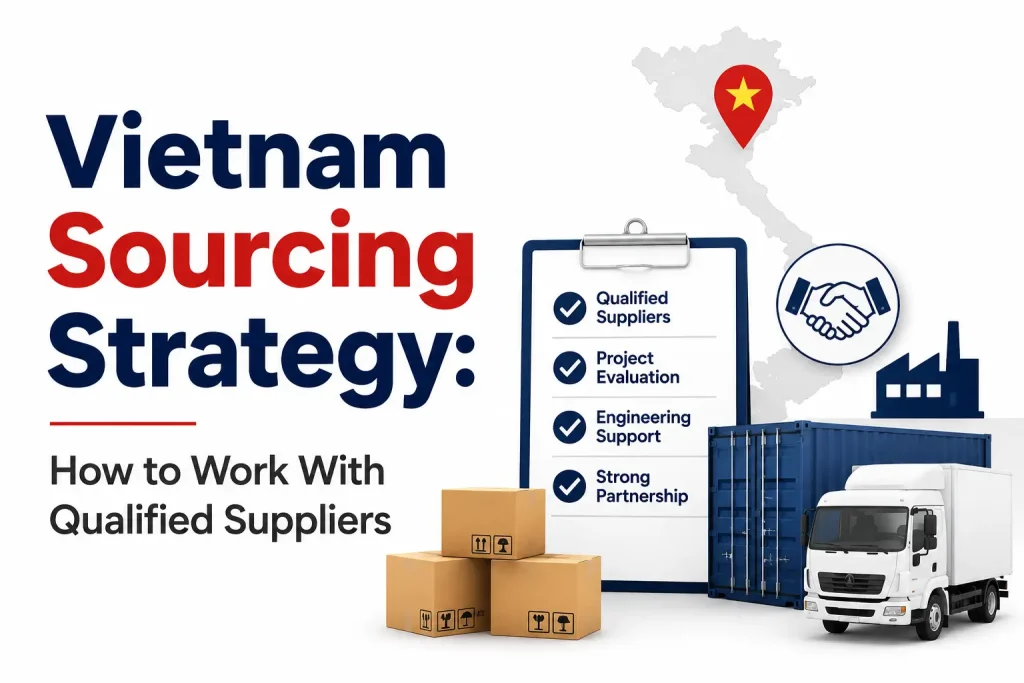
A strong Vietnam Sourcing Strategy is not only about finding suppliers. It is also about knowing which projects are worth bringing to the right suppliers.
Why Qualified Suppliers in Vietnam Are Limited
Vietnam has many manufacturers across different industries. However, the number of suppliers with advanced capabilities can be much smaller.
For example, a buyer may need a supplier for a complex plastic injection mold. Many factories can make simple molds. However, fewer suppliers may have the equipment, engineering team, and experience needed for a large or complex mold.
Similarly, some outdoor product suppliers may have experience with tents or camping products. However, only a few may have the ability to develop a new product from an early concept.
As a result, buyers should not treat every supplier as interchangeable.
Instead, they should identify the suppliers that have the right capabilities for the project.
A Good Project Must Match the Right Supplier
One of the most important parts of a Vietnam Sourcing Strategy is project-supplier matching.
A good supplier may not be the right supplier for every project. Likewise, a buyer may have a good project but approach a supplier that does not fit its needs.
Before sending an RFQ, buyers should consider:
- Product complexity
- Expected annual volume
- Target price
- Required tooling
- Engineering requirements
- Required certifications
- Production timeline
- Export requirements
- Supplier experience with similar products
- Long-term business potential
Therefore, buyers should first understand the project. Then, they can select the most suitable suppliers.
This approach saves time for both sides.
Why Complex Projects Require More Than a Quotation
For simple products, a supplier may provide a price quickly.
However, complex projects can require significant work before a supplier can provide a reliable quotation.
For example, consider a plastic injection mold project.
The supplier may need to:
- Review the product design
- Check the part structure
- Perform DFM
- Review the mold structure
- Develop a mold workflow
- Analyze the production process
- Review material requirements
- Estimate tooling costs
- Estimate production costs
- Prepare a final quotation
This work takes engineering time.
Moreover, the supplier may need several days or even longer to complete the review. Therefore, a quotation request is not always a simple sales activity.
It can become a small engineering project before the supplier can provide a final price.
Supplier Time Is Valuable
When qualified suppliers are limited, supplier time becomes especially important.
A leading supplier may receive many potential projects. They must decide which projects deserve engineering resources.
Therefore, buyers should provide clear information from the beginning.
A strong RFQ should include:
- Product drawings
- Specifications
- Material requirements
- Estimated volume
- Target market
- Packaging requirements
- Required certifications
- Expected timeline
- Tooling requirements
- Any known technical challenges
This allows the supplier to understand the opportunity quickly.
More importantly, it helps the supplier decide whether the project fits its capabilities.
Avoid Sending the Same Project to Suppliers Without a Clear Plan
Repeated RFQs can create problems when the buyer does not have a clear project plan.
For example, a buyer may ask a leading supplier for a quotation. The supplier spends time reviewing the project and preparing a price.
The buyer then rejects the quotation.
A second project arrives, and the supplier performs the same type of work again. The buyer rejects that quotation as well.
After several similar situations, the supplier may decide not to spend more engineering time on future RFQs.
Therefore, buyers should avoid using qualified suppliers simply as free quotation sources.
The relationship can become difficult if the supplier repeatedly invests time without seeing a realistic opportunity.
Evaluate Project Seriousness Before Approaching Leading Vendors
Before contacting a high-value supplier, buyers should evaluate how serious and realistic the project is.
For example, buyers should ask:
- Is the product already approved internally?
- Is there a real customer or market opportunity?
- Is the budget available?
- Is the expected volume realistic?
- Is the product specification complete?
- Is the timeline realistic?
- Is the buyer ready to move forward after receiving the quotation?
- What is the expected next step after the quotation?
These questions help separate a real project from early-stage market research.
Of course, early research still has value. However, buyers should communicate the project stage clearly.
That transparency helps suppliers decide how much time they should invest.
When Buyers Should Consider Paying Engineering Costs
Sometimes, a supplier needs to perform substantial engineering work before providing a final quotation.
In these cases, buyers should consider paying for the work.
For example, a plastic injection mold supplier may need to spend significant time on:
- DFM analysis
- Mold design review
- Mold flow analysis
- Mold structure planning
- Engineering calculations
- Tooling workflow development
If the buyer cannot move forward immediately, asking the supplier to provide all this work for free may not create a healthy relationship.
Instead, the buyer can discuss an engineering fee.
This creates a more balanced relationship. The supplier receives compensation for its engineering time, while the buyer receives a more detailed technical evaluation.
Furthermore, the engineering fee can sometimes become part of the future tooling or development cost if the project moves forward.
Prototype Development Can Also Require Payment
The same principle applies to other product categories.
Consider camping equipment or outdoor products.
A supplier may not be able to provide an accurate quotation simply by looking at drawings. They may need to develop a prototype first.
That prototype can require:
- Materials
- Labor
- Pattern development
- Sample production
- Hardware
- Testing
- Engineering time
As a result, the supplier may need to spend real money before giving the buyer a reliable quotation.
Therefore, buyers should consider paying the prototype or development cost when appropriate.
This can also show that the buyer has serious interest in the project.
A Small Investment Can Build a Stronger Supplier Relationship
Paying for engineering or prototype work is not simply an additional cost.
Instead, it can be an investment in the supplier relationship.
A qualified supplier is more likely to prioritize a project when the buyer respects its time and resources.
Moreover, the supplier can provide more detailed work when it knows the buyer has a serious commercial opportunity.
This creates a more balanced relationship:
- Buyer: receives better technical support and a more reliable quotation.
- Supplier: receives compensation for engineering and development work.
- Both sides: build trust before starting production.
Ultimately, this can improve the chance of a long-term partnership.
What If the Buyer Has a Limited Budget?
Not every buyer has the budget to pay engineering fees or prototype costs for every RFQ.
This is especially common for startups and small businesses.
In this situation, buyers can use a different sourcing approach.
Instead of sending every project directly to leading manufacturers, they can work with a Vietnam sourcing agent or local sourcing partner.
A strong sourcing partner may already have relationships with multiple suppliers.
Therefore, the partner can help:
- Screen suitable suppliers
- Compare initial prices
- Check supplier capabilities
- Collect basic quotations
- Communicate with factories
- Consolidate supplier feedback
- Identify the most promising options
This approach can reduce the amount of work required from leading suppliers during the early stage.
Choose a Sourcing Partner With Strong Supplier Relationships
Not all sourcing partners provide the same value.
For projects with limited budgets, buyers should look for partners with strong local relationships.
A good sourcing partner should understand the supplier landscape and know which vendors are suitable for specific products.
More importantly, the partner should have enough purchasing power and supplier trust to obtain responses quickly.
For startups, this can be especially useful.
Instead of asking five or ten factories to spend time on a project, the sourcing partner can first identify two or three realistic options.
Then, the buyer can invest more time in the most promising supplier.
A Better Vietnam Sourcing Strategy
A strong Vietnam Sourcing Strategy should focus on quality rather than simply increasing the number of RFQs.
The process can follow a simple structure:
1. Understand the project
Define the product, volume, budget, timeline, and technical requirements.
2. Evaluate project potential
Determine whether the project has a realistic path to production.
3. Match the project with suitable suppliers
Select suppliers based on capability and experience.
4. Communicate the project clearly
Give suppliers enough information to evaluate the opportunity.
5. Respect supplier engineering time
Understand that complex quotations may require significant work.
6. Consider development fees
Pay for engineering or prototype work when the supplier must invest substantial resources.
7. Build the relationship
Focus on long-term cooperation rather than one-time quotations.
8. Use a sourcing partner when needed
For early-stage projects or limited budgets, use a partner with established supplier relationships.
The Goal Is Not the Cheapest Quotation
A sourcing project should not be judged only by the first quotation.
A very low quotation may not lead to a successful production relationship.
Instead, buyers should consider the supplier’s:
- Technical capability
- Communication
- Engineering support
- Production capacity
- Quality system
- Lead time
- Export experience
- Willingness to support product development
- Long-term fit
Therefore, the best supplier is often the supplier that can successfully develop and produce the product, not simply the supplier with the lowest initial price.
Conclusion
Vietnam offers many sourcing opportunities, but qualified suppliers for complex projects can be limited. Therefore, buyers need a more careful approach when working with leading vendors.
A successful Vietnam Sourcing Strategy starts with project qualification and supplier matching. Buyers should understand the value of supplier time, especially when a project requires DFM, mold analysis, prototype development, or other engineering work.
When significant work is required, paying for engineering or prototype development can create a healthier relationship. Meanwhile, buyers with limited budgets can work with sourcing partners that already have strong supplier relationships.
Ultimately, successful sourcing from Vietnam is not about sending more RFQs. It is about sending the right projects to the right suppliers and building relationships that create value for both sides.