For many global buyers, Vietnam sourcing starts with a simple goal: find a factory in Vietnam.
However, finding a factory is only the first step. A stable supply chain requires more than one factory. It requires reliable materials, capable suppliers, strong production processes, and good quality control.
Today, many companies are also looking beyond the traditional China+1 model. They want to build a supply chain that can support their business for many years.
Therefore, the real question is not only where a product is assembled.
The better question is:
How much of the supply chain can be developed in Vietnam?
This article introduces a three-level framework for building a genuine Vietnam supply chain. It also explains how buyers can move from simple assembly toward a deeper and more sustainable manufacturing network.
Why Vietnam Sourcing Needs a Long-Term Strategy
Vietnam has become an important manufacturing base for global buyers. Moreover, many companies now use Vietnam as part of their China+1 sourcing strategy.
However, moving the final assembly to Vietnam does not automatically create a strong Vietnam supply chain.
For example, a product may follow this path:
China components → Vietnam assembly → USA
The factory is in Vietnam. Yet, most of the supply chain may still depend on China.
This model can work for some products. However, it may offer limited local value and limited supply-chain depth.
A stronger approach is to gradually develop more activities in Vietnam.
That can include:
- Raw material sourcing
- Component manufacturing
- Injection molding
- CNC machining
- Casting
- Forging
- Sewing
- Rubber molding
- Product assembly
- Quality control
- Testing
- Packaging
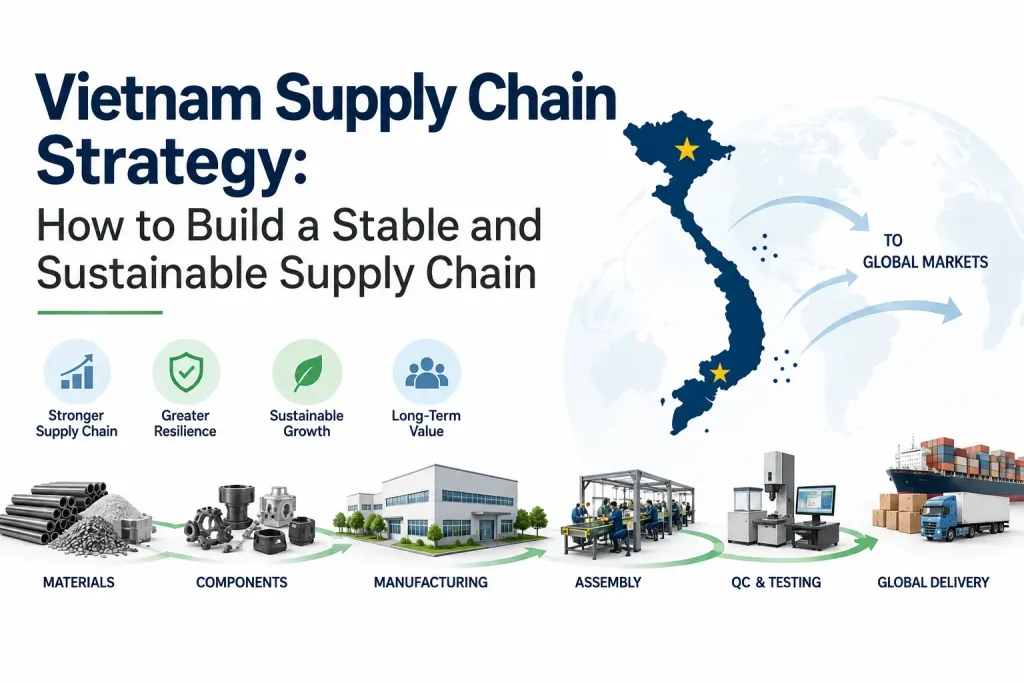
As more of these activities move into a connected local network, Vietnam becomes more than an assembly location.
It becomes a supply-chain base.
The Three Levels of Vietnam Supply Chain Development
There is no single model that works for every product.
Instead, buyers can think about Vietnam sourcing in three levels.
Each level represents a different depth of local manufacturing.
Level 1 — Assembly in Vietnam
The first level is simple.
China components
↓
Vietnam assembly
↓
USA
At this level, the Vietnam factory mainly performs final assembly.
For example, Chinese suppliers may provide most of the components. The Vietnam factory then assembles, packs, and ships the finished product.
This approach can be useful when a buyer needs to start production in Vietnam quickly.
However, the supply chain remains highly dependent on external suppliers.
The buyer may still depend on China for:
- Components
- Materials
- Tooling
- Production equipment
- Technical knowledge
- Supplier capacity
Therefore, this model provides a Vietnam production location. It does not necessarily create a deep Vietnam supply chain.
Level 2 — Manufacturing in Vietnam
However, the second level goes deeper.
China or other-country raw materials
↓
Vietnam manufacturing
↓
Vietnam components
↓
Vietnam assembly
↓
USA
At this level, Vietnam factories perform real manufacturing processes.
Depending on the product, these processes can include:
- Injection molding
- CNC machining
- Casting
- Forging
- Sewing
- Rubber molding
- Metal forming
- Cutting
- Welding
- Surface finishing
As a result, more production value and manufacturing activity take place in Vietnam.
The factory may still import some materials or components. That is normal.
The goal is not to localize everything immediately.
Instead, the goal is to identify which parts of the supply chain make sense to develop in Vietnam.
This level can also give buyers more control over production.
For example, a buyer may work with one Vietnamese supplier for molded parts and another for CNC parts. A third supplier may handle final assembly.
Over time, these suppliers can form a more connected production network.
Level 3 — Building a Vietnam Value Chain
The third level is the deepest model.
Instead of only moving manufacturing to Vietnam, the buyer develops a broader local supply chain.
A typical structure could look like this:
Non-China or diversified raw materials
↓
Vietnam material processing
↓
Vietnam components
↓
Vietnam manufacturing
↓
Vietnam assembly
↓
Vietnam QC and testing
↓
USA
This model creates more value inside Vietnam.
It also creates stronger links between local suppliers.
For example, a product may use locally processed materials. A Vietnamese supplier then produces the components. Another factory performs final assembly. Local testing and quality control complete the process.
The result is a connected manufacturing chain.
Therefore, the buyer is no longer simply sourcing a factory.
The buyer is developing a supply chain.
Vietnam Supply Chain Strategy: Choosing the Right Level
Not every product needs Level 3.
In fact, trying to localize every process can increase cost and complexity.
Instead, buyers should choose the right level based on the product and business model.
Important factors include:
- Product complexity
- Annual volume
- Material requirements
- Component availability
- Manufacturing capabilities
- Tooling requirements
- Production cost
- Quality requirements
- Lead time
- Export requirements
- Supply-chain risk
For some products, Level 1 may be a practical starting point.
For other products, Level 2 may provide a better balance between cost and local manufacturing.
Meanwhile, products with high volume or long-term demand may justify deeper development toward Level 3.
The key is to build the supply chain step by step.
From Factory Sourcing to Supply Chain Development
Traditional sourcing often follows a simple process:
Find a factory → Negotiate price → Place an order → Ship the product
This approach can work for short-term sourcing.
However, long-term supply-chain development requires a different process.
A more strategic model is:
Find → Develop → Localize → Integrate
1. Find
First, identify suitable Vietnamese suppliers.
The focus should not be only on price.
Buyers should also review:
- Manufacturing capability
- Equipment
- Quality systems
- Production capacity
- Export experience
- Management
- Engineering support
- Material sourcing
- Financial stability
2. Develop
Next, develop the supplier.
Some Vietnamese factories already have good equipment and production teams. However, they may need support to meet international buyer requirements.
For example, buyers may need to improve:
- Product specifications
- Quality systems
- Documentation
- Packaging
- Testing
- Production planning
- Communication
- Delivery control
Therefore, supplier development can be as important as supplier discovery.
3. Localize
Once the main production is stable, buyers can look for more local sourcing opportunities.
For example:
Imported component
↓
Vietnam supplier development
↓
Vietnam-made component
This can gradually reduce dependency on external suppliers.
However, localization should make commercial sense.
A local supplier is useful when it can meet the required cost, quality, capacity, and lead time.
4. Integrate
Finally, connect different suppliers into one supply chain.
For example:
Material supplier
↓
Component supplier
↓
Machining supplier
↓
Assembly factory
↓
QC and testing
↓
Logistics
This creates a broader manufacturing ecosystem.
As a result, the buyer has more than one factory relationship. The buyer has a supply-chain network.
Building a Stable Vietnam Supply Chain
A stable supply chain does not mean that every supplier must be located in Vietnam.
Instead, stability comes from having enough capability and flexibility to manage changes.
A stable Vietnam supply chain should consider several areas.
Reliable Materials
First, material supply must be reliable.
A factory may have excellent production equipment. However, production can still stop if critical materials are unavailable.
Therefore, buyers should understand:
- Material source
- Material supplier
- Lead time
- Minimum order quantity
- Alternative sources
- Material quality
Multiple Capable Suppliers
Second, buyers should avoid unnecessary single-source risk.
For critical components, a second qualified supplier can provide useful backup capacity.
However, this does not mean every component needs two suppliers.
Instead, buyers should identify the components that could create major production problems if supply stops.
Strong Manufacturing Capability
Third, the supply chain needs real manufacturing capability.
This includes both equipment and people.
A factory may have modern machines. However, experienced engineers and production teams are also important.
Therefore, supplier evaluation should look beyond the factory building.
Quality Control
Quality must also remain consistent as the supply chain becomes larger.
For example:
Incoming material inspection
↓
In-process QC
↓
Final inspection
↓
Pre-shipment inspection
This creates better control across the production process.
Backup Capacity
Finally, buyers should consider backup capacity.
Production problems can come from many sources.
For example:
- Machine failure
- Material shortages
- Labor shortages
- Quality problems
- Supplier delays
- Logistics disruption
A strong supply chain prepares for these risks before they happen.
Why Supply-Chain Depth Matters
A deeper supply chain can provide several long-term benefits.
First, it can reduce dependence on a single country or supplier.
Second, it can create more control over production.
Third, it can improve communication between different manufacturing stages.
Moreover, local supplier development can help factories build new capabilities.
For Vietnam, this creates a broader manufacturing ecosystem.
Instead of only exporting finished products, Vietnam can develop stronger capabilities across materials, components, processing, assembly, and testing.
That is the difference between:
Production in Vietnam
and
A supply chain built in Vietnam.
Vietnam Sourcing Should Not Mean “Move Everything to Vietnam”
There is an important point here.
A sustainable Vietnam supply chain does not require every material and component to come from Vietnam.
Some materials may remain more competitive in China, India, Thailand, Korea, Japan, or other markets.
Likewise, some components may not yet have enough production capacity in Vietnam.
Therefore, the objective should not be maximum localization at any cost.
Instead, the objective should be:
Build the right level of Vietnam value and capability for each product.
This creates a more practical sourcing strategy.
For example, a buyer may start with imported raw materials and Vietnamese manufacturing.
Later, the buyer may develop Vietnamese component suppliers.
After that, the buyer may localize selected materials or processes.
This gradual approach can create a stronger supply chain without forcing unnecessary cost increases.
From China+1 to Vietnam Supply-Chain Development
China+1 remains an important sourcing strategy for many global companies.
However, there is a difference between:
China+1 production
and
Vietnam supply-chain development.
This distinction also matters when buyers evaluate whether production in Vietnam represents genuine manufacturing or simply the movement of goods through Vietnam. For a broader overview of the issue, see our Vietnam Transshipping: What Global Buyers Should Know.
China+1 may mean:
China supply chain
Vietnam final assembly
Vietnam supply-chain development goes further:
Local materials
Vietnam-made components
Domestic manufacturing
Vietnam assembly
Vietnam QC and testing
The second model creates deeper local capability.
Therefore, companies should ask a broader question when planning Vietnam sourcing:
Are we simply moving production to Vietnam, or are we developing production in Vietnam?
That distinction can shape the long-term sourcing strategy.
A Practical Roadmap for Buyers
Building a deeper Vietnam supply chain takes time.
Therefore, buyers can use a step-by-step roadmap.
Phase 1 — Start
Identify qualified Vietnamese factories and start production.
Goal: Establish a reliable production base.
Phase 2 — Stabilize
Improve quality, production control, documentation, and delivery performance.
Goal: Create stable production.
Phase 3 — Develop
Identify components and processes that can be sourced or manufactured in Vietnam.
Goal: Increase local manufacturing value.
Phase 4 — Connect
Build relationships between Vietnamese material, component, manufacturing, and assembly suppliers.
Goal: Create a connected supply chain.
Phase 5 — Optimize
Review cost, quality, capacity, risk, and supplier performance over time.
Goal: Build a sustainable and resilient sourcing model.
This process does not need to happen in one year.
For many products, supply-chain development is a multi-year process.
The Role of Vietnam Sourcing Partners
As supply chains become more complex, buyers may need more than a supplier database.
They may need local support to:
- Find suppliers
- Compare factories
- Verify capabilities
- Develop suppliers
- Coordinate production
- Identify local components
- Manage quality
- Monitor production
- Build alternative sources
This creates a different role for a sourcing partner.
Instead of only connecting buyers with factories, the partner helps build the supply chain around the product.
That approach is especially useful when buyers have limited local knowledge.
Building a Genuine Vietnam Supply Chain
The long-term opportunity is not simply to make Vietnam another assembly location.
Instead, the opportunity is to develop a stronger manufacturing ecosystem.
The three levels provide a simple way to think about this:
Level 1 — Assembly
China components → Vietnam assembly → USA
Level 2 — Manufacturing
Materials → Vietnam manufacturing → Vietnam assembly → USA
Level 3 — Vietnam Value Chain
Materials → Vietnam components → Vietnam manufacturing → Vietnam assembly → QC/testing → USA
The right choice depends on the product.
However, buyers that have long-term demand can consider moving gradually toward deeper local capability.
The goal is not to force every product into the same model.
The goal is to build the right supply chain for each product.
Conclusion
Vietnam sourcing should not simply mean finding a factory in Vietnam.
A stronger long-term approach is to build a supply chain in Vietnam.
That process can start with assembly. Then, it can move toward manufacturing. Finally, where it makes business sense, it can develop into a broader Vietnam value chain.
This is the path from factory sourcing to supply-chain development.
For global buyers, the goal is not simply to move production from one country to another.
Instead, the goal is to build a stable, capable, and sustainable supply chain that can support the business for years.
Vietnam Sourcing should not only mean finding production in Vietnam. It should mean developing production in Vietnam.