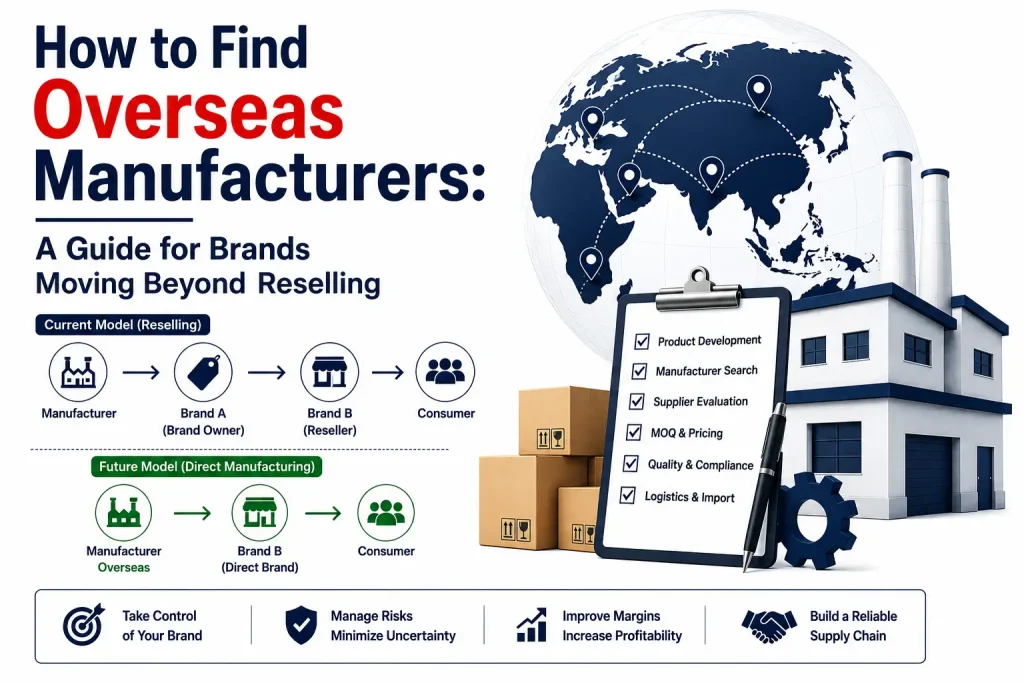
For many brands, reselling an established product is a simple way to enter a market. A brand can source products from another brand, list them on its website, and focus on sales and marketing.
However, this model can create limits over time. The brand may have little control over product cost, design, supply, and production capacity. As sales grow, direct manufacturing can become more attractive.
This is where brands start to find overseas manufacturers.
Moving from reseller to direct manufacturing, however, is not simply about finding a factory with a lower price. It means taking control of product development, tooling, quality, compliance, logistics, and supplier management.
For brands making this move, understanding the main risks can prevent costly mistakes.
Why Brands Move Beyond Reselling
A reseller often depends on another brand for product supply. This model works well when demand is small or when the reseller wants to test the market.
Over time, however, several problems can appear.
The reseller may face:
- Limited control over product pricing
- Limited control over product design
- Changes in product availability
- Higher wholesale costs
- Limited customization
- Competition from other resellers
- Dependence on one brand or supplier
Therefore, direct manufacturing can offer more control.
A brand can work with a manufacturer to develop its own product, control specifications, and build a longer-term supply chain.
However, the transition also creates new responsibilities.
How to Find Overseas Manufacturers
The first step is to define exactly what the manufacturer needs to produce.
A simple product description is often not enough. Manufacturers need enough information to understand the product, production process, materials, and expected quality.
Before contacting factories, prepare as much of the following information as possible:
- Product drawings or CAD files
- Product dimensions
- Material requirements
- Product photos or reference samples
- Target quantity
- Expected annual volume
- Packaging requirements
- Required testing
- Target market
- Target cost, if available
Then, create a shortlist of manufacturers based on their actual capabilities.
Do not select a factory based only on a website or a low quotation. Instead, review its equipment, experience, production process, quality system, export history, and ability to meet your requirements.
Start With the Product, Not the Factory
Many brands make the same mistake when they start sourcing.
They search for a factory first and only later define the product requirements.
Instead, start with the product.
The factory should understand:
- What the product must do
- Which materials it requires
- Which dimensions are critical
- What quality level you expect
- How the product will be tested
- How it will be packed and shipped
This approach makes supplier comparison easier.
It also reduces the risk of selecting a factory that looks suitable but cannot produce the product correctly.
MOQ Can Become a Major Barrier
Minimum order quantity, or MOQ, is one of the first challenges a reseller can face.
A brand may already have sales history, but that does not mean its volume is high enough for direct manufacturing.
For example, a reseller may sell 2,000 units per year. A manufacturer may require 5,000 or 10,000 units for one production run.
The gap creates a problem.
The brand must either increase its order quantity or find a manufacturer with a lower MOQ.
MOQ can also apply to individual variations.
For example, a factory may set separate minimums for:
- Different colors
- Different sizes
- Different models
- Different materials
- Different packaging options
Therefore, brands should calculate expected demand before negotiating with factories.
A low unit price is not useful if the required MOQ creates too much inventory.
Quantity and Forecast Risk
Manufacturing directly also changes how a brand manages demand.
When buying from another brand, the reseller can often reorder based on current sales. Direct manufacturing usually requires more planning.
The brand may need to forecast demand several months ahead.
That creates two risks.
If the forecast is too low, the brand may run out of stock. If the forecast is too high, the brand may hold excess inventory.
Therefore, brands should review:
- Current sales
- Seasonal demand
- Expected growth
- New customer demand
- Product life cycle
- Safety stock
- Production lead time
A good manufacturer can support the production plan, but the brand still owns the demand risk.
Tooling and Upfront Investment
Custom manufacturing often requires tooling.
Depending on the product, this may include molds, dies, fixtures, jigs, or other production tools.
The brand may need to pay for these tools before mass production starts.
This creates several questions:
- Who pays for the tooling?
- Who owns the tooling?
- Can the tool move to another factory?
- How long will the tool last?
- Who pays for tool maintenance?
- Can the manufacturer use the tool for another customer?
These points should be agreed upon before production begins.
Otherwise, a brand may invest heavily in tooling and later discover that moving to another supplier is difficult.
Design and Engineering Can Be More Difficult Than Expected
A reseller may know the product very well from a commercial perspective. However, that does not mean it has the technical information needed for manufacturing.
The original product may have been developed by Brand A and its existing manufacturer.
Brand B may only have access to the finished product.
In that case, the new manufacturer may need to develop the product from a sample.
This can involve:
- Measuring the existing product
- Creating drawings
- Developing CAD files
- Identifying materials
- Building prototypes
- Developing tooling
- Testing samples
- Making production adjustments
As a result, the project can become much more expensive than a simple sourcing exercise.
IP Can Be a Critical Issue
Intellectual property is one of the most important areas for a reseller moving into manufacturing.
A product may involve several types of IP.
These can include:
- Product design
- Patents
- Design rights
- Trademarks
- CAD files
- Proprietary materials
- Manufacturing know-how
- Tooling
A reseller cannot assume that buying a product gives it the right to reproduce that product.
For example, Brand B may legally resell Brand A’s product. That does not automatically give Brand B the right to copy the product and manufacture it under its own brand.
Therefore, Brand B should first understand what rights it has.
If necessary, the brand should also review agreements with Brand A and obtain appropriate legal advice before starting production.
Existing Factory Relationships Can Create a Conflict
This is a special challenge when the reseller wants to reproduce an established product.
Suppose Brand A already works with one of the best manufacturers in the market.
Brand B may identify the same factory and ask it to produce a similar product.
The factory may refuse.
Why?
The manufacturer may already have a strong relationship with Brand A. It may also have confidentiality obligations or commercial restrictions.
The factory may not want to risk an existing customer relationship.
This is especially important in product categories where only a few manufacturers have the required capability.
A leading factory may already serve the major brands in the market.
Therefore, Brand B has two choices.
It can try to negotiate with the existing manufacturer, or it can develop a new manufacturing partner.
Both options carry risks.
Developing a New Manufacturer Takes Time
A new supplier may offer a fresh start.
However, a new supplier also creates uncertainty.
The factory may have limited experience with the product. It may understand the basic manufacturing process but lack experience with the exact specifications.
This can lead to problems with:
- Product quality
- Material selection
- Production consistency
- Tooling
- Testing
- Production speed
- Cost control
Therefore, supplier qualification should happen before placing a large production order.
A small trial order or pilot production can help reduce the risk.
Product Quality Must Match the Existing Product
Brand B is not developing a product from zero.
Customers already know the product they are buying.
Therefore, the new product must meet the expected standard.
The new manufacturer may need to match:
- Dimensions
- Weight
- Material
- Color
- Surface finish
- Hardness
- Strength
- Performance
- Packaging
- Appearance
A sample can look correct but still fail during mass production.
For this reason, brands should define clear quality requirements before production starts.
A pre-production sample should also receive approval before mass production.
Testing and Compliance May Need to Start Again
A reseller may assume that the existing product already has all required testing.
That may not be enough.
When Brand B changes the manufacturer, material, design, or production process, existing test reports may not cover the new product.
Depending on the product category and market, the brand may need:
- Material testing
- Chemical testing
- Mechanical testing
- Safety testing
- Product performance testing
- Packaging testing
- Regulatory review
Therefore, compliance should become part of the sourcing plan from the beginning.
Testing should not be treated as the final step before shipment.
Materials and Components Can Be Hard to Replicate
The original manufacturer may have a well-established supply chain.
Brand B may not know where the factory buys its materials and components.
For example, the original factory may use a specific:
- Resin
- Rubber compound
- Fabric
- Metal component
- Coating
- Adhesive
- Color formulation
- Packaging material
A new manufacturer may suggest a substitute.
The substitute may reduce cost, but it can also change product performance.
Therefore, material approval is important when transferring production to a new supplier.
Cost Is More Than the Factory Price
One of the biggest mistakes is comparing only the quoted unit price.
The real cost includes much more.
A brand should consider:
- Product price
- Tooling
- Engineering
- Sampling
- Testing
- Quality inspection
- Packaging
- Freight
- Duties and tariffs
- Warehousing
- Inventory
- Payment terms
For example, a factory may offer a lower unit price but require a much higher MOQ.
Another factory may offer a higher unit price but support a smaller order.
The better option depends on the total supply chain cost.
Importing Adds New Responsibilities
A reseller buying from a US-based brand may have little experience with international importing.
Direct overseas manufacturing changes that.
The brand may now need to manage:
- International freight
- Customs clearance
- Import documentation
- Customs classification
- Duties and tariffs
- Importer responsibilities
- Customs brokers
- Cargo insurance
- Warehousing
Therefore, logistics planning should start before production.
The cheapest factory is not always the best option if the supply chain creates high landed costs or operational problems.
Quality Control Becomes the Brand’s Responsibility
When Brand B buys from Brand A, Brand A usually manages its own supplier relationships.
Once Brand B starts manufacturing directly, that responsibility moves to Brand B.
The brand needs a process for:
- Sample approval
- Material approval
- Pre-production inspection
- Production monitoring
- Final inspection
- Defect management
- Corrective actions
- Shipment approval
This is especially important for brands without an internal sourcing or quality team.
A factory should not be expected to manage its own quality without clear requirements and independent checks.
Working Capital Requirements Increase
Direct manufacturing also requires more cash.
The brand may need to pay for tooling before production. It may then pay a deposit for the production order.
After production, the brand still needs to pay for freight, duties, and warehousing.
At the same time, the finished goods may sit in inventory for weeks or months.
Therefore, the brand needs enough working capital to support the entire production cycle.
This can become a major barrier for smaller brands.
Channel Conflict With the Original Brand
There is another commercial risk that brands should consider.
Brand B may still sell Brand A’s products while developing its own competing product.
Brand A may see this as a threat.
The relationship could become difficult if Brand B:
- Copies a product too closely
- Competes directly on price
- Uses information obtained as a reseller
- Approaches Brand A’s manufacturer
- Uses Brand A’s product specifications
- Launches a competing product
Therefore, Brand B should review its commercial agreement with Brand A before starting direct manufacturing.
The sourcing strategy must protect the business relationship as well as the new supply chain.
Building a Backup Supplier
Finding one capable manufacturer is not always enough.
If the product is important to the business, Brand B should consider developing a second source.
A backup supplier can reduce risk when:
- The main factory reaches capacity
- Lead times increase
- Prices rise
- Quality declines
- Production stops
- Demand grows faster than expected
However, qualifying a backup supplier also takes time and money.
Therefore, supplier diversification should follow a clear risk-based plan.
A Practical Approach to Overseas Manufacturing
Brands do not need to solve every problem at once.
A structured process can reduce the risk.
Step 1: Define the Product
Prepare the available product information, samples, specifications, and packaging requirements.
Step 2: Review IP and Commercial Rights
Confirm that the brand has the right to develop and manufacture the product.
Step 3: Define the Target Volume
Estimate annual demand and realistic initial order quantities.
Step 4: Find Overseas Manufacturers
Shortlist manufacturers based on product capability rather than price alone.
Step 5: Qualify the Suppliers
Review equipment, experience, quality systems, capacity, materials, and export experience.
Step 6: Develop Samples
Use prototypes to confirm the design, materials, dimensions, and performance.
Step 7: Finalize Tooling and Testing
Confirm tooling ownership and complete the required product testing.
Step 8: Run a Pilot Production
Start with a controlled production run before committing to larger volumes.
Step 9: Inspect Before Shipment
Use clear quality requirements and independent inspection when appropriate.
Step 10: Build the Long-Term Supply Chain
After the first successful order, work on capacity planning, cost improvement, and backup suppliers.
When Should a Brand Use a Sourcing Partner?
Finding overseas manufacturers is only one part of the process.
For an experienced sourcing team, the work can include supplier research, qualification, product development, quality control, logistics, and supplier management.
For a small brand, managing all these areas internally can be difficult.
A sourcing partner can help the brand:
- Identify suitable manufacturers
- Compare supplier capabilities
- Manage factory communication
- Support product development
- Coordinate samples
- Review tooling
- Arrange quality inspections
- Support testing
- Manage production
- Develop backup suppliers
Most importantly, the goal should not be to find the cheapest factory.
The goal is to build a reliable manufacturing system that can support the brand as it grows.
Conclusion
Moving from reseller to direct manufacturing can give a brand more control over cost, product development, quality, and supply.
However, the transition also creates new risks. MOQ, tooling, engineering, IP, factory relationships, supplier qualification, testing, quality control, logistics, and working capital all need careful planning.
For that reason, brands should take a structured approach when they find overseas manufacturers.
The right manufacturer is not simply the factory with the lowest quotation. It is the partner that can meet the product requirements, support the expected volume, protect quality, and build a stable supply chain for the long term.
For brands ready to move beyond reselling, the right overseas manufacturing strategy can turn a dependent supply model into a more controlled and scalable business.