For many companies, supply chain diversification starts with one simple question: Where else can we manufacture outside China?
Vietnam, India, Thailand, Indonesia, Mexico, and other countries have become popular alternatives. This broader shift toward supply chain diversification is changing how global buyers evaluate manufacturing and sourcing options. However, moving final assembly to another country does not always reduce supply chain risk.
A product may be assembled in Vietnam while its materials, components, tooling, and machinery still come from China.
As a result, the factory location changes, but the supply chain dependency remains.
This is why companies need to look beyond the traditional China+1 strategy.
Supply chain diversification by layer offers a more complete approach. Instead of moving the entire supply chain to one new country, companies can diversify different layers across several sourcing locations.
The goal is simple: reduce single-country dependency while building a more flexible and resilient supply chain.
What Is Supply Chain Diversification by Layer?
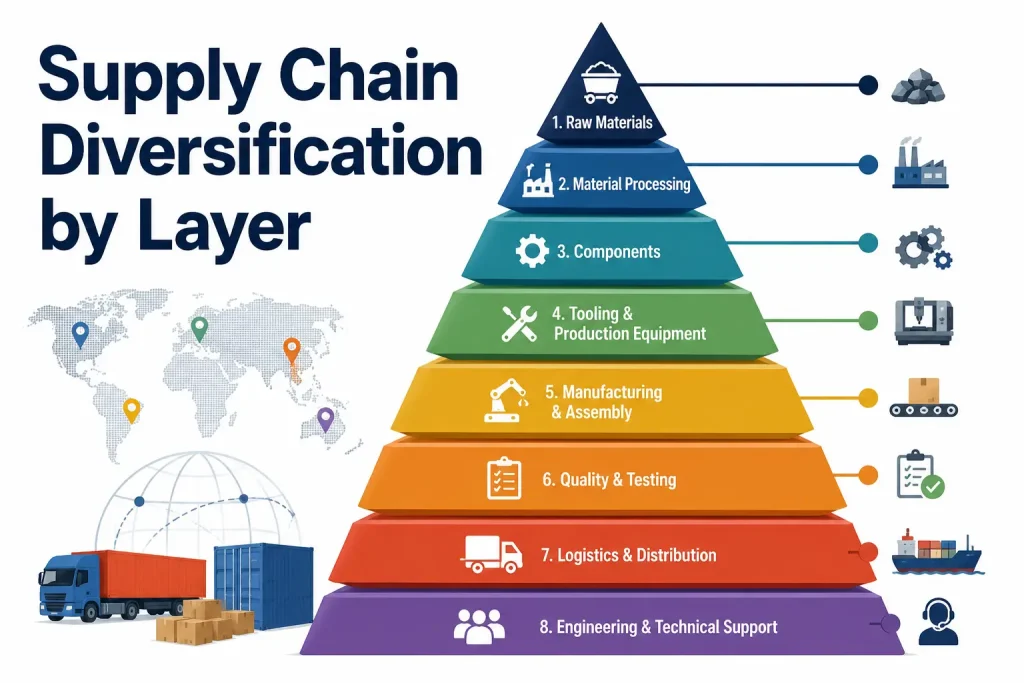
Supply chain diversification by layer means looking at each part of the supply chain separately.
A typical manufacturing supply chain includes:
- Raw materials
- Material processing
- Components
- Tooling and production equipment
- Manufacturing and assembly
- Quality and testing
- Logistics and distribution
- Engineering and technical support
Each layer can depend on a different country.
For example, a company could source raw materials from Vietnam, specialized components from China, electronics from South Korea, and final assembly from Vietnam.
This does not mean the company needs to eliminate China.
Instead, it reduces the risk of depending on one country for every critical part of production.
Why China+1 Is Not Always Enough
The China+1 strategy has become a common way to reduce manufacturing risk.
The idea is straightforward:
Keep China as one production base and add another country as an alternative.
For example:
China + Vietnam
This approach can work well. However, it can also create a false sense of diversification.
Consider a product assembled in Vietnam.
The factory may buy:
- Plastic resin from China
- Electronic components from China
- Steel parts from China
- Molds from China
- Production equipment from China
- Packaging materials from Vietnam
The final product may ship from Vietnam. However, several critical supply chain layers still depend on China.
Therefore, the real supply chain looks more like:
China → Materials → Components → Tooling → Vietnam Assembly → US Market
The company has moved assembly. It has not fully diversified the supply chain. This is the “+0.5” problem that many companies face when they try to implement China+1. Our analysis of the China Plus One reality explains why moving production does not always create a truly diversified supply chain.
That difference matters.
Supply Chain Diversification by Layer: The 8 Key Layers
A stronger strategy starts by mapping the supply chain layer by layer.
1. Raw Materials
Raw materials sit at the beginning of the supply chain.
Depending on the product, they may include:
- Steel
- Aluminum
- Plastic resin
- Rubber
- Cotton
- Chemicals
- Wood
- Glass
- Paper
- Other industrial materials
A company should ask where these materials come from.
More importantly, it should ask whether the material has another reliable source.
For example, moving plastic product manufacturing to Vietnam does not remove supply risk if the factory still depends on one overseas source for its resin.
Therefore, raw material sourcing should become part of the diversification plan.
2. Material Processing
Raw materials often require additional processing before manufacturers can use them.
For example:
Raw material → Processing → Usable industrial material
This layer can include:
- Metal processing
- Plastic compounding
- Chemical processing
- Textile processing
- Rubber compounding
- Mineral processing
This layer often receives less attention.
However, it can create a major dependency.
A country may have strong manufacturing capacity but limited local processing for certain materials.
As a result, manufacturers may still rely on imports for critical inputs.
3. Components
Components often represent a large part of a product’s supply chain.
They may include:
- Fasteners
- Motors
- Electronics
- Connectors
- Springs
- Plastic parts
- Metal parts
- Cables
- Batteries
- Sub-assemblies
Companies should map the source of critical components.
They should also identify which components have only one qualified supplier or one country of supply.
For example, a factory in Vietnam may produce a finished product locally. However, if 40% of the product’s critical components still come from one country, the supply chain remains exposed.
Therefore, component diversification can be just as important as factory diversification.
4. Tooling and Production Equipment
Tooling is another layer that companies often overlook.
Manufacturing may depend on:
- Injection molds
- Die-casting molds
- Stamping dies
- CNC fixtures
- Jigs
- Production machines
- Testing equipment
- Automation equipment
A factory may operate in Vietnam while its molds and production equipment come from China.
That is not necessarily a problem.
However, companies should understand the dependency.
For critical products, they should know where replacement tooling, spare parts, and technical support will come from.
This information helps buyers understand the real supply chain risk.
5. Manufacturing and Assembly
This is the layer most buyers see first.
It includes:
- Injection molding
- CNC machining
- Metal fabrication
- Casting
- Stamping
- Sewing
- Welding
- Surface finishing
- Product assembly
Vietnam has become an important option for many of these activities.
However, manufacturing location should not become the only measure of diversification.
Instead, buyers should connect manufacturing with the other supply chain layers.
A factory in Vietnam can become an important alternative production base. At the same time, buyers should understand which inputs still come from other countries.
6. Quality and Testing
Quality is another important part of a reliable supply chain.
Depending on the product, this may include:
- Product inspection
- Material testing
- Performance testing
- Certification
- Laboratory testing
- Measurement
- Compliance checks
Companies should understand where critical testing takes place.
They should also check whether local suppliers have the equipment and capability needed for the product.
This matters because production cannot scale smoothly if every important test requires a long external process.
7. Logistics and Distribution
Diversification does not stop at the factory gate.
Companies should also review:
- Ports
- Freight routes
- Warehousing
- Customs
- Inland transportation
- Distribution centers
- Logistics providers
For example, two factories may operate in different countries but depend on the same shipping route.
In that case, geographic diversification may not provide as much protection as expected.
Therefore, companies should consider both production risk and logistics risk.
8. Engineering and Technical Support
The final layer is knowledge.
This includes:
- Product engineering
- Process engineering
- Tooling design
- Technical support
- Maintenance
- Production know-how
- Supplier development
This layer can be difficult to measure.
However, it can become critical when a company moves production to a new country.
A factory may have good machines and workers. Yet, it may still depend on outside technical support for tooling, process development, or equipment maintenance.
Building local technical capability can therefore make diversification much stronger over time.
China+1 vs. China+N vs. Diversification by Layer
These three strategies are related, but they are not the same.
China+1
The company adds one alternative country.
Example:
China + Vietnam
This is often the easiest first step.
China+N
The company develops several alternative countries.
Example:
China + Vietnam + Thailand + India + Indonesia
This approach provides more options. However, it also requires more supplier management.
Diversification by Layer
The company chooses the best location for each important supply chain layer.
For example:
| Supply Chain Layer | Sourcing Location |
|---|---|
| Raw materials | Vietnam |
| Material processing | Thailand |
| Components | China |
| Electronics | South Korea |
| Assembly | Vietnam |
| Tooling | China / Vietnam |
| Logistics | Singapore / Vietnam |
| Market | United States |
This approach reflects how global supply chains actually work.
A company does not need to force every layer into one country.
Instead, it can build a network that uses the strengths of different countries.
A Simple Example: Moving Production From China to Vietnam
Consider a company that currently manufactures a product entirely in China.
Its supply chain looks like this:
China materials → China components → China assembly → US market
The company wants to reduce China dependency.
The first option is a basic China+1 strategy:
China materials → China components → Vietnam assembly → US market
This creates a second manufacturing location.
However, China still supports several important layers.
A more diversified model could look like:
Vietnam / Southeast Asia materials → Multi-country components → Vietnam manufacturing → Vietnam assembly → US market
The company can then gradually qualify alternative suppliers for critical materials and components.
It does not need to move everything immediately.
Instead, it can reduce dependency step by step.
How to Identify Hidden Supply Chain Dependencies
The first step is to ask better questions.
Do not ask only:
Where is your factory?
Also ask:
- Where do you source your raw materials?
- Where are your main components made?
- Where are your molds produced?
- Where does your factory buy machinery?
- Where do replacement parts come from?
- Which materials have only one source?
- Which components have only one qualified supplier?
- Which suppliers depend on one country?
- Where does critical testing take place?
- Which parts have the longest lead time?
- Which suppliers would be difficult to replace?
These questions reveal dependencies that a basic factory audit may miss.
Most importantly, companies should identify critical dependencies.
Not every component requires the same level of diversification.
A common screw may have many alternative sources.
A specialized electronic component may not.
Therefore, companies should focus first on the layers that could stop production.
Build a Supply Chain Diversification Strategy
For companies starting with China+1, the first step is to understand how to build an alternative sourcing base without creating unnecessary cost or complexity. Our guide to the China Plus One strategy provides a practical starting point.
Step 1: Map the Current Supply Chain
Start with the full product.
Map:
Materials → Components → Manufacturing → Assembly → Testing → Logistics
Then identify the country behind each layer.
Step 2: Identify Single-Country Dependencies
Look for areas where one country provides most or all of the supply.
Pay particular attention to critical materials and components.
Step 3: Rank Supply Chain Risks
Not every dependency needs immediate action.
Rank each layer based on:
- Business impact
- Availability of alternatives
- Lead time
- Cost
- Switching difficulty
- Supplier capacity
This helps prioritize the next steps.
Step 4: Find Alternative Suppliers
Search for suppliers in different countries.
Vietnam may be suitable for manufacturing, machining, plastics, rubber, metal fabrication, textiles, packaging, and other product categories.
Other layers may fit better in Thailand, India, Indonesia, South Korea, Japan, Mexico, or other markets.
The goal is not to find one country that does everything.
The goal is to find the right alternative for each important layer.
Step 5: Qualify and Test
Do not move critical production based only on a supplier’s capability statement.
Instead:
- Review samples
- Check quality
- Test materials
- Validate tooling
- Run pilot production
- Review lead times
- Compare costs
- Check export experience
This reduces the risk of moving too quickly.
Step 6: Build a Multi-Country Supply Network
Finally, create a supply network with realistic alternatives.
The goal is not to use every country.
Instead, maintain enough qualified options to keep production moving when market conditions change.
Where Vietnam Fits in Supply Chain Diversification
Vietnam can play an important role in a diversified supply chain.
Its strongest opportunity is not to replace every Chinese supplier.
Instead, Vietnam can provide alternative capacity across selected manufacturing layers.
Depending on the product, these may include:
- Product assembly
- Injection molding
- CNC machining
- Metal fabrication
- Rubber products
- Textiles
- Furniture
- Packaging
- Wood products
- Selected engineered products
At the same time, buyers should understand Vietnam’s limits.
Some advanced materials, electronics, chemicals, machinery, and specialized components may still come from other countries.
That is normal.
A strong supply chain does not need every layer in one country.
Instead, it needs enough qualified sources to reduce critical dependency.
The Goal Is Not to Eliminate China
Supply chain diversification does not mean removing China from every supply chain.
China remains a major manufacturing base with deep supplier networks, strong infrastructure, large production capacity, and broad material and component availability.
For many companies, China will remain part of the supply chain.
The bigger goal is to avoid putting every critical layer in one country.
A diversified supply chain may still include China.
However, it should also have qualified alternatives.
For example:
China for selected components + Vietnam for manufacturing + Thailand for materials + South Korea for electronics
This can create a more balanced supply network.
Therefore, diversification should focus on dependency, not ideology.
Why Supply Chain Diversification Matters More Today
Global supply chains now face more uncertainty than before. Tariffs, trade restrictions, and geopolitical tensions are also changing where companies manufacture and source. These geopolitical supply chain risks are making diversification an increasingly important part of manufacturing strategy.
Companies must consider:
- Tariffs
- Trade restrictions
- Shipping disruptions
- Labor costs
- Material prices
- Geopolitical risk
- Capacity shortages
- Supplier financial risk
- Changes in customer demand
A supply chain that depends too heavily on one country can become difficult to manage when conditions change.
However, diversification also has a cost.
Managing five suppliers across four countries is more complex than managing one supplier in one country.
Companies must balance:
Cost + Quality + Capacity + Risk + Flexibility
The right strategy is therefore not maximum diversification.
It is smart diversification.
From Factory Sourcing to Supply Chain Design
The next stage of global sourcing will go beyond finding a lower-cost factory.
Buyers will increasingly ask:
Where should each part of our supply chain be located?
That is a different question.
It changes the role of sourcing from factory selection to supply chain design.
Instead of asking:
“Which country can make this product?”
Companies can ask:
“Which countries should support each critical layer of this product?”
That approach creates a more flexible supply network.
It also gives companies more options when costs, tariffs, capacity, or market conditions change.
Conclusion
Supply chain diversification is no longer just about moving production from one country to another.
The China+1 strategy remains useful. However, it does not always address the deeper dependencies inside a global supply chain.
Supply chain diversification by layer provides a more complete approach.
Companies can map raw materials, processing, components, tooling, manufacturing, testing, logistics, and technical support. Then, they can identify which layers need alternative sources.
Vietnam can play an important role in this strategy. Yet, the objective should not be to replace China with Vietnam across the entire supply chain.
The better goal is to build a flexible network where different countries support different layers.
In the end, supply chain resilience does not come from finding one new country.
It comes from creating more than one path to keep the business moving.