When US buyers compare Vietnam and China, product pricing is often one of the first questions.
At first, a Vietnam factory may appear more expensive. In other cases, the initial quote may look very competitive. However, the quoted price does not always tell the full story.
The way a factory calculates and negotiates price can differ by country, factory, owner, and customer.
This is especially important when working with privately owned factories in Vietnam. Many Vietnamese factory owners have less experience working with US buyers than their Chinese counterparts. As a result, the negotiation process can sometimes depend more on business relationships and personal trust.
Understanding this difference can help buyers approach Vietnam manufacturing cost negotiation in a more effective way.
Why Manufacturing Pricing Is More Than a Quotation
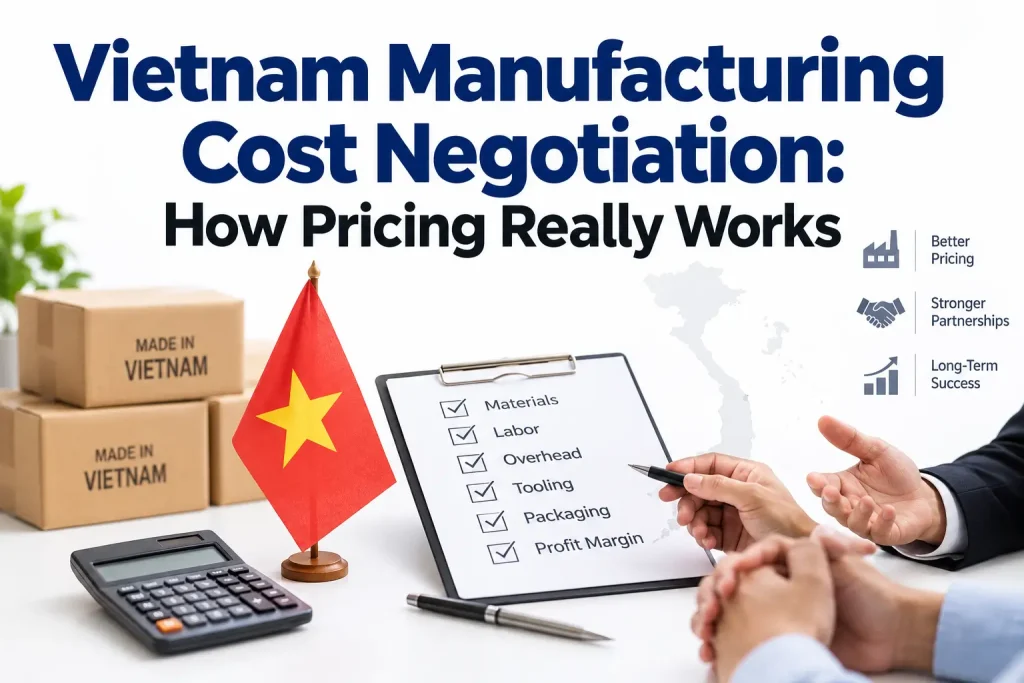
A factory price usually includes several cost elements.
These may include:
- Raw materials
- Labor
- Machine time
- Factory overhead
- Tooling and molds
- Packaging
- Quality control
- Profit margin
- Payment terms
- Production volume
- Order risk
However, the final price is not always calculated in the same way by every factory.
For example, an experienced export factory may calculate each cost carefully before giving a quote. Another factory may start with a target price based on the customer, order size, and expected relationship.
Therefore, buyers should not look at the quoted unit price alone.
The key question is:
How did the factory arrive at that price?
How Experienced China Factories Approach Price Negotiation
Many Chinese factory owners have spent years working with international customers.
They may have experience with US buyers, European buyers, trading companies, sourcing agents, and large international brands.
Because of this experience, price discussions can become highly detailed.
An experienced factory may consider:
- Material cost
- Material yield
- Labor time
- Machine capacity
- Production efficiency
- Factory overhead
- Tooling cost
- Packaging cost
- Order quantity
- Payment terms
- Shipping terms
- Expected annual volume
- Target profit margin
As a result, the factory owner may know exactly where there is room to reduce cost.
For example, a buyer may ask for a 5% price reduction.
The factory may then review the main cost drivers instead of simply saying yes or no.
They may ask:
- Can the material specification change?
- Can the packaging be simplified?
- Can the order quantity increase?
- Can production be scheduled during a lower-load period?
- Can payment terms improve?
- Can tooling cost be spread across a larger order?
This makes the negotiation more like a commercial calculation.
In other words, the discussion often focuses on which cost can change.
Why Vietnam Manufacturing Cost Negotiation Can Feel Different
Vietnam has a growing manufacturing base. However, many locally owned factories have less experience with US customers than established Chinese export factories.
This does not mean Vietnamese factories are less capable.
In fact, many Vietnamese factories have strong equipment, skilled workers, and good production capabilities.
However, their approach to commercial negotiation can sometimes be different.
For some factory owners, the relationship with the customer matters greatly.
The owner may consider questions such as:
- Do I trust this customer?
- Is this customer easy to work with?
- Does the customer communicate clearly?
- Does the customer pay on time?
- Could this customer bring more business?
- Do I want to build a long-term relationship with this buyer?
Therefore, the price may not always come from a detailed cost calculation alone.
Instead, the owner may adjust the price based on the overall business relationship.
Relationship Can Influence Factory Pricing
This relationship-driven approach is common in many business cultures. Vietnam is no exception.
For example, two customers may request the same product from the same factory.
Both customers may have the same order quantity.
Yet, the factory owner may not offer exactly the same commercial terms.
Why?
The factory may have different levels of trust in each customer.
One customer may have worked with the factory for several years. Another customer may be placing the first order.
Similarly, one customer may communicate well and provide clear forecasts. Another may frequently change specifications or delay decisions.
Consequently, the factory may view the two customers as having different levels of business risk.
This can affect the final price.
Building a strong supplier relationship can therefore create value beyond the initial quotation. For more on this topic, see building supplier relationships to reduce manufacturing costs.
This Does Not Mean Every Vietnam Factory Works This Way
It is important to avoid treating this as a rule.
Vietnam has many factories with strong international experience.
Some have worked with US customers for decades. Others operate as part of larger international manufacturing groups.
These factories may use detailed cost models and structured pricing systems.
Therefore, the difference is not simply:
China = professional pricing
and
Vietnam = relationship pricing
The real difference is often related to factory maturity, export experience, ownership structure, customer base, and management style.
Ownership structure is particularly important because Vietnam’s manufacturing sector includes several different factory types. Understanding whether you are working with a local factory, Chinese-invested manufacturer, FDI company, or state-owned enterprise can provide useful context when evaluating pricing and negotiation style. See our guide to Factory Types in Vietnam for more details.
A newer Vietnam factory may negotiate very differently from an established Vietnam factory.
Likewise, a small Chinese factory may negotiate differently from a large Chinese export manufacturer.
For buyers, this distinction is important.
What US Buyers Should Expect When Negotiating in Vietnam
US buyers entering Vietnam should prepare for a different negotiation process.
First, do not assume that the first quotation represents the factory’s final cost.
However, do not assume that the factory has a large hidden margin either.
Instead, ask questions that help explain the quotation.
For example:
- What are the main cost drivers?
- What material specification is included?
- What production volume was used for the quotation?
- Does the price include packaging?
- Does the price include tooling?
- What production efficiency does the factory expect?
- What annual volume could support a lower price?
- Which specifications could reduce cost?
- What payment terms were used for the calculation?
These questions move the discussion from “Can you lower the price?” to “How can we lower the cost?”
That is usually a more productive conversation.
How to Get Better Pricing From Vietnam Suppliers
Price negotiation should start before the final quotation.
First, make the product specification as clear as possible.
A factory cannot give a meaningful price if important information is missing.
For example, the buyer should define:
- Product dimensions
- Material
- Finish
- Color
- Packaging
- Quality requirements
- Testing requirements
- Order quantity
- Annual volume
- Delivery requirements
Next, separate the product cost from other costs.
For example, ask the factory to show:
Product price + tooling + packaging + testing + other charges
This makes the quotation easier to compare.
Also, discuss volume.
A factory may not reduce the price for an order of 1,000 units. However, the same factory may offer a different price for 10,000 or 50,000 units.
Therefore, buyers should share realistic volume expectations whenever possible.
Do Not Negotiate Only on Unit Price
A lower unit price is not always a lower total cost.
For example, a factory may offer a lower product price but require:
- Higher MOQ
- Larger tooling investment
- Less flexible payment terms
- More expensive packaging
- Longer production time
- Higher inspection costs
As a result, the buyer may save on the unit price but lose money elsewhere.
A better approach is to evaluate the total manufacturing cost.
This includes both direct and indirect costs.
For example:
Total Cost = Product Cost + Tooling + Packaging + Testing + Quality Costs + Logistics
The exact calculation will depend on the product and sourcing model.
Still, this approach gives buyers a clearer view of the real cost.
Use Benchmark Pricing During Negotiation
Buyers should also use market benchmarks.
If you receive quotes from several qualified factories, compare them carefully.
Do not compare price alone.
Compare:
- Material specifications
- Product quality
- Production process
- MOQ
- Tooling
- Packaging
- Payment terms
- Lead time
- Certifications
- Quality control
- Factory capabilities
For example, one factory may quote $5.00 while another quotes $5.40.
The $5.00 quote may look better at first.
However, if the $5.40 factory uses better material, includes better packaging, and has lower quality risk, the difference may not be significant.
Therefore, price should always be evaluated together with the full commercial offer.
Why Long-Term Relationships Can Improve Cost
Relationship building does not mean paying a higher price to maintain a friendly relationship.
Instead, a strong relationship can improve communication and reduce business friction.
Over time, a factory may understand the buyer’s requirements better.
The buyer may also understand the factory’s cost structure better.
This can create several benefits:
- Faster quotation
- Better communication
- More flexible production support
- Faster problem solving
- Better payment discussions
- Better planning
- More openness about cost drivers
Furthermore, repeat orders give the factory more confidence.
The factory can plan production more efficiently. The buyer can also provide better forecasts.
As a result, both sides may find opportunities to reduce cost.
Vietnam Manufacturing Cost Negotiation Requires a Different Mindset
The most effective approach is not to treat Vietnam as a cheaper version of China.
Vietnam has its own manufacturing ecosystem and business culture.
Some factories are highly experienced in international trade. Others are still developing their export business.
Therefore, buyers should first understand the factory they are dealing with.
Ask:
How experienced is this factory with US customers?
Then ask:
How does the owner calculate pricing?
Finally, ask:
What factors could realistically reduce the cost?
These questions provide much more useful information than simply asking for a lower price.
A Practical Negotiation Approach for US Buyers
A simple process can make Vietnam price negotiation easier.
1. Build a clear RFQ
Give the factory complete product information.
This reduces assumptions and prevents hidden cost differences.
2. Request a detailed quotation
Ask the factory to separate product cost, tooling, packaging, testing, and other charges.
3. Benchmark multiple factories
Compare qualified factories using the same specifications.
4. Understand the owner’s pricing logic
Ask what factors drive the quoted price.
5. Discuss cost reduction, not only price reduction
Look for changes in material, packaging, volume, production method, or order planning.
6. Build the relationship
Good communication and reliable business behavior can create more flexibility over time.
7. Review total cost
Finally, calculate the complete manufacturing and supply chain cost.
This approach gives buyers a better basis for negotiation.
Vietnam vs. China: What Buyers Should Understand
Vietnam and China should not be viewed simply as two countries competing on factory price.
Their manufacturing ecosystems are different.
China has a very large and mature export manufacturing base. Many factory owners have extensive experience negotiating with international buyers.
Vietnam has developed rapidly as an alternative manufacturing location. However, supplier experience varies widely.
Therefore, buyers may encounter more variation in pricing behavior in Vietnam.
Some factories will provide highly structured cost calculations.
Others may place more weight on the customer relationship.
Both approaches exist.
The buyer’s job is to understand which type of supplier they are dealing with.
Conclusion
Vietnam manufacturing cost negotiation is not simply about asking a factory to lower its price.
The real process involves understanding how the factory calculates cost, how the owner views risk, and how the business relationship affects commercial decisions.
Experienced China factories may often approach negotiation through detailed cost calculations because of their long history with international buyers.
Meanwhile, some Vietnam factories may place greater importance on trust, relationship, customer potential, and long-term cooperation.
However, this difference does not apply to every factory.
For US buyers, the best starting point is a clear RFQ, realistic volume information, detailed cost questions, and a comparison of total manufacturing cost.
Most importantly, buyers should learn how the supplier thinks about price.
Once that becomes clear, price negotiation becomes much more than asking for a discount. It becomes a practical discussion about how both sides can reduce cost while maintaining quality and a sustainable supplier relationship.