For nearly 10 years, the world has discussed the “China+1” strategy. The goal was simple: reduce dependence on China by moving manufacturing to countries like Vietnam, Mexico, India, and Southeast Asia.
However, the reality is more complex.
China remains the “factory of the world” and still sits at the center of global manufacturing. Therefore, after nearly a decade of China+1, the #1 position has not truly been replaced.
At the same time, the market is clearly seeing border shifts in manufacturing activities. Companies are diversifying production, while Chinese manufacturers continue expanding overseas.
To better understand the China+1 model, find out more here: What Is China Plus One Strategy?
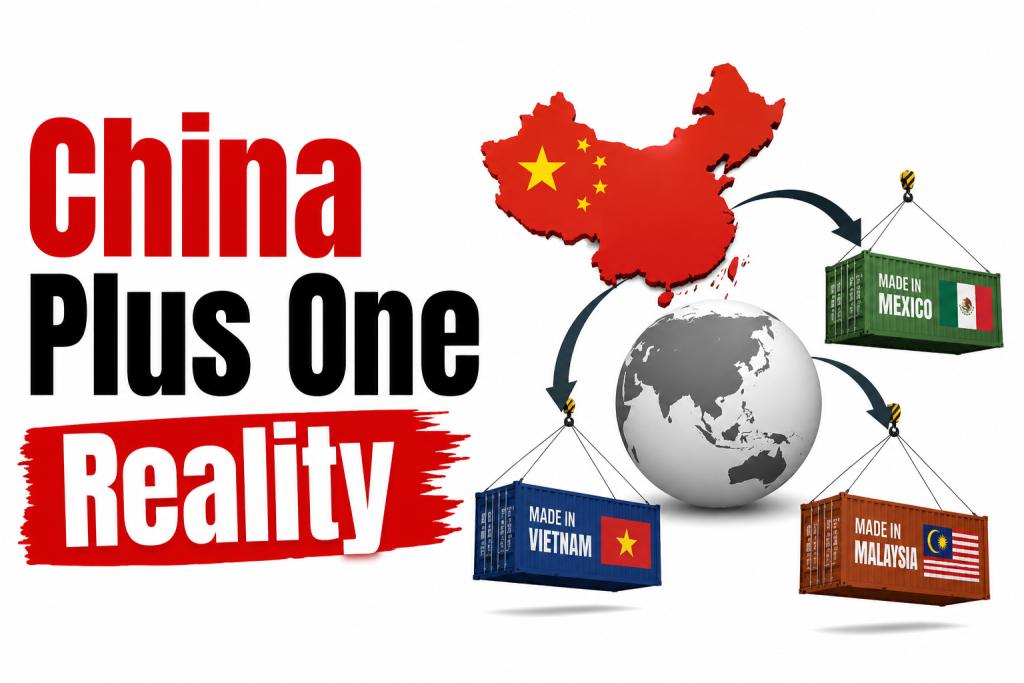
China Plus One Reality: China Still Sits at the Center of Global Manufacturing
Although many factories moved out of China, the global supply chain still depends heavily on Chinese industrial ecosystems.
China continues to dominate:
- Raw materials
- Industrial chemicals
- Electronics components
- Tooling and molds
- Machinery
- Industrial clusters
- Supply chain speed
As a result, many countries outside China still rely on Chinese upstream suppliers.
For example:
- A factory in Vietnam may assemble products locally.
- However, materials and components often still come from China.
- Therefore, the final product may say “Made in Vietnam,” while the supply chain behind it remains Chinese-centered.
There Is a Border Shift in Manufacturing
Although China remains dominant, manufacturing activities are clearly expanding into other countries.
Find out more here: Vietnam Factories Status: A Strategic Move Amidst Global Shifts
In 2026, this trend continues strongly in Vietnam. However, the global economy remains slower because interest rates are still high. As a result, many companies continue delaying inventory purchases and expansion plans.
Nevertheless, the long-term trend still points toward diversification.
In the coming years:
- Lower interest rates may support demand recovery.
- U.S. consumption could become stronger again.
- Global buyers may continue shifting partial production outside China.
At the same time, Chinese FDI continues flowing into Vietnam throughout 2026.
Many Chinese manufacturers are:
- Expanding factories
- Leasing industrial land
- Building supplier networks
- Moving selected production lines into Vietnam
Therefore, Vietnam continues benefiting from the China+1 movement.
Have Other Countries Truly Competed With China?
The short answer is: not yet.
In the short term, replacing China is extremely difficult.
More importantly, directly competing against China may even be the wrong strategy.
Find out more here: Why “Competing With China” Is the Wrong Starting Point
China built its manufacturing ecosystem over several decades. Today, the country still offers:
- Deep supplier networks
- Skilled industrial labor
- Fast tooling capabilities
- Strong logistics systems
- Massive production scale
As a result, most countries still cannot fully match China’s industrial efficiency.
China Is Globalizing Its Supply Chain Model
China is not standing still while losing market share. Instead, Chinese manufacturers are globalizing their supply chain model.
Southeast Asia Expansion
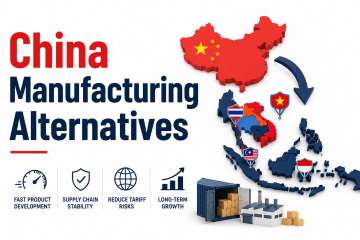
Chinese factories continue expanding into: Vietnam, Thailand or Malaysia.
This strategy helps companies use FTAs like CPTPP and RCEP, reduce tariff risks, and export to the U.S. and Europe more efficiently.
Nearshoring Into Mexico
At the same time, Chinese EV and component companies continue building factories in Mexico. Many projects are concentrated near the U.S. border, especially in Nuevo León.
This strategy helps suppliers access the North American market, benefit from USMCA, and reduce “Made in China” exposure.
As a result, China is transforming from “the centralized factory of the world” into “the manager of a global manufacturing network.”. Products may now say “Made in Vietnam” or “Made in Mexico” instead of “Made in China.”
However, the capital, technology, and upstream ecosystem often still remain connected to China.
China Plus One Reality: Why It Still Looks Like +0.5
The original idea behind China+1 was simple:
- Keep part of manufacturing in China
- Build a second independent manufacturing base elsewhere
However, reality developed differently.
Instead of creating fully independent supply chains, many companies created what is often called supply chain transshipment.
Find out more here: Vietnam Transshipping: What Global Buyers Should Know
Chinese Manufacturing Relocation
When U.S. buyers requested production shifts away from China after tariffs, many Chinese manufacturers quickly relocated selected operations into: Vietnam, Malaysia, and Mexico.
However: Machinery, engineers, and materials often still came from China.
Low Domestic Value Creation
Many “+1” countries mainly handle: Assembly, packaging, and final processing.
Meanwhile, higher-value activities still remain inside China.
These include: Material production, advanced manufacturing, industrial engineering, and component ecosystems.
The Math Behind +0.5
In many cases: Exports from Vietnam to the U.S. increase, while Vietnam’s imports from China also rise sharply at the same time.
As a result: China still captures much of the upstream value, while local economies mainly capture labor and logistics margins.
Therefore, from 2017 to 2026:
China+1 often looks more like China + 0.5 rather than a full replacement model.
Geopolitical Supply Chains Are Reshaping Manufacturing
The global manufacturing system is now entering a new phase.
Find out more here:
- Geopolitical Supply Chains: How Globalization 2.0 Is Reshaping Manufacturing in 2026
- From Trade War to Supply Chain Diversification: What Changes After Trump’s 2026 China Visit?
Today, supply chain decisions are no longer based only on: Cost, labor, and manufacturing capability.
Now, companies must also consider:
- Tariffs
- Geopolitical risks
- Trade agreements
- National security concerns
- Supply chain resilience
As a result, diversification will likely continue over the next decade.
Conclusion
China+1 is real. Manufacturing diversification is happening across Vietnam, Mexico, India, and Southeast Asia.
However, the world has not truly reached a full “+1” yet.
Instead, the global economy is moving toward a distributed manufacturing model where China still controls a large part of the upstream ecosystem.
Therefore, the current reality looks closer to:
- China + 0.5
rather than: - China fully replaced
In the coming years, diversification will likely continue. Nevertheless, China will probably remain one of the most important manufacturing centers in the world for a long time.