Introduction
Many buyers are expanding their supply chains outside Mainland China. As a result, Vietnam, Thailand, Malaysia, and Indonesia have become important sourcing destinations.
However, many buyers have the same expectation. They want supplier information, product reviews, and quotations within a few days.
This approach may work for simple products. However, it is much more difficult for complex engineering projects.
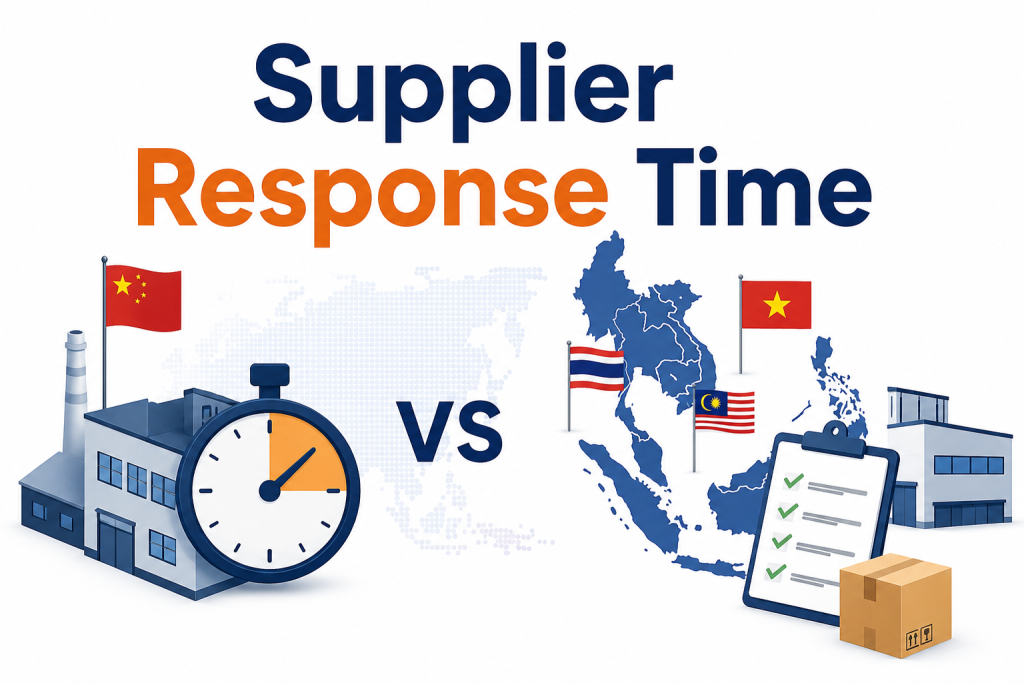
In many cases, buyers compare supplier response speed between Mainland China and Southeast Asia. Unfortunately, they often compare two completely different sourcing environments.
Supplier Response Time is not only about sending an email and waiting for a quotation. Instead, it depends on technical knowledge, supplier relationships, and purchasing power.
Understanding this difference can save significant time during supplier development.
Why Supplier Response Time Is Different Between Mainland China and Southeast Asia
Many people think Southeast Asia is completely independent from China. However, this is not always true.
In fact, many factories in Vietnam and Thailand are Chinese-owned factories operating outside China.
Therefore, supplier capability depends more on the factory itself than on the country.
At the same time, supplier ecosystems are very different.
Mainland China has:
- Large supplier networks
- Mature engineering teams
- Faster internal communication
- Strong export experience
Meanwhile, Southeast Asia has:
- Fewer supplier options
- Smaller engineering teams
- More limited technical resources
- Longer supplier qualification processes
As a result, Supplier Response Time is usually longer in Southeast Asia.
Supplier Response Time Depends on Product Complexity
Many sourcing projects are not regular products.
Instead, they are engineered products that require technical review before suppliers can provide quotations.
Examples include:
- NSF certified hoses
- Pillow bearings
- Aluminum mudguards
- HVAC insulation products
- Custom rubber components
For these products, suppliers cannot simply calculate material costs and send pricing.
First, they need to review several factors:
- Product drawings
- Technical specifications
- Material requirements
- Certifications
- Manufacturing processes
Therefore, the quotation process naturally takes more time.
Supplier Response Time Starts With Product Understanding
Many sourcing delays happen before suppliers even start working.
Sometimes, the team does not fully understand the product.
As a result, suppliers receive incomplete information.
This creates several problems:
- Suppliers ask multiple clarification questions.
- Different suppliers interpret requirements differently.
- Engineering teams need extra review cycles.
- Quotation timelines become longer.
Therefore, technical understanding is extremely important from the beginning.
For high engineering projects, companies should assign people who can properly understand:
- Drawings
- Manufacturing methods
- Material specifications
- Certification requirements
A wrong technical assumption at the beginning can delay the entire sourcing process.
Why Existing Supplier Relationships Matter
Supplier Response Time also depends on relationships.
Suppliers prioritize customers differently.
If suppliers already know your company, they usually respond faster.
This is especially true for China-based suppliers.
Strong purchasing relationships create several advantages:
- Faster communication
- Faster engineering review
- Faster quotations
- Higher priority during busy periods
On the other hand, new customers often enter the normal supplier queue.
Therefore, response time becomes slower.
Building relationships may take time initially. However, future projects become much faster.
Purchasing Power Directly Affects Supplier Response Time
Purchasing power is another important factor.
Suppliers invest more resources when they see long-term business opportunities.
This does not mean buyers must have huge volumes today.
Instead, suppliers want to understand future business potential.
Companies should clearly communicate:
- Existing manufacturing facilities
- Customer base
- Long-term sourcing plans
- Expansion strategies
This approach creates stronger supplier confidence.
As a result, suppliers become more willing to support engineering projects quickly.
What Is a Realistic Timeline for Complex Engineering Projects?
Many buyers expect results within three days.
However, this expectation is often unrealistic for new suppliers.
A more realistic timeline may look like this:
Within 24 hours
- Market insights
- Initial supplier recommendations
- Supplier capability assessment
Over the next 3 to 7 days
- Product review
- Engineering discussions
- Initial quotations
During the following 1 to 2 weeks
- Technical clarifications
- Supplier refinement
- Final quotation adjustments
Of course, timelines can be shorter if supplier relationships already exist.
Otherwise, engineering projects need additional time.
How Companies Can Improve Supplier Response Time
As a result, companies can improve sourcing speed with a better process.
First, engineering teams and sourcing teams should work closely together.
Second, communication with suppliers should be clear and consistent.
Third, technical information should be complete before contacting suppliers.
Companies should focus on these areas:
- Share accurate drawings and specifications
- Build long-term supplier relationships
- Prioritize suppliers with existing partnerships
- Strengthen purchasing power in target countries
- Collaborate closely between sourcing and engineering teams
Small improvements can create significant time savings.
Conclusion
Many companies believe sourcing outside Mainland China will automatically create faster and better results.
However, reality is more complex.
Supplier Response Time depends on technical understanding, supplier relationships, purchasing power, and product complexity.
For simple products, supplier response can be very fast.
However, complex engineering projects require additional review and communication.
Therefore, companies should adjust their expectations and sourcing strategies.
A strong collaboration model will always deliver better results than simply pushing suppliers for faster quotations.
In the end, understanding how suppliers work is often more important than finding more suppliers.