In 2017, the United States started a major trade war with China. Since then, global supply chains have changed quickly. Many companies started reducing risk by moving part of their production outside China.
At the same time, countries like Vietnam, India, and Mexico gained more manufacturing investment. COVID-19 also pushed companies to diversify suppliers and production locations faster.
Now, after Donald Trump’s second China visit in May 2026, many businesses are asking the same question. Will manufacturing outside China continue, or will companies move back to China again?
Overall, the answer is clear. Supply chain diversification will continue. However, the strategy will become more practical and more selective.
Why Manufacturing Outside China Started After the 2017 Trade War
Before 2017, many global companies depended heavily on China. The country offered:
- strong supplier networks,
- low production cost,
- skilled labor,
- fast logistics,
- and large factory capacity.
However, the US-China trade war changed business thinking.
The United States added tariffs on many Chinese products. Meanwhile, China also responded with tariffs and trade restrictions.
As a result, companies started looking for backup manufacturing locations.
Many buyers wanted to:
- reduce tariff risk,
- avoid supply chain disruption,
- diversify suppliers,
- and improve flexibility.
Therefore, the “China+1” strategy became popular across many industries.
How COVID Accelerated Manufacturing Outside China
COVID-19 created another major supply chain shock.
During the pandemic:
- factories stopped production,
- shipping costs increased,
- ports faced congestion,
- and buyers struggled to secure inventory.
As a result, companies realized that depending on one country created serious risk.
Therefore, many businesses accelerated manufacturing outside China after 2020.
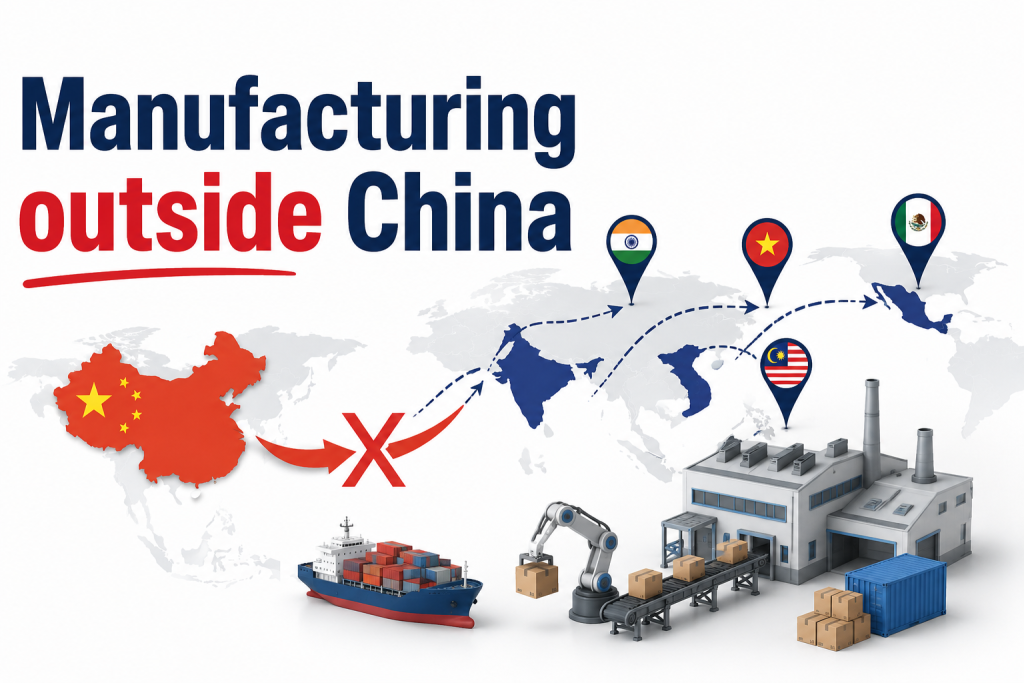
Companies started sourcing from:
- Vietnam,
- India,
- Thailand,
- Malaysia,
- and Mexico.
At the same time, many firms kept part of their operations in China. Instead of leaving China completely, they added secondary manufacturing locations.
This approach helped companies reduce risk while maintaining stable production.
What Trump’s 2026 China Visit Means for Global Supply Chains
Trump’s 2026 China visit signals a different phase in US-China relations.
In 2017, the focus centered on confrontation and tariffs. However, the 2026 visit focuses more on stability and business confidence.
Recently, both countries faced tension again because of:
- tariffs,
- export controls,
- semiconductor restrictions,
- and rare earth supply concerns.
Therefore, many businesses worried about another major supply chain shock.
However, the 2026 visit may temporarily reduce some uncertainty.
As a result, companies may feel more confident when planning:
- sourcing strategies,
- factory expansion,
- inventory management,
- and long-term supply agreements.
Still, the visit does not reverse global diversification trends.
Why Manufacturing Outside China Will Continue in 2027
Manufacturing outside China will likely continue through 2027 and beyond.
However, the strategy now looks different from earlier expectations.
In 2017, some people believed companies could fully leave China. Today, businesses understand that China remains extremely important in global manufacturing.
China still offers:
- deep supplier ecosystems,
- strong infrastructure,
- advanced industrial clusters,
- and high production efficiency.
Therefore, many companies no longer aim for “full decoupling.”
Instead, they focus on:
- reducing strategic risk,
- improving flexibility,
- and building regional supply chains.
As a result, companies now prefer balanced sourcing models.
For example:
- China remains the main production base,
- while Southeast Asia supports diversification,
- and Mexico supports nearshoring for the US market.
Nearshoring and Friend-Shoring Are Reshaping Supply Chains
Today, businesses use new supply chain strategies more often.
These strategies include:
- nearshoring,
- friend-shoring,
- and regional manufacturing.
Nearshoring means moving production closer to the customer market. Therefore, Mexico continues gaining investment from US companies.
Meanwhile, friend-shoring means sourcing from politically friendly countries.
As a result, countries like Vietnam and India continue attracting manufacturing projects.
However, companies no longer move production only because of labor cost. Today, they also consider:
- political stability,
- logistics,
- tariff exposure,
- and long-term supply chain security.
Therefore, supply chain decisions have become more strategic than before. Find out more here Geopolitical Supply Chains: How Globalization 2.0 Is Reshaping Manufacturing in 2026
Why Vietnam Still Benefits From Manufacturing Outside China
Vietnam continues benefiting from supply chain diversification.
The country offers several advantages:
- competitive labor cost,
- growing manufacturing experience,
- strong export growth,
- and improving infrastructure.
In addition, Vietnam already supports many industries, including:
- furniture,
- textiles,
- electronics,
- packaging,
- and consumer products.
Meanwhile, many buyers now view Vietnam as part of a long-term sourcing strategy instead of a short-term alternative.
However, Vietnam also faces challenges:
- rising labor costs,
- infrastructure pressure,
- limited supplier depth in some sectors,
- and strong competition from India and Mexico.
Still, Vietnam remains one of the strongest manufacturing alternatives in Asia.
What Businesses Should Expect Next
Global supply chains will likely remain diversified over the next few years.
However, businesses now understand that complete separation from China is unrealistic for many industries.
Therefore, companies will probably continue using a balanced approach:
- keep core production in China,
- expand secondary production in other countries,
- and reduce dependence on one location.
At the same time, strategic industries like:
- AI,
- semiconductors,
- telecom,
- and advanced technology
will likely face tighter controls and stronger competition.
Meanwhile, consumer goods and traditional manufacturing may remain more stable.
Overall, businesses now focus more on flexibility than full relocation.
Conclusion
Nearly ten years after the US-China trade war began, global supply chains continue changing. However, the direction today looks more practical than before.
Manufacturing outside China still continues because companies want flexibility, risk reduction, and supply chain security. At the same time, China remains a critical part of global manufacturing.
Trump’s 2026 China visit may reduce short-term tension and improve business confidence. However, it does not reverse the long-term diversification trend already shaping global supply chains.
Instead, the world is moving toward a more balanced supply chain structure. China remains the core manufacturing hub, while countries like Vietnam, India, and Mexico continue supporting diversification and regional production.