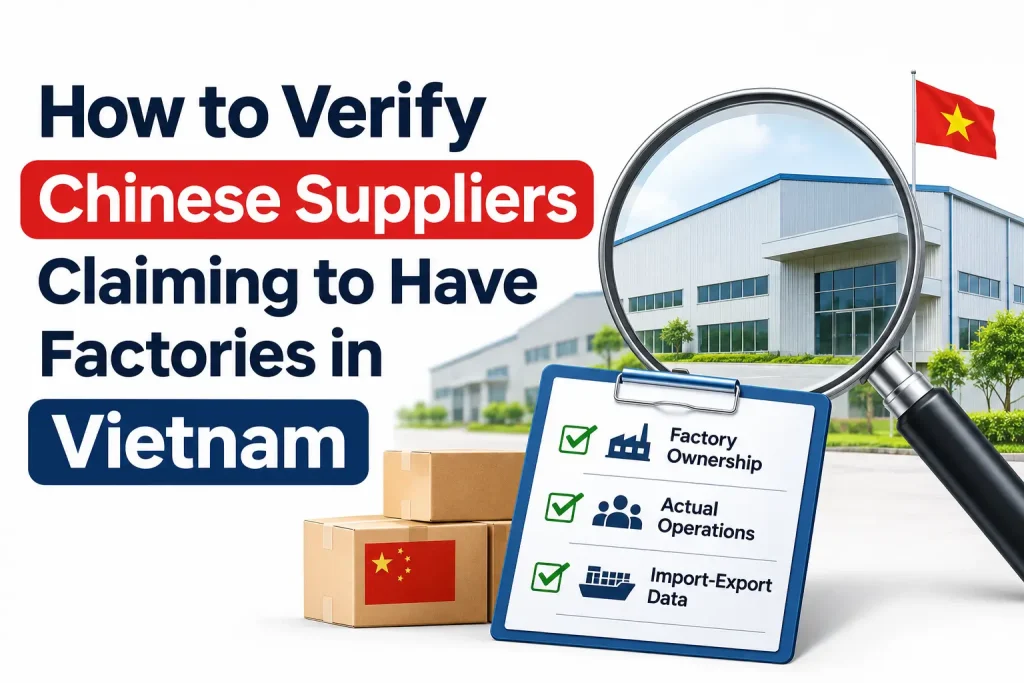
Many Chinese suppliers claim to operate factories in Vietnam. However, some only work with other Chinese companies that own or manage factories in the country.
This creates risks for buyers seeking direct manufacturing partners. A supplier’s website or factory photos do not prove ownership or actual production capacity.
Therefore, buyers should verify company records, local operations, and trade data before choosing a Vietnam manufacturing partner.
Why Chinese Suppliers Claim to Have Factories in Vietnam
The shift from China to Vietnam has encouraged many Chinese manufacturers to expand their business into Southeast Asia. However, not every supplier that advertises a Vietnam factory has direct manufacturing operations there.
In reality, several business models can exist behind these claims.
1. Direct Factory Ownership
Some Chinese manufacturers have invested in and established their own factories in Vietnam. They may operate through a Vietnamese subsidiary or a locally registered manufacturing company.
In this case, the supplier may control:
- Factory facilities and production equipment
- Local employees and production teams
- Manufacturing processes and quality control
- Factory management and daily operations
This is a more direct manufacturing structure. However, buyers should still verify the legal entity and actual production activities.
2. Partnership with Another Chinese Factory
Some Chinese suppliers do not own or operate factories in Vietnam. Instead, they partner with another Chinese company that already has manufacturing facilities in the country.
For example, Company A in China may advertise a Vietnam factory on its website. However, the actual factory belongs to Company B, another Chinese company with operations in Vietnam.
Company A may manage customer relationships, product development, and orders. Meanwhile, Company B handles production.
This arrangement is not necessarily a problem. However, buyers should understand who controls production and who takes responsibility for quality.
3. Subcontracting to Local Manufacturers
Another model involves Chinese suppliers outsourcing production to independent Vietnamese factories.
Instead of owning production facilities, they place orders with local manufacturers based on customer requirements.
This model can offer access to Vietnam’s manufacturing network. However, it creates additional risks if buyers expect direct factory control or exclusive production capacity.
4. Trading Companies with Manufacturing Partners
Some suppliers operate mainly as trading companies. They manage sourcing, quotations, and export orders without owning production facilities.
However, they may present partner factories as their own manufacturing facilities.
Therefore, buyers should distinguish between a supplier’s actual business operations and its manufacturing network.
To understand these differences, buyers can also read our guide to different types of factories in Vietnam.
How to Verify Chinese Suppliers in Vietnam
Buyers should use several verification methods instead of relying on supplier-provided information alone.
The following steps can help confirm whether a Chinese supplier actually owns or operates a factory in Vietnam.
1. Check the Vietnamese Company’s Legal Registration
Start by identifying the legal entity behind the factory.
Ask the supplier to provide:
- Vietnamese company name
- Business registration certificate
- Enterprise identification number or tax code
- Registered business address
- Investment registration certificate, if applicable
Next, compare these details with official company registration records and local business information.
However, a registered company does not automatically prove factory ownership. Some companies register an office or trading business without operating manufacturing facilities.
Therefore, check whether the registered business activities match the supplier’s manufacturing claims.
2. Verify the Actual Factory Address
A supplier may provide a factory address in Vietnam. However, that address could belong to another company or an industrial park partner.
Check the location through independent sources.
Useful verification methods include:
- Contacting the industrial park management office
- Asking local sourcing professionals to visit the facility
- Checking the company’s factory signage and registered address
- Requesting a live video call from the production floor
- Comparing the factory’s name with its legal registration
For example, if a Chinese supplier claims to own a plastic injection molding factory in Vietnam, ask to see its injection machines, molds, production lines, and local production team.
A showroom or rented office is not proof of manufacturing operations.
For more practical guidance, see our article on how to verify a factory in Vietnam.
3. Use Import-Export Data to Verify Manufacturing Activities
Import-export data can provide valuable information about a supplier’s actual business activities.
Instead of relying only on company websites, buyers can examine shipment records to identify the companies involved in international trade.
For example, check:
- Exporter and shipper names
- Consignee and buyer information
- Shipment dates and frequency
- Product descriptions and HS codes
- Shipping origins and destinations
- Historical trade relationships
These records can help identify whether the Chinese supplier exports directly from Vietnam or relies on another company for shipments.
Example:
A Chinese supplier claims to have a factory in Vietnam and offers products manufactured locally.
However, import-export records show that another Vietnamese company regularly exports the same product category to the US.
This does not automatically prove that the supplier has no factory. Nevertheless, it provides a reason to investigate the relationship between the two companies.
Import-export data cannot confirm legal ownership by itself. However, it can reveal important supply chain relationships and help identify the actual exporting entity.
4. Verify Through Local Sources and Factory Visits
Local verification is particularly important when Chinese suppliers have complex business relationships in Vietnam.
Some factory relationships may not appear clearly in public company records or shipment databases.
Therefore, buyers should work with local sourcing professionals who understand the manufacturing market.
They can help:
- Confirm whether the factory actually exists
- Identify the factory’s legal operator
- Check whether the supplier owns or partners with the facility
- Speak with local management and production staff
- Inspect machinery, production lines, and warehouse operations
- Identify possible subcontracting arrangements
Moreover, an independent factory visit can help verify whether the facility produces the specific product the supplier offers.
For example, a supplier may show a large factory in Vietnam. However, that facility may manufacture plastic components while the supplier outsources final product assembly to another company.
Local verification helps uncover these differences.
5. Confirm Who Controls Production and Quality
Factory ownership is only one part of supplier verification.
Buyers should also understand who manages daily production and takes responsibility for product quality.
Ask the supplier:
- Who owns the production equipment?
- Who employs and manages factory workers?
- Who controls production planning?
- Who performs incoming and final quality inspections?
- Who handles production problems and corrective actions?
- Who is responsible for product compliance?
These questions help distinguish a direct manufacturer from a trading company or manufacturing partner.
In addition, request production records, quality inspection reports, and sample production evidence.
A reliable manufacturing partner should clearly explain its production structure.
Red Flags When Verifying Chinese Suppliers in Vietnam
Certain warning signs deserve additional attention during supplier evaluation.
| Red flag | Why it matters |
|---|---|
| Cannot provide a Vietnamese company name | The actual operating entity remains unclear |
| Factory address belongs to another company | The supplier may not own or operate the facility |
| Refuses independent factory visits | Production claims cannot be easily verified |
| No local management or production staff | The facility may not have direct operations |
| Shipment records show another exporter | Another company may handle production or exports |
| Factory photos appear on multiple company websites | The supplier may use shared or partner factory images |
| Cannot explain production responsibilities | The manufacturing arrangement may lack transparency |
However, one warning sign does not automatically mean a supplier is dishonest.
Some legitimate manufacturers use partner factories or shared production facilities. The key is to understand the business relationship and verify the actual production structure.
Build a Reliable Vietnam Supply Chain Through Proper Verification
Finding a supplier in Vietnam is not the same as finding a reliable manufacturing partner.
Buyers should look beyond marketing claims and verify the legal entity, factory location, production capacity, and actual business relationships.
A proper verification process can help reduce sourcing risks and prevent unexpected changes in manufacturing arrangements.
Ultimately, successful sourcing depends on knowing who makes your products and where production actually takes place.
Work with local sourcing professionals and use independent trade data to make better supplier decisions before placing an order.