Introduction
Choosing the right plastic is critical in manufacturing. It affects safety, function, and product life. However, many plastics look similar. As a result, mistakes often happen during sourcing and production.
This plastic identification guide explains simple ways to identify common plastics. These methods are low-cost and easy to use. Therefore, they are useful during product development and factory audits.
Why Plastic Selection Matters in Manufacturing
In manufacturing, material choice directly affects product performance. Moreover, it also impacts safety and compliance.
For example, in electrical cables:
- Materials must resist fire
- They should self-extinguish
- Otherwise, fire risks increase
Similarly, in electric motors:
- Plastics must handle heat
- They must provide insulation
- Poor materials can fail under load
Another example is food packaging:
- PET is widely used for safety
- In contrast, PVC may release harmful substances under heat
- Therefore, wrong material can create health risks
As a result, correct plastic identification is essential before mass production.
Plastic Identification Guide: Simple Methods for Manufacturing
In practice, factories often use quick tests before lab analysis. These methods are simple but effective.
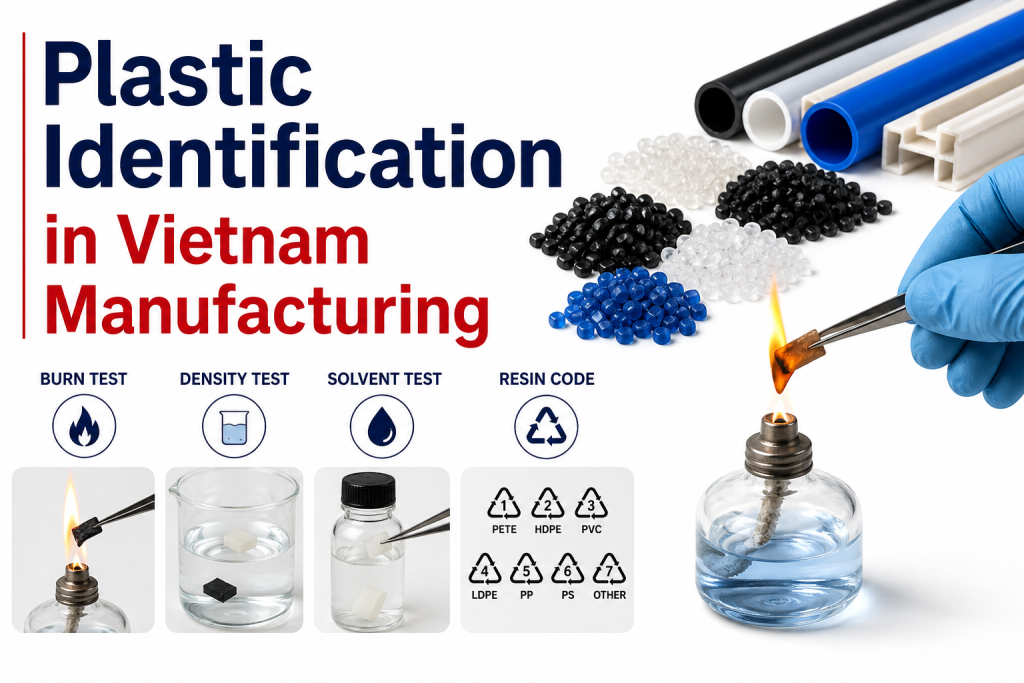
🔥 Burn Test (Quick Identification Method)
The burn test is one of the fastest methods. However, it should be done carefully.
Check the following:
- Flame color
- Smell
- Smoke and residue
Typical results:
- PE / PP → blue-yellow flame, clean burn
- PVC → weak flame, strong chemical smell
- PET → slight sweet smell
Therefore, this method helps detect major material differences quickly.
🌊 Density Test (Float or Sink)
This test uses water to check density. It is simple and reliable.
- PE / PP → float
- PET / PVC → sink
Additionally, salt water can improve accuracy. As a result, this method is useful for sorting materials.
✋ Flexibility and Elasticity Test
Different plastics behave differently under stress.
- PE → very soft and flexible
- PP → slightly rigid but still flexible
- PS → brittle and easy to break
Thus, this test gives quick physical feedback.
🧪 Acetone Test (Solvent Check)
This method uses common nail polish remover.
- PS → dissolves or becomes sticky
- PE / PP → no reaction
However, use this test in a controlled setting. It is helpful for identifying specific plastics.
👁️ Transparency and Surface Check
Visual inspection is simple but effective.
- PET → clear and glossy
- PE → cloudy or matte
- PVC → smooth and rigid
Therefore, experienced teams can identify materials quickly by appearance.
🔊 Sound Test
Tap the material lightly and listen.
- Hard plastics → sharp, clear sound
- Soft plastics → dull sound
Although simple, this method works well for thicker parts.
🏷️ Resin Identification Code
Many products include recycling symbols.
- 1 → PET
- 2 → HDPE
- 3 → PVC
- 5 → PP
- 6 → PS
If available, this is the fastest identification method.
🌡️ Heat Resistance Test
Hot water can reveal material behavior.
- PP → holds shape under heat
- PE → softens faster
Therefore, this test is useful for kitchen or industrial applications.
🔪 Cutting / Shaving Test
Use a blade to check material response.
- PE → smooth, soft shaving
- PS → cracks or breaks
As a result, this method helps identify brittle plastics.
Conclusion
Plastic identification is essential in manufacturing. It helps avoid costly mistakes and safety risks.
Simple methods like burn test and density test provide quick insights. However, combining multiple methods gives better accuracy.
In real production, these tests support faster decisions during sourcing and quality control.