Introduction
When developing a new product, buyers often focus on materials, cost, and lead time. However, small design details can create big manufacturing problems.
One common example is the draft angle.
A draft angle is a small slope added to vertical walls. It helps remove a part from a mold after production. Although it looks simple, it has a major impact on product quality and production efficiency.
Moreover, a good draft angle can reduce defects, shorten cycle times, and extend mold life.
For companies developing engineered products in Vietnam, understanding this concept can save both time and money.
What Is a Draft Angle?
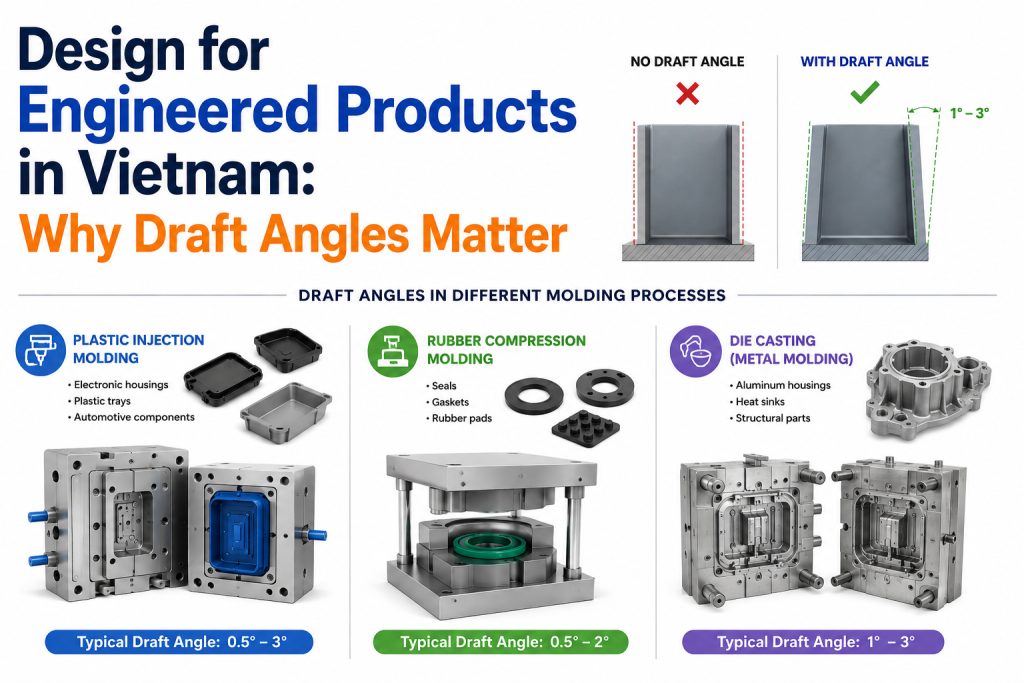
A draft angle is a small angle added to the side walls of a product.
Instead of creating a perfectly straight wall, engineers add a slight taper.
This allows the part to separate from the mold more easily.
Most draft angles range from 0.5° to 3°. However, the actual value depends on the material, surface finish, and product geometry.
Without a draft angle, several problems may occur.
For example:
- Parts can get stuck inside the mold.
- Surface scratches may appear.
- Extra force may damage the product.
- Mold wear can increase over time.
- Production speed can decrease.
Therefore, draft angles are a basic design rule in manufacturing.
Why Draft Angles Matter for Engineered Product Vietnam Projects
Many international buyers now develop products in Vietnam. They work with local factories for tooling, prototyping, and mass production.
However, some designs come directly from customers without manufacturing review.
As a result, products may look good in CAD drawings but become difficult to produce.
Draft angles help solve this issue.
They offer several benefits:
- Faster mold release
- Better product quality
- Lower risk of defects
- Longer mold life
- Lower maintenance costs
- More stable production
In addition, factories can reduce manual adjustments during production.
This creates a more efficient supply chain.
Which Manufacturing Processes Use Draft Angles?
Draft angles are common in many manufacturing methods.
Plastic Injection Molding
Moreover, plastic injection molding relies heavily on draft angles.
Almost every molded plastic part needs them.
Common products include:
- Electronic housings
- Plastic trays
- Automotive components
- Storage containers
- Appliance parts
Typical recommendations:
- Smooth surfaces: 0.5° to 1°
- Textured surfaces: 2° to 5°
The deeper the wall, the larger the draft angle should be.
Rubber Compression Molding
Rubber compression molding also uses draft angles.
However, requirements are usually lower because rubber is flexible.
Common products include:
- Rubber seals
- Gaskets
- Anti-vibration pads
- Rubber feet
- Industrial bumpers
Typical recommendations:
- 0.5° to 2°
Still, deeper parts often need larger draft angles.
Rubber Injection Molding
Similarly, rubber injection molding follows similar rules.
As a result, factories use this process for more complex parts.
Examples include:
- Automotive seals
- Cable grommets
- Bellows
- Protective covers
Typical recommendations:
- 1° to 3°
Deep Drawing
Deep drawing forms sheet metal into three-dimensional shapes using a punch and die.
Although this process does not use mold release in the same way as injection molding, engineers still incorporate slight tapers to improve part removal and manufacturing efficiency.
Common products include:
- Stainless steel sinks
- Metal cups
- Battery casings
- Automotive body components
- Kitchen cookware
Typical recommendations:
- 0.5° to 2°
Deeper parts and complex geometries may require larger draft angles to reduce friction and prevent deformation.
Die Casting Mold
Die casting also requires draft angles because metal parts must be released from hardened steel dies.
Common products include:
- Aluminum electronic housings
- Heat sinks
- Automotive brackets
- Gearbox covers
- Industrial machine components
Typical recommendations:
- Internal surfaces: 1° to 3°
- External surfaces: 0.5° to 2°
Complex geometries may require larger draft angles.
Blow Mold
Blow molding produces hollow plastic products and also benefits from proper draft design.
Common products include:
- Water bottles
- Detergent containers
- Fuel tanks
- Cosmetic bottles
- Industrial drums
Typical recommendations:
- 1° to 3°
Larger containers often require additional draft for easier mold release.
Vacuum Forming Mold (Thermoforming Mold)
Vacuum forming uses heated plastic sheets that are shaped over a mold.
Draft angles help separate the finished part without distortion.
Common products include:
- Food packaging trays
- Refrigerator liners
- Medical equipment covers
- Automotive interior panels
- Display packaging
Typical recommendations:
- 3° to 5°
Deep parts may require even larger draft angles.
Sand Casting Mold
Sand casting also uses draft angles to remove patterns without damaging the sand mold.
Common products include:
- Pump housings
- Valve bodies
- Machine bases
- Engine blocks
- Industrial impellers
Typical recommendations:
- External surfaces: 1° to 2°
- Internal surfaces: 2° to 3°
Wood patterns often require larger draft angles than metal patterns.
Rotational Molding
Rotational molding creates large hollow plastic products and uses draft angles to simplify part removal.
Common products include:
- Water storage tanks
- Coolers
- Playground equipment
- Chemical containers
- Outdoor furniture
Typical recommendations:
- 1° to 3°
Large and deep products may require additional draft depending on their shape.
Common Design Mistakes Buyers Should Avoid
Many buyers are product experts. However, they may not specialize in mold design.
Therefore, these mistakes are common.
Designing Vertical Walls at 90 Degrees
Perfectly straight walls may look clean on a drawing.
However, they create resistance inside the mold.
Instead, always add a draft angle.
Ignoring Surface Texture
Textured surfaces increase friction.
As a result, parts become harder to remove.
Factories often increase draft angles for textured products.
Adding Draft Angles Too Late
Late changes can be expensive.
For example, tooling may need modifications after production has started.
Therefore, draft angles should be reviewed early.
How Draft Angles Support Design for Manufacturing
Design for Manufacturing, also called DFM, focuses on making products easier to produce.
Draft angles are one of the first items engineers review.
A simple DFM checklist includes:
- Product geometry
- Wall thickness
- Draft angles
- Material selection
- Surface finish
- Mold complexity
Consequently, fewer problems appear during mass production.
This also improves communication between buyers and factories.
Tips for Buyers Working with Vietnam Suppliers
International buyers can avoid many issues by asking the right questions early.
Before approving a design, ask your supplier:
- What draft angle is recommended?
- Is the design suitable for molding?
- Will the surface texture require more draft?
- Are there any high-risk areas?
- Can the factory provide DFM feedback?
Moreover, involve the factory before finalizing the product design.
This saves both cost and development time.
Conclusion
Draft angles are small design features, but they have a large impact on manufacturing success.
They improve product quality, increase production efficiency, and reduce tooling problems.
For companies developing engineered products in Vietnam, draft angles should never be overlooked.
A simple design change at the beginning of a project can prevent expensive issues later.
Most importantly, early collaboration between buyers and suppliers creates stronger products and smoother production.
You maybe interested in Product Development Tips in Vietnam.