Developing a high strength rubber product can involve more than selecting the right rubber material. For custom OEM products, the compound, product design, fixture, and testing method may all need to work together.
In this project, the customer required a rubber product with a very high pull force. The target load reached approximately 18,000 N, or about 4,000 lbf. However, the challenge was not only the high load requirement.
The product was an OEM design, so standard laboratory fixtures were not suitable. The rubber compound also needed to meet the required strength. In addition, the testing method had to handle a load that was higher than the normal capacity available at the laboratories evaluated for this project.
Therefore, we developed the rubber compound, custom fixture, and test process in Vietnam. This approach helped the customer maintain better quality control and reduce development lead time.
High Strength Rubber Product Development: The Main Challenge
A standard rubber product can often use standard materials and testing methods. However, a custom OEM product can require a different approach.
In this case, the product needed to withstand a high pulling force without premature failure. Therefore, we had to consider the entire development process instead of looking at the rubber material alone.
The main requirements included:
- A high strength rubber compound
- A custom OEM product design
- A dedicated rubber test fixture
- A high-force pull test
- A testing capacity of approximately 18,000 N
- A controlled testing speed
- A suitable laboratory testing system in Vietnam
Most importantly, all these elements needed to work together.
Developing the Rubber Compound for High Strength
The rubber compound plays an important role in the performance of a high strength rubber product.
A rubber compound cannot simply be selected based on hardness. The development team also needs to consider tensile strength, elongation, tear resistance, and the actual application of the product.
For this project, the rubber compound was developed around the customer’s performance requirements.
The development process focused on:
- Rubber material selection
- Compound formulation
- Strength requirements
- Product application
- Sample development
- Physical testing
- Performance improvement
Furthermore, keeping the compound development in Vietnam allowed the team to communicate directly with the factory. This made it easier to review test results and make changes when needed.
Instead of moving the material development between different countries, the project team could work directly with the local manufacturing team.
Why a Standard Rubber Test Fixture Was Not Suitable
The product was a custom OEM design. Therefore, the laboratory did not have a standard fixture that could directly hold and test the product.
A test fixture is not simply a tool for holding a sample. It must transfer the pulling force to the product in a controlled way.
For this reason, we developed a dedicated fixture for the product.
The fixture development considered:
- Product geometry
- Connection points
- Load direction
- Fixture mounting interface
- Contact areas
- Machine compatibility
- Required pulling force
- Safe load transfer
The fixture also needed to connect properly to the laboratory’s Universal Testing Machine.
Therefore, the lab reviewed the fixture design and its end connections before testing. This step helped confirm that the fixture could be safely mounted to the machine.
Developing a Custom High-Force Pull Test
The required pull force created another challenge.
The project required a pull test up to approximately 18,000 N (18 kN), or about 4,000 lbf. However, most laboratories evaluated for this project normally had lower force capacities for rubber testing, typically around 10,000 N or less, and were primarily designed for standard rubber test methods. In addition, rubber testing facilities operated by rubber companies were generally not equipped for this level of load.
- A standard rubber testing setup was not sufficient for this project, so we worked closely with a trusted laboratory partner in Vietnam to find a workable solution.
- Because their tensile machines were designed for standard test methods, any custom setup involving special grips, fixtures, or higher loads required careful review to avoid potential damage to the machine or clamping system.
- After several rounds of technical discussion and engineering review, the laboratory agreed to support a custom test setup based on our fixture design and controlled loading approach.
The testing system used a strain gauge-based load cell for force measurement, rather than a hydraulic pressure gauge, to ensure accurate and stable readings under high load conditions. The entire setup was then validated together with the lab to confirm safe operation within their equipment limits.
High Strength Rubber Product Development in Vietnam: Connecting Rubber Factory, CNC Fixture Manufacturing, and Laboratory Testing
The testing process required close coordination between the rubber factory, CNC fixture developer, and laboratory, as each function operates with its own technical standards and working methods.
- Laboratory team: reviewed product requirements, defined test conditions, load requirements, and machine compatibility
- CNC fixture team: evaluated mechanical design, designed load transfer structure, and ensured machining feasibility
- Rubber factory: focused on material behavior, compound performance, molding constraints, and product stability
After these parallel reviews, the project lead aligned all three parties to ensure the fixture design matched both the product geometry and the laboratory machine interface. This step was critical because the fixture is the connection point between the rubber product and the testing system, and any mismatch could affect the accuracy of the results.
Once the full system was confirmed, the team prepared the test configuration and verified that the machine, load cell, and fixture assembly could safely handle the required force. The sample was then tested under controlled conditions, with continuous monitoring of force response and deformation behavior throughout the process.
This integrated approach ensured that the evaluation reflected the real OEM product performance under application-level loading conditions, rather than a simplified or isolated rubber test.
Developing the Compound, Fixture, and Test in Vietnam
One of the key advantages of this project was that the main development activities took place in Vietnam.
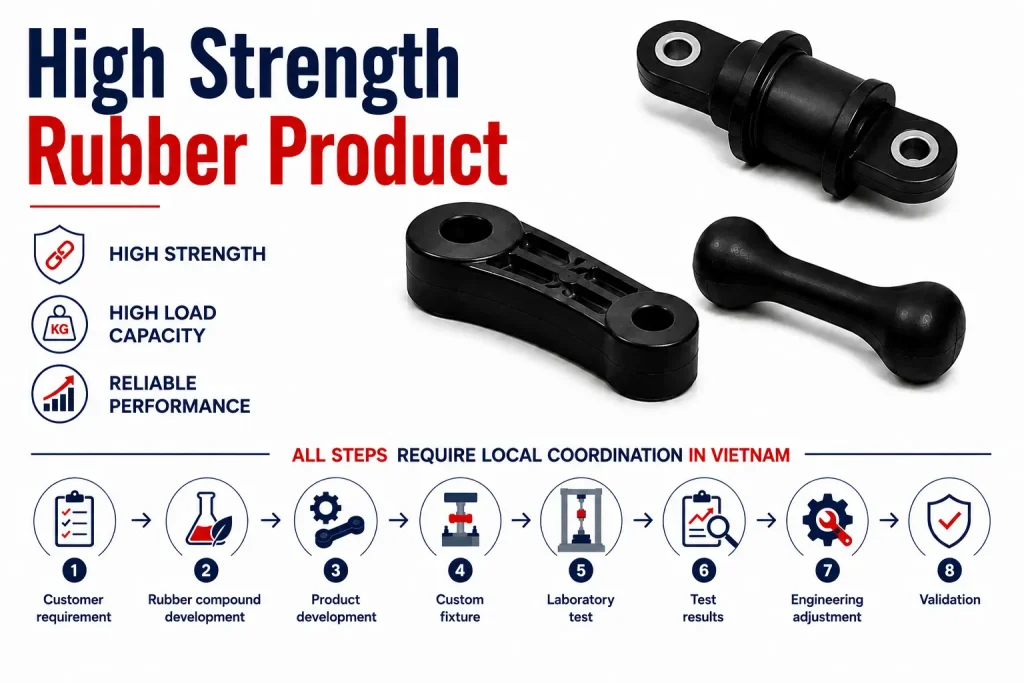
The rubber compound, custom fixture, and testing process all required local coordination.
This created a connected development process:
Customer requirement → Rubber compound development → Product development → Custom fixture → Laboratory test → Test results → Engineering adjustment → Validation
This local process helped reduce unnecessary delays.
Better Quality Control Through Local Development
Keeping the development process in Vietnam also helped improve quality control.
The customer could coordinate directly with the factory and laboratory. At the same time, the project team could follow the product from material development through testing.
This provided better visibility into:
- Material development
- Product production
- Fixture development
- Test preparation
- Laboratory results
- Product improvement
In addition, the team could identify problems earlier.
For a custom OEM product, this matters because a problem with the material, fixture, or test setup can affect the final result.
By keeping the development process connected, the team could separate these issues more easily and find the right solution.
Reducing Lead Time for Custom Rubber Products
Lead time is another important reason to keep development and testing close to the manufacturing source.
A project can take much longer when each activity happens in a different country.
For example, the process could require:
Factory → overseas fixture supplier → overseas laboratory → test result → factory → fixture adjustment → laboratory retest
Each step can add shipping time, communication time, and coordination work.
In contrast, a Vietnam-based development process can connect the factory, fixture supplier, and laboratory more efficiently.
As a result, the team can respond faster when the customer needs a design change or another test.
This is especially useful for OEM products that require several rounds of development before production approval.
From Product Development to Test Validation (and Why It Matters for Global Buyers)
The project demonstrates an important point about high strength rubber products. The rubber material alone does not determine the success of the final product. Instead, the material, product design, fixture, testing machine, and test method must all work together to achieve reliable results.
- Developed a full solution including rubber compound, OEM product, custom fixture, and high-force testing up to ~18 kN, with full validation support.
- High strength rubber sourcing requires more than machinery — it needs an integrated process for development, testing, and validation.
- A local supply chain in Vietnam enables faster communication, better control, quicker testing, and simpler project coordination.
Conclusion
Developing a high strength rubber product can require a complete engineering approach. In this project, the required pull force reached approximately 18,000 N, which was beyond the normal rubber testing capacity available from the laboratories evaluated for the project.
The solution required more than a stronger rubber compound. The team also needed to develop a custom fixture and a suitable high-force test method.
By developing the rubber compound, fixture, and testing process in Vietnam, we created a more connected development process for the customer. This approach improved quality control, simplified coordination, and helped reduce development lead time.
For global buyers developing custom OEM rubber products, Vietnam can provide more than manufacturing capacity. With the right local partners, buyers can also coordinate material development, custom tooling and fixtures, laboratory testing, and product validation within the same supply chain.