Many buyers believe they can develop products remotely. They review samples through photos, videos, and video calls. Then, they approve the sample and wait for production.
However, product development does not work that way.
A sample may look perfect on a screen. Yet, the actual product can tell a very different story once it arrives.
That is why on-the-ground sourcing in Vietnam remains critical. Local sample reviews help buyers find problems early, communicate expectations clearly, and reduce expensive mistakes later.
Why Remote Sample Reviews Often Miss Important Details
Photos and videos can only show part of the product.
In most cases, the factory presents the sample from selected angles. As a result, buyers only see what the camera shows.
Meanwhile, many important details remain difficult to evaluate remotely.
These include:
- Color accuracy
- Surface finish
- Material texture
- Product feel
- Weight
- Packaging quality
- Product functionality
- Ease of use
- Small cosmetic defects
For example, a product may look smooth in photos. However, once you touch it, the material may feel cheap or rough.
Likewise, a color may appear correct on a screen. Yet, the actual color may look different under natural light.
Therefore, reviewing samples through a screen creates risk.
On-the-Ground Sourcing Vietnam Provides Real Product Evaluation
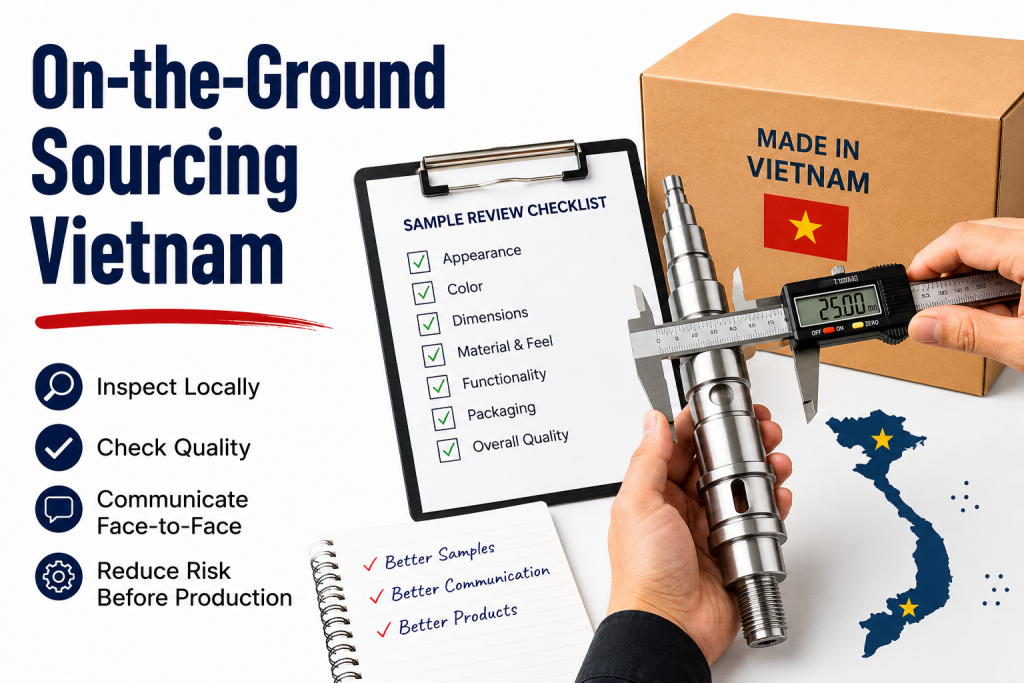
With on-the-ground sourcing in Vietnam, someone can physically inspect the sample before it ships overseas.
This process provides a more complete evaluation.
A local sourcing team can:
- Hold the product
- Test its functions
- Measure dimensions
- Compare colors
- Check packaging
- Review assembly quality
- Identify defects
- Verify overall user experience
As a result, many issues can be corrected before the sample reaches the buyer.
This saves both time and money.
Fast Shipping Does Not Solve Development Problems
Some buyers argue that shipping samples from Vietnam to the United States is already fast.
That is true.
Many samples arrive within three to five days.
However, fast shipping does not eliminate development delays.
Imagine receiving a sample after several weeks of development.
Then, you discover:
- The color is wrong
- The product feels different
- The function does not work properly
- The packaging looks poor
Now the factory must revise the sample.
After that, another sample cycle begins.
Consequently, the project timeline extends again.
The shipping cost may be small. However, the lost development time is often much more expensive.
Why Face-to-Face Feedback Matters
Sample review is not only about finding defects.
More importantly, it is about communication.
When a local team visits the factory, feedback becomes clearer.
The sourcing team can:
- Show the issue directly
- Explain buyer expectations
- Discuss improvements immediately
- Confirm corrective actions
- Align quality standards
As a result, misunderstandings decrease significantly.
Moreover, factory teams usually respond faster when discussions happen in person.
This creates a stronger foundation for future production.
On-the-Ground Sourcing Vietnam Helps Set Quality Expectations Early
Many buyers focus only on one question:
“Is the sample acceptable?”
However, this approach misses a much bigger issue.
The real question should be:
“Can this factory consistently deliver this quality during mass production?”
A sample is more than a product.
Instead, it is a demonstration of the factory’s quality mindset.
Therefore, the sample stage becomes an opportunity to establish expectations.
The factory should understand that quality matters from the very beginning.
Even small defects should receive attention.
These may include:
- Minor scratches
- Uneven stitching
- Poor printing
- Small color differences
- Loose assembly parts
Although these issues seem small, they often become larger during mass production.
Sample Quality and Production Quality Are Connected
Many factories treat samples differently from production.
Likewise, many buyers review samples without considering production reality.
This creates a gap.
A factory may produce one acceptable sample. However, producing ten thousand units consistently is much harder.
For that reason, sample reviews should focus on more than appearance.
Buyers should also evaluate:
- Manufacturing capability
- Process control
- Attention to detail
- Quality culture
- Corrective action speed
If a factory struggles with quality on a few samples, production quality may become a much bigger challenge later.
Therefore, the sample stage provides valuable insight into future manufacturing performance.
The Goal Is Not Sample Approval
Many people think the goal of sample development is approval.
In reality, approval is only one step.
The larger goal is to build confidence.
Buyers need confidence that:
- The product meets requirements
- The factory understands expectations
- Quality standards are clear
- Production risks are controlled
On-the-ground sourcing in Vietnam helps achieve these goals.
As a result, buyers make better decisions before placing large orders.
Conclusion
Product development involves much more than reviewing photos and joining video calls.
Although technology makes communication easier, it cannot replace physical sample evaluation.
A product’s color, feel, function, and quality must be experienced firsthand. Furthermore, face-to-face discussions help factories understand expectations more clearly.
That is why on-the-ground sourcing in Vietnam remains an important part of successful product development.
The best time to find a problem is before the sample ships. More importantly, the best time to establish quality expectations is before production begins.
You maybe interested in Quality Control in Vietnam Manufacturing Contract: A Complete Guide for International Buyers.