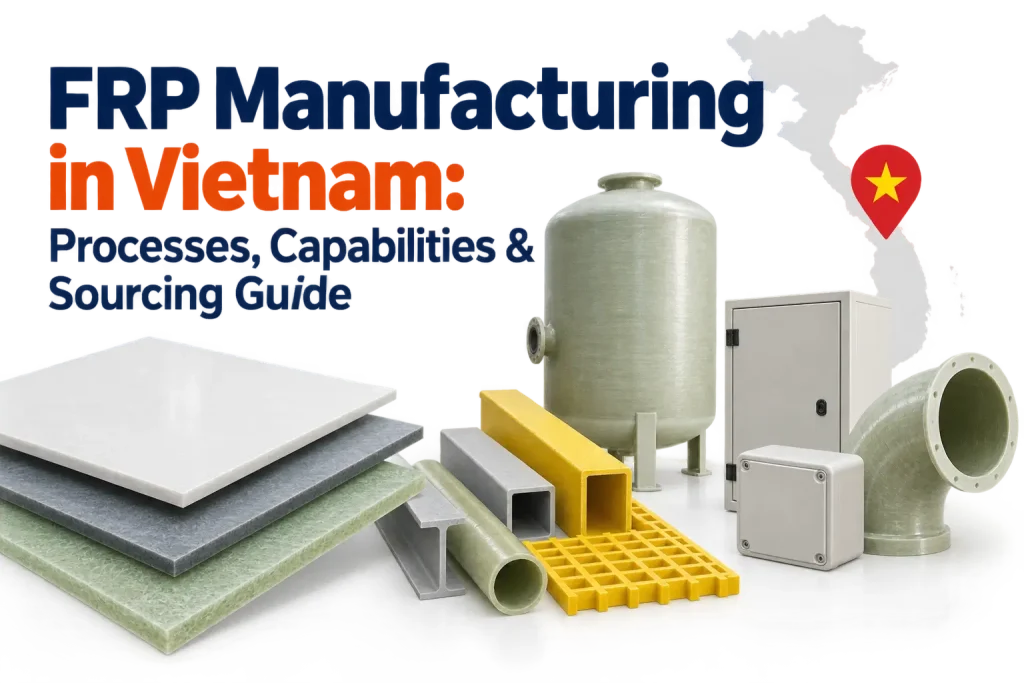
FRP is widely used for industrial, electrical, construction, automotive, and infrastructure products. Vietnam has also developed manufacturing capabilities for several FRP and composite processes.
However, not every factory can produce every type of FRP product. The right manufacturing process depends on the product design, volume, material, tooling, and performance requirements.
For buyers looking to source outside China, Vietnam can offer several options for FRP production. This guide explains the main processes, local capabilities, and key points to consider when sourcing FRP products in Vietnam.
What Is FRP?
FRP stands for Fiber Reinforced Plastic. It combines a plastic resin with reinforcing fibers.
Glass fiber is the most common reinforcement for FRP products. However, manufacturers can also use carbon fiber and other reinforcement materials.
The basic structure includes:
- Resin: The plastic matrix that holds the product together.
- Fiber: The reinforcement that provides strength and stiffness.
- Additives: Materials that improve color, surface finish, fire resistance, or other properties.
FRP can provide several benefits:
- Good strength-to-weight ratio
- Corrosion resistance
- Good electrical insulation
- Low maintenance
- Good dimensional stability
- Flexible product design
Therefore, FRP works well for many industrial and commercial applications.
FRP Manufacturing Vietnam: What Can Local Factories Produce?
Vietnam has experience with several FRP manufacturing processes. However, factory capabilities vary by product and production volume.
For example, some factories focus on large, low-volume FRP products. Meanwhile, others specialize in continuous profiles or molded components.
Common FRP processes available in Vietnam include:
- Hand lay-up
- Spray-up
- Resin infusion
- RTM
- Filament winding
- Pultrusion
- SMC compression molding
- BMC compression molding
The best process depends on the product.
For example, pultrusion works well for products with a constant cross-section. In contrast, SMC works better for molded parts with more complex shapes and higher production volumes.
Main FRP Manufacturing Processes in Vietnam
1. Hand Lay-Up
Hand lay-up is one of the simplest FRP manufacturing methods.
Workers place fiber reinforcement into a mold. They then apply resin over the fiber and allow the material to cure.
This process works well for:
- Large panels
- Covers
- Tanks
- Equipment housings
- Prototypes
- Low-volume products
The process requires relatively simple tooling. As a result, it can work well for smaller production runs.
However, labor plays a large role in the final quality. Therefore, buyers should check the factory’s production controls and inspection process.
2. Spray-Up
Spray-up uses a spray gun to apply resin and chopped glass fiber onto a mold.
This process can produce large FRP components faster than traditional hand lay-up.
Typical applications include:
- Large covers
- Tanks
- Vehicle components
- Industrial equipment
- Construction products
Spray-up can be useful for larger products. However, it may provide less precise fiber placement than some closed-mold processes.
3. Resin Infusion and RTM
Resin infusion and RTM use more controlled molding methods.
In resin infusion, dry fiber goes into the mold first. The manufacturer then introduces resin into the fiber structure under vacuum pressure.
RTM, or Resin Transfer Molding, uses a closed mold. In this process, the manufacturer injects resin into the mold containing the reinforcement.
These processes can provide better control over:
- Fiber content
- Surface finish
- Product thickness
- Dimensional consistency
They can therefore suit products that need better quality control than basic hand lay-up.
4. Filament Winding
Filament winding uses continuous fiber that wraps around a rotating mold.
This process works particularly well for cylindrical products.
Common applications include:
- FRP pipes
- Pressure vessels
- Storage tanks
- Chemical tanks
- Industrial cylinders
The process provides controlled fiber placement. As a result, manufacturers can design the fiber structure around the product’s expected loads.
5. Pultrusion
Pultrusion is a continuous process for making FRP profiles.
Glass fiber passes through resin before entering a heated forming die. The machine then pulls the material through the die and cures it into a fixed shape.
Pultrusion works well for:
- Rods
- Tubes
- Beams
- Channels
- Angles
- Gratings
- Structural profiles
It is especially useful when the product has a constant cross-section.
For more information, see our guide to Glass Fiber Pultrusion Manufacturing in Vietnam.
Pultrusion can be an attractive sourcing option when a buyer needs long FRP profiles with consistent dimensions.
6. SMC Compression Molding
SMC stands for Sheet Molding Compound.
More specifically, SMC uses a prepared sheet material that contains resin, chopped glass fiber, filler, and additives.
The factory places the SMC material into a heated mold. The press then applies pressure and heat to form the final product.
SMC works well for:
- Electrical enclosures
- Equipment covers
- Automotive components
- Industrial panels
- Housings
- Other molded FRP components
SMC can support higher production volumes than many manual FRP processes.
It can also provide good dimensional consistency and surface quality.
However, tooling costs can be higher. Therefore, SMC makes more sense when the expected production volume can support the tooling investment.
7. BMC Compression Molding
BMC stands for Bulk Molding Compound.
In this process, manufacturers use a bulk material containing resin, short glass fibers, fillers, and additives. The material is then placed into a mold, where heat and pressure form the final component.
BMC is useful for smaller molded components with complex shapes.
Typical applications include:
- Electrical components
- Electrical housings
- Automotive parts
- Industrial components
The choice between BMC and SMC depends on the product design, material requirements, production volume, and surface requirements.
How to Choose the Right FRP Process
The manufacturing process should match the product requirements.
| Product requirement | Suitable process |
|---|---|
| Large and low-volume part | Hand lay-up |
| Large FRP component | Spray-up |
| Better fiber and surface control | Resin infusion |
| Complex molded component | RTM |
| Pipes and tanks | Filament winding |
| Constant FRP profile | Pultrusion |
| High-volume molded part | SMC |
| Small complex molded component | BMC |
However, this table should only serve as a starting point.
The factory should review the actual product drawing before confirming the process.
FRP Materials Used in Vietnam
The resin and reinforcement also affect the manufacturing process.
Common resin options include:
- Polyester
- Vinyl ester
- Epoxy
- Phenolic resin
Glass fiber remains the most common reinforcement for general FRP applications.
For more demanding applications, buyers may consider carbon fiber or other reinforcement materials.
The correct material depends on:
- Required strength
- Temperature resistance
- Chemical exposure
- Fire requirements
- Weight target
- Cost target
- Outdoor exposure
Therefore, buyers should define the required performance before requesting quotations.
Vietnam’s Composite Manufacturing Capability
Vietnam’s composite industry covers both traditional fiberglass products and more advanced composite applications.
Some manufacturers focus on glass fiber products. Others work with carbon fiber or more specialized composite materials.
For buyers, this means supplier selection matters as much as process selection.
A factory may have experience with FRP tanks but not have the equipment for SMC compression molding. Another factory may have a compression molding press but lack experience with a buyer’s required resin system.
Vietnam’s carbon composite sector also offers additional opportunities for specialized applications. For a broader look at this area, see this Vietnam Carbon Composite Manufacturing Insight.
What Should Buyers Ask Vietnamese FRP Manufacturers?
Before selecting a supplier, buyers should confirm the factory’s actual production capability.
Key questions include:
- Which FRP processes do you currently operate?
- What resin systems can you use?
- Which glass fiber types can you process?
- What is your maximum product size?
- What is your maximum mold size?
- What production volume can you support?
- Do you make molds in-house?
- What is your typical tooling lead time?
- What is your MOQ?
- Can you provide production samples?
- What testing equipment do you have?
- Which export markets do you currently serve?
- Can you meet the buyer’s required standards?
It is also important to ask for photos or videos of the actual production line.
A supplier may claim to manufacture FRP products. However, the factory may outsource some key processes.
This distinction matters when quality, lead time, and cost are important.
Tooling Considerations for FRP Manufacturing
Tooling requirements vary significantly between FRP processes.
Hand lay-up may require relatively simple molds. In contrast, SMC compression molding requires a dedicated compression mold.
Tooling cost depends on:
- Product size
- Product geometry
- Mold material
- Production volume
- Surface finish
- Required tolerances
- Expected mold life
Therefore, buyers should not compare only the piece price.
A factory with a higher unit price may offer lower tooling costs or better production stability. The total landed cost should include tooling, production, packaging, shipping, and quality costs.
Quality Control for FRP Products
FRP quality can vary based on the process and factory controls.
Important quality checks may include:
- Product dimensions
- Thickness
- Weight
- Surface finish
- Fiber distribution
- Resin content
- Color
- Warpage
- Mechanical strength
- Water absorption
- Chemical resistance
The required tests depend on the final application.
For electrical products, buyers may also need specific electrical and fire testing.
For structural products, mechanical performance becomes more important.
Therefore, the inspection plan should follow the product specification rather than use the same checklist for every FRP product.
Is Vietnam a Good Sourcing Location for FRP?
Vietnam can be a viable sourcing location for many FRP products.
The country has manufacturers with experience in different composite processes. However, the supplier base is not uniform.
For this reason, buyers should start with the product requirements rather than simply searching for an “FRP factory.”
A good sourcing process should identify:
- The required FRP material.
- The correct manufacturing process.
- The required production volume.
- The tooling requirements.
- The factory’s actual equipment.
- The factory’s quality system.
- The export and compliance requirements.
- The total landed cost.
This approach helps buyers avoid selecting a factory based only on a low quotation.
FRP Manufacturing in Vietnam: Sourcing Considerations
For US buyers looking to diversify their supply chain, Vietnam can be considered alongside other Asian manufacturing locations.
However, FRP sourcing requires a technical supplier review.
The right factory should have the correct equipment, material experience, tooling capability, and quality controls for the specific product.
Vietnam is therefore not a single-source solution for every FRP product. Instead, it offers several manufacturing options that can fit different product types and production requirements.
By matching the product with the right process and factory, buyers can build a more reliable FRP supply chain in Vietnam.