Introduction
Many buyers become frustrated when a factory increases the price after the sampling stage. They already paid the sample cost, approved the sample, and expected the original quotation to stay the same.
However, this situation is common in sourcing and product development.
In many cases, the factory did not intentionally change the price. Instead, the sampling stage revealed costs that were not clear at the beginning.
Over the years, we have seen this happen in many Vietnam sourcing projects. Therefore, buyers should understand why this happens and how to manage it correctly.
Why Does Factory Price Increase After Sampling Happen?
The simple answer is this.
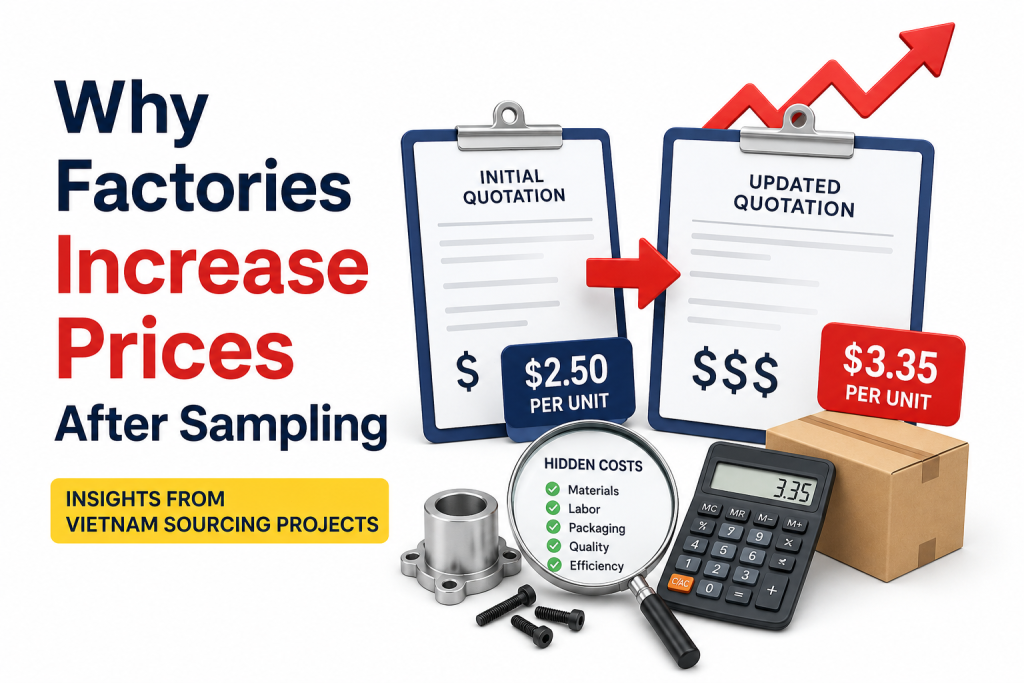
An initial quotation is often an estimate, not a final production cost.
At the beginning, factories usually receive limited information. Sometimes they only have a sketch, a 3D file, photos, or a rough specification sheet.
However, the sampling process turns assumptions into actual production work.
As a result, hidden costs start to appear.
1. The Product Is More Complex Than Expected
Many factories do not fully understand the product until they physically build it.
During sampling, they may discover:
- More assembly steps
- More manual work
- Difficult production processes
- Longer production time
For example, a factory may estimate five minutes for assembly. However, the actual time may become ten minutes.
Consequently, labor costs increase.
2. Missing Components Are Found During BOM Review
A Bill of Materials, or BOM, may not be complete at the beginning.
Why a BOM Matters When You Develop New Product in Vietnam.
During sampling, factories often discover additional items.
These may include:
- Extra screws
- Rubber pads
- Adhesives
- Magnets
- Labels
- Protective films
Although these items seem small, they can increase the total cost.
Therefore, the original quotation must be adjusted.
3. Packaging Was Not Fully Included
This is very common in sourcing projects.
Initially, factories may only price the product itself.
Later, buyers may add packaging requirements.
For example:
- Retail boxes
- Printed inserts
- Barcode labels
- Polybags
- Master cartons
As a result, the total price increases.
Therefore, buyers should discuss packaging requirements early.
4. Sub-Supplier MOQ Is Higher Than Expected
Factories often depend on other suppliers.
These sub-suppliers provide materials, hardware, and packaging.
During sampling, factories finally receive actual quotations from these vendors.
Then they may discover:
- High minimum order quantities
- Large setup costs
- Expensive material purchases
Consequently, factories need to revise the unit price.
This is especially common for low-volume projects.
5. Quality Requirements Are More Demanding Than Expected
Sometimes buyers add new requirements during development.
For example, they may request:
- Better surface finishing
- Tighter tolerances
- Exact Pantone color matching
- Additional quality inspections
Although these changes improve the product, they also increase production costs.
Therefore, buyers should expect pricing adjustments.
6. Production Efficiency Is Lower Than Planned
Factories often estimate production speed before making samples.
However, reality may be different.
During sampling, they may discover:
- Machines need frequent adjustments
- Operators need extra training
- Defect rates are higher
As a result, production becomes slower.
Consequently, labor costs increase.
7. The Original Quote Was Too Aggressive
Unfortunately, this also happens.
Some factories intentionally provide a low quotation to win the project.
Then, after the sampling stage, they increase the price.
This is a warning sign.
Buyers should ask for a detailed explanation if the increase is significant.
A trustworthy factory should always provide clear reasons.
How Buyers Should Handle a Factory Price Increase After Sampling
Buyers should not immediately reject the price increase.
Instead, they should investigate the reason first.
Ask the factory to provide a cost breakdown.
For example, request information about:
- Material changes
- Labor adjustments
- Packaging costs
- New production steps
- Additional quality requirements
Then compare these costs with the original quotation.
If the explanation makes sense, the increase may be reasonable.
However, if the factory cannot explain the changes, buyers should be cautious.
Best Practices to Avoid Future Surprises
Fortunately, buyers can reduce this risk.
Here are a few simple practices:
- Define product specifications early.
- Include packaging requirements from day one.
- Build a complete BOM before sampling.
- Confirm quality requirements upfront.
- Ask factories to separate estimated costs from confirmed costs.
- Review quotations again after sample completion.
These steps create better transparency between buyers and factories.
Conclusion
A factory price increase after sampling is not always a bad sign.
In fact, the sampling stage often reveals hidden costs that nobody saw earlier.
However, buyers should always ask questions and request detailed explanations.
In our Vietnam sourcing projects, we treat sampling as a learning phase, not a final pricing phase.
When buyers understand this process, they can manage costs better and build stronger supplier relationships.