Introduction
Direct factory sourcing seems like the simplest way to buy from manufacturers in Vietnam. However, contacting factories directly does not always lead to successful projects, especially when order volumes are small or requirements are complex.
An established sourcing agent offers more than factory data. Their relationships with manufacturers can help buyers open discussions and explore solutions when direct approaches fail.
This article compares both options and explains when buyers should work through an agent before building direct factory relationships.
What Is Direct Factory Sourcing?
Direct factory sourcing means buying from manufacturers without using a sourcing intermediary. Buyers contact factories, request quotations, review samples, and manage production themselves.
This approach offers several advantages:
- Direct communication: Buyers discuss specifications and changes with the factory.
- Price transparency: Buyers can review factory quotations and negotiate commercial terms.
- Greater control: Buyers manage product development, orders, and production decisions.
- Long-term relationships: Successful cooperation can support repeat orders and future projects.
However, direct sourcing also requires time and experience. Buyers must find suitable manufacturers, verify their capabilities, compare quotations, and resolve problems during production.
For companies with established sourcing teams, these tasks may be manageable. In contrast, buyers entering a new market may struggle to identify the right factory or gain its attention.
Why Direct Factory Sourcing Can Be Difficult
Direct factory sourcing works well for many projects. Nevertheless, some manufacturers may reject a request even when they have the equipment and skills to make the product.
The reason is not always technical capability. Instead, the project may not match the factory’s commercial priorities.
Small Order Volumes
Many factories prefer large orders because production setup, tooling, and labor require time and money.
For example, a US buyer may want to test a new product with an initial order of 300 units. However, the factory may prefer orders of 2,000 units or more.
The buyer may receive a rejection before the factory fully evaluates the product’s potential.
An experienced sourcing agent can help reopen the discussion. The agent may explain the buyer’s future plans, explore a trial order, or negotiate a practical minimum order quantity.
Although the factory can still decline, an established relationship may create an opportunity that a cold inquiry cannot.
Complex Manufacturing Requirements
Some projects involve custom tooling, multiple materials, tight tolerances, or special surface finishes. As a result, factories must assess engineering resources, production risks, and costs before accepting the work.
A new buyer may not know which details matter most to the factory. Consequently, the initial request may appear too difficult or expensive.
Instead of stopping at the first rejection, a sourcing agent can clarify the requirements and discuss possible adjustments. The agent may also introduce another manufacturer with more suitable capabilities.
Limited Trust Between New Partners
A new buyer and a factory may have different expectations about order volume, payment terms, quality, and future demand.
Furthermore, the factory may not know whether the buyer has a serious project or is simply collecting quotations. Buyers face the same uncertainty when evaluating an unfamiliar manufacturer.
An established sourcing agent can help both parties communicate more effectively. When the agent already has a working relationship with the factory, the discussion may move beyond an initial price request.
What Sourcing Agents Offer Beyond Factory Data
Factory databases, trade data, and sourcing tools help buyers discover potential suppliers. However, finding a factory is only the first step toward successful production.
As explained in Vietnam Sourcing Data and Insight: Expanding Factory Search with Sourcing-AI and Vietnam Factory Insight, sourcing information can help buyers expand their search and identify potential manufacturers.
However, information alone cannot guarantee that a factory will accept a project. An experienced sourcing agent may also offer three important advantages.
1. Established Manufacturer Relationships
Building relationships with factories takes time. Through previous projects and ongoing communication, sourcing agents may learn about manufacturers’ capabilities, priorities, and production limits.
Therefore, they can approach suitable factories with a better understanding of what each side needs.
This knowledge is particularly useful when a project requires flexibility or falls outside a factory’s usual order profile.
2. Better Project Communication
How a buyer presents a project can influence the factory’s response.
For example, a request for 300 units may appear unattractive when the factory sees only a small order. However, a discussion that includes realistic product development plans and potential future demand may provide more context.
A sourcing agent can explain the opportunity clearly without making promises the buyer cannot support.
As a result, the factory can make a more informed decision.
3. Practical Problem-Solving
Sometimes, the original request does not fit a factory’s standard process. Instead of abandoning the project, an experienced agent may help explore alternative materials, production methods, order quantities, or suitable manufacturers.
This does not mean an agent can solve every manufacturing problem. Rather, the agent can help both parties identify realistic options and decide whether the project is worth pursuing.
For more context on the value beyond manufacturing itself, read What US Companies Really Sell When They OEM from Asia.
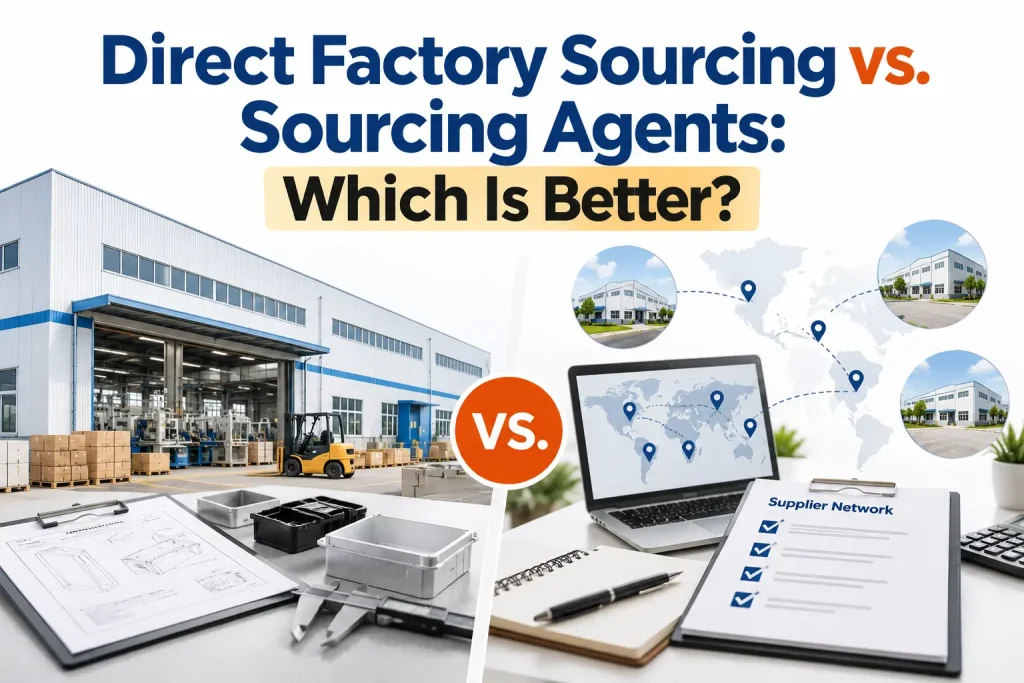
Direct Factory Sourcing vs. Sourcing Agents: Which Is Better?
Neither approach is always better. The right choice depends on the project stage, the buyer’s experience, and the factory relationship.
| Factor | Direct Factory Sourcing | Working Through a Sourcing Agent |
|---|---|---|
| Factory communication | Buyer manages communication directly | Agent can help coordinate discussions |
| Supplier discovery | Buyer researches and evaluates factories | Agent may provide access to an existing network |
| Small initial orders | Depends on factory policy | Agent may help negotiate a workable approach |
| Complex requirements | Buyer leads technical discussions | Agent may help clarify requirements and identify options |
| Cost structure | No sourcing-agent fee, but internal costs remain | May involve service fees or commissions |
| Project management | Buyer handles coordination | Support depends on the agreed service scope |
| Long-term cooperation | Direct relationship from the start | Relationship can develop before direct management increases |
Direct sourcing may be more efficient when buyers already know the factory and understand its processes. Meanwhile, an agent can be valuable when buyers need market knowledge, introductions, or help overcoming early project challenges.
Importantly, working through an agent does not automatically mean higher total costs. A suitable agent may help reduce wasted time, improve factory selection, and prevent avoidable mistakes. Buyers should compare these benefits against the actual service fees.
A Practical Approach: Start with an Agent, Then Go Direct
For new projects in Vietnam, a staged approach can combine the benefits of supplier relationships with the control of direct sourcing.
Step 1: Define the Project Clearly
Prepare the product specifications, target price, expected order volume, quality requirements, and timeline.
If the product requires custom tooling or special processes, include those details as well. Clear information helps the agent identify suitable manufacturers.
Step 2: Use the Agent’s Network to Approach Factories
Ask the agent to identify manufacturers that match the project’s technical and commercial needs.
During the first discussions, buyers can learn about factory capabilities, minimum order quantities, pricing, and production constraints.
Furthermore, the agent can help clarify misunderstandings before they delay the project.
Step 3: Evaluate the Factory and Develop Samples
Once a factory shows interest, review its capabilities and work together on sample development.
At this stage, assess the factory’s responsiveness, technical understanding, quality standards, and willingness to solve problems. These factors matter just as much as the initial quotation.
Step 4: Build Direct Communication
When both sides understand the requirements and have established a working relationship, buyers can begin managing routine communication directly.
For example, they may handle repeat orders, packaging details, production schedules, and engineering changes with the factory.
Meanwhile, the sourcing agent can continue to support complex negotiations or production issues if the service agreement allows it.
This approach helps buyers build independence without losing access to useful supplier relationships.
Why Supplier Relationships Matter in Vietnam
Vietnam has manufacturers across many industries, but their capabilities and export experience vary. Some factories have strong production facilities yet limited experience working directly with US buyers.
Consequently, buyers must evaluate more than equipment, capacity, and price. They also need to understand how a factory communicates, manages expectations, and handles commercial challenges.
This issue affects manufacturers as well as buyers. Our article, Why Vietnam Factories Struggle to Sell Directly to U.S. Retailers, explores why manufacturing capability alone may not be enough to win and retain US customers.
For buyers, the lesson is clear: the right supplier relationship can make a difference when a project requires more than a quotation.
Conclusion
Direct factory sourcing gives buyers greater control, but it does not always provide the easiest path to a successful project. Established sourcing agents can help buyers navigate small orders, complex requirements, and unfamiliar supplier networks.
Start with the approach that best fits your needs. Build trust, confirm manufacturing capabilities, and move toward direct cooperation when both sides are ready.