Selling toys in the US requires more than finding a factory with the right production capabilities. Products must also meet applicable CPSC safety requirements before they enter the market.
However, testing requirements vary between plastic toys, plush toys, wooden toys, and electronic toys. Each product has different materials, designs, and safety risks.
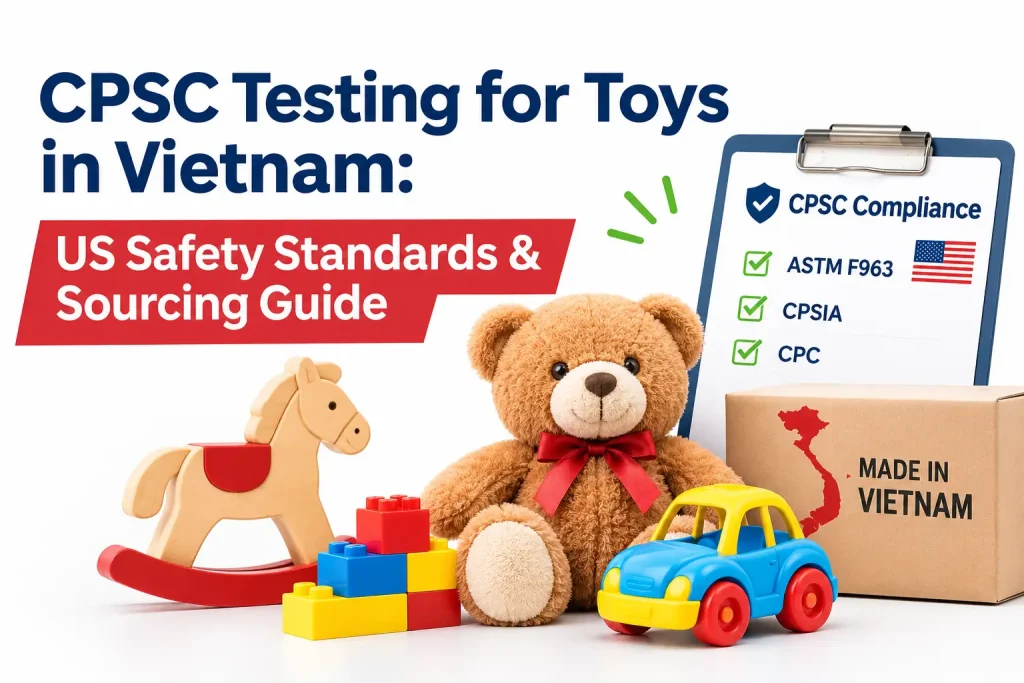
This guide explains CPSC testing, ASTM F963, CPSIA, and CPC requirements. It also covers how US brands and importers can manage toy compliance when sourcing from Vietnam.
1. What Is CPSC Testing for Toys?
The Consumer Product Safety Commission (CPSC) is a US government agency that protects consumers from unsafe products. It sets and enforces safety requirements for toys and other consumer goods sold in the United States.
For toys intended for children 12 years old and younger, manufacturers and importers must meet applicable children’s product safety rules. These products generally require third-party testing and a Children’s Product Certificate (CPC).
However, CPSC compliance does not mean every toy needs the same tests. Requirements depend on the product type, intended age group, materials, and design.
The main regulations and standards include:
- ASTM F963: The mandatory US toy safety standard, incorporated under 16 CFR Part 1250.
- CPSIA: The Consumer Product Safety Improvement Act, which sets requirements for lead, phthalates, and other children’s product safety matters.
- CPC: A Children’s Product Certificate that confirms compliance with applicable children’s product safety rules.
- Other CPSC regulations: Additional requirements may apply to small parts, electrically operated toys, and specific product categories.
Therefore, US buyers should identify the applicable requirements before starting mass production.
2. Different CPSC Testing Requirements for Each Toy Type
Different toy categories have different safety risks. As a result, testing plans must match the product’s construction, materials, and intended use.
A plastic toy may require different mechanical and chemical tests than a plush toy. Similarly, an electronic toy may need additional checks for electrical and thermal hazards.
Plastic Toys
Plastic toys are common in the US market. They include injection-molded toys, building blocks, dolls, toy vehicles, and various children’s play accessories.
Key testing areas may include:
- Total lead content: Checks lead levels in accessible component parts.
- Phthalates: Applies to accessible components containing regulated plasticizers.
- Mechanical and physical safety: Checks sharp edges, sharp points, small parts, and structural strength.
- Impact and use testing: Evaluates whether components break or become hazardous during normal use or foreseeable abuse.
- Surface coatings: Additional lead testing may apply if the product has paint or similar coatings.
For example, an injection-molded ABS toy with painted details may require both material testing and mechanical safety testing. The exact test plan depends on the product’s design and age grading.
Plush Toys and Stuffed Animals
Plush toys include stuffed animals, teddy bears, soft dolls, and fabric-based children’s toys.
Unlike plastic toys, plush products contain fabrics, stuffing materials, stitching, and sometimes plastic or metal accessories.
Important testing areas may include:
- Stuffing materials: ASTM F963 Section 4.3.7 covers stuffing material requirements.
- Seam strength: Checks whether seams remain secure during use and abuse testing.
- Small parts: Examines detachable eyes, noses, buttons, and other accessories.
- Flammability: Applicable flammability requirements must be reviewed for the product.
- Chemical compliance: Lead and phthalates requirements may apply to accessible components.
For example, a teddy bear with plastic eyes and polyester filling needs a different testing assessment from a simple fabric doll without detachable accessories.
For buyers interested in manufacturing capabilities, see our guide to Vietnam stuffed animal manufacturers.
Wooden Toys
Wooden toys include puzzles, building blocks, educational toys, and wooden vehicles.
Although wood is a natural material, it still needs to meet applicable safety requirements.
Testing may cover:
- Lead content in accessible components.
- Lead in paint and surface coatings.
- Sharp edges, splinters, and exposed points.
- Small parts and choking hazards.
- Mechanical strength and durability.
However, painted wooden toys may need additional chemical testing compared with unfinished wooden products.
Electronic Toys
Electronic toys include battery-powered cars, interactive dolls, musical toys, and light-up toys.
These products have additional safety considerations because they contain electrical components.
Testing may cover:
- Electrical and thermal safety.
- Battery compartments and battery access.
- Mechanical and physical hazards.
- Small parts and choking risks.
- Chemical requirements for accessible components.
Some electrically operated toys may also fall under 16 CFR Part 1505. Therefore, buyers should confirm whether this additional regulation applies to their product.
3. Key US Toy Safety Standards: ASTM F963, CPSIA and CPC
US buyers often use the terms ASTM F963, CPSIA, and CPC when discussing toy compliance. However, each serves a different purpose.
ASTM F963 – Toy Safety Standard
ASTM F963 is the main US toy safety standard. It covers mechanical, physical, chemical, and other safety requirements for toys.
The standard includes requirements for:
- Material quality and cleanliness.
- Flammability.
- Toxic substances.
- Small parts.
- Sharp edges and points.
- Sound-producing toys.
- Electrical and thermal energy.
- Stuffing materials.
- Cords, straps, and elastics.
Not every section applies to every toy. The buyer or responsible manufacturer must identify the relevant sections based on the product.
CPSIA – Children’s Product Safety Requirements
CPSIA establishes several important safety requirements for products intended for children.
Common requirements include:
- Total lead content: Generally, no more than 100 ppm in accessible component parts.
- Lead in paint and similar coatings: Generally, no more than 90 ppm.
- Phthalates: Certain regulated phthalates must not exceed 0.1% in accessible component parts.
- Tracking labels: Children’s products and their packaging must carry applicable traceability information.
These requirements apply according to their specific legal scope and exceptions.
CPC – Children’s Product Certificate
A CPC is a written certificate that confirms a children’s product meets all applicable safety requirements.
The certificate must identify:
- Product identification and description.
- Applicable safety regulations and standards.
- The US importer or responsible manufacturer.
- Contact information for the person maintaining test records.
- Date and place of manufacture.
- Date and place of testing.
- The CPSC-accepted third-party laboratory.
An important distinction is that the testing laboratory does not issue the CPC.
For products manufactured overseas, the US importer is responsible for issuing the CPC based on valid testing results. The importer may work with the factory and testing laboratory to prepare the required documentation.
4. How CPSC Testing Works for Toys Manufactured in Vietnam
Vietnamese factories can coordinate product testing with qualified laboratories. However, buyers must confirm that the selected laboratory has CPSC acceptance for every required testing category.
The process typically involves five steps.
Step 1: Identify the Product and Age Group
The US buyer should provide:
- Product description and intended use.
- Target age group.
- Product specifications and drawings.
- Material and component details.
- Packaging information.
Age grading is important because safety requirements can differ between products intended for children under three, children aged three to six, and older children.
Step 2: Review Materials and Product Construction
The factory should prepare a complete material list.
For example, an injection-molded toy may contain ABS, PP, PVC, paint, metal screws, and rubber components.
Meanwhile, a plush toy may contain polyester fabric, polyester filling, plastic eyes, and embroidery thread.
Each material and component may create different testing requirements.
Step 3: Prepare Samples and Confirm the Test Plan
The factory and buyer should work with the laboratory to identify the applicable tests.
Before sending samples, request an itemized quotation covering:
- Required test standards.
- Sample quantity.
- Testing costs.
- Estimated lead time.
- Required product documents.
Instead of ordering every possible test, buyers should request a product-specific testing plan.
Step 4: Conduct Testing and Review Results
The laboratory performs the required tests and issues a test report.
If the product fails, the factory must identify the problem, correct the design or materials, and arrange retesting where necessary.
However, passing a test on one sample does not automatically guarantee that every production batch will remain compliant.
The factory must maintain consistent materials, components, and manufacturing processes.
Step 5: Prepare CPC and Production Records
After receiving passing test results, the responsible US importer issues the CPC.
The factory should support the buyer by maintaining:
- Material specifications and BOM.
- Test reports and laboratory records.
- Approved samples.
- Production batch information.
- Material supplier records.
- Change control documentation.
- Tracking labels: Print and apply buyer-approved tracking labels to the product and/or packaging, as required. The labels should contain the applicable manufacturer or private labeler information, production location and date, and other required traceability details.
The US importer should review and approve the tracking label artwork before mass production.
This process helps buyers maintain product compliance throughout production and future orders.
5. Choosing a CPSC-Accepted Testing Laboratory in Vietnam
Testing location is an important consideration when sourcing toys from Vietnam.
Factories may work with international testing companies such as SGS, Intertek, and TÜV. However, buyers should not assume that every branch or laboratory can perform every CPSC test.
CPSC acceptance depends on the laboratory’s accredited scope and the specific safety regulation.
Before selecting a laboratory, buyers should confirm:
- Is the laboratory listed by CPSC as an accepted third-party testing laboratory?
- Does its acceptance cover the required ASTM F963 sections?
- Can it perform the required CPSIA chemical tests?
- Does it provide complete English test reports?
- Can it support sample collection and testing in Vietnam?
- What are the testing costs and lead times?
For some products, one laboratory may not cover every required test. Therefore, buyers may need to use more than one laboratory.
US buyers should also compare quotations from different laboratories. Testing costs depend on product complexity, material types, number of components, and required test methods.
The factory can coordinate sample preparation and testing. However, the US importer remains responsible for ensuring that the product meets applicable requirements.
Conclusion
CPSC compliance is an essential part of sourcing children’s toys for the US market. However, each product needs a testing plan based on its materials, design, and intended age group.
Factories in Vietnam can support sample preparation, laboratory testing, and production documentation. By addressing compliance early, US brands can reduce sourcing risks and build more reliable supply chains in Vietnam.